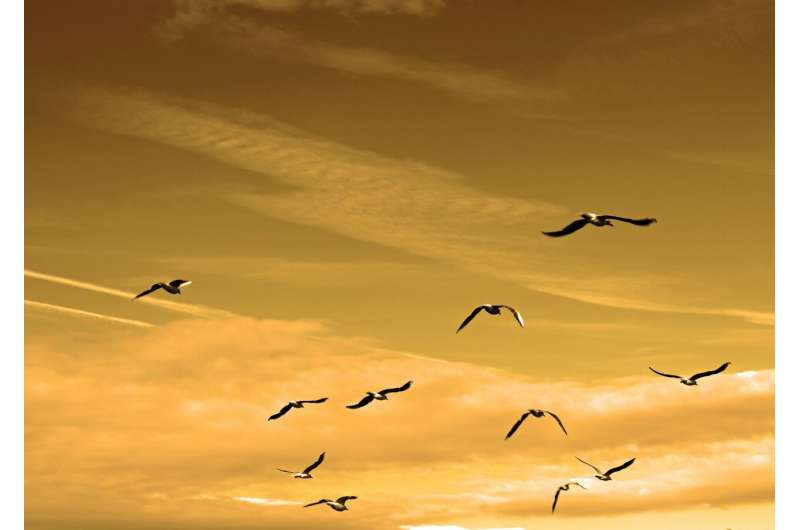
Five plastic flappers, 3D-printed to mimic bird wings and mounted on motorized arms, pulse up and down in a glass tank at NYU’s Applied Mathematics Laboratory, sending ripples through the water. Slowly, they align—self-organizing into a precise line, one behind the other, gliding forward like a flock in flight. This isn’t just a simulation; it’s a window into a deeper truth about nature’s most mesmerizing movements. Mathematicians Christiana Mavroyiakoumou, Leif Ristroph, and Jiajie Wu have discovered that flocks of birds and schools of fish move not just in harmony, but in patterns strikingly similar to soft crystalline materials—where individual animals act like atoms arranged in a delicate, responsive lattice.
For decades, scientists have marveled at how thousands of starlings can swirl in unison or how fish dart through reefs without collision. While earlier studies explained general coordination through rules like alignment and proximity, the precise physical structure of these formations remained elusive. This new research, published in Physical Review Fluids, reveals that these animal collectives aren’t just following behavioral rules—they’re behaving like physical materials, with elastic, spring-like interactions between individuals that maintain order while allowing flexibility.
The team’s breakthrough came from modeling these groups as soft crystals—ordered solids whose atomic arrangements are fragile but adaptive. In the lab, the flapping foils, moving through water as proxies for flying birds, spontaneously formed stable, evenly spaced lines—just as the model predicted. These formations adjusted dynamically to flow changes, much like real flocks responding to wind or predators. Mavroyiakoumou, now a fellow at Oxford’s Mathematical Institute, notes that this fragility isn’t a flaw: it’s the key to responsiveness. The animals, like atoms in a soft crystal, must constantly sense and react to maintain cohesion.
The implications stretch far beyond biology. Understanding collective motion as a form of “flow-mediated matter” opens doors in robotics, swarm drones, and energy-harvesting systems where coordinated motion under variable forces is critical. Engineers might one day design fleets of autonomous vehicles that self-organize like starlings or underwater sensors that school like tuna, all guided by the same principles that govern nature’s most elegant movements.
As Ristroph puts it, “Because these movements are similar to those that form the building blocks of materials, the work opens new avenues for analyzing—and potentially manipulating—how these components interact.” In a world where complexity often feels overwhelming, this discovery reminds us that even the most chaotic-seeming dances of nature may be guided by quiet, hidden order—fragile, yes, but exquisitely tuned to the world around it.