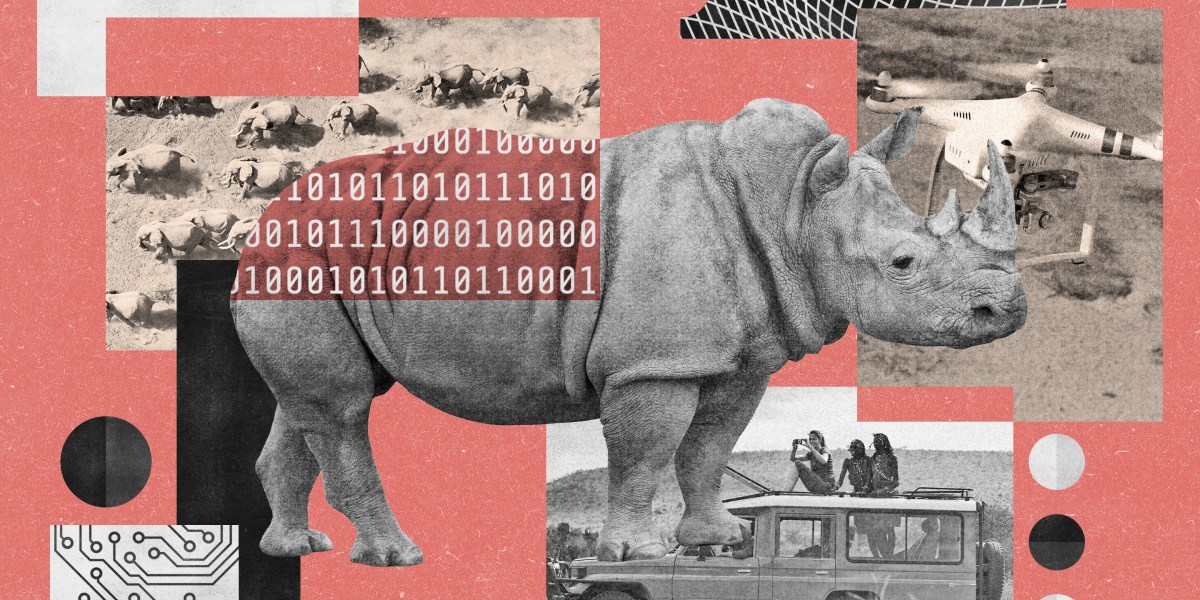
Jake Wall, a Canadian geography PhD working for Save the Elephants, wrote a simple algorithm in 2012 to detect when an elephant's GPS collar had stopped moving for more than five or six hours—a signal that the animal might be dead. That pioneering program, designed to alert park rangers to poaching, became the seed for EarthRanger, a wildlife-management platform that has since expanded across six continents and 90 countries, protecting everything from pumas in Chile to chimpanzees in Rwandan rainforests.
Africa's elephant populations were in crisis that year, hunted by well-organized poachers at scales that overwhelmed rangers' efforts to stop them. Wall's algorithm was a breakthrough: real-time data that could mobilize field teams to intervene before it was too late. When EarthRanger launched in 2015, developed by Save the Elephants with Vulcan, the investment company of late Microsoft cofounder Paul Allen, it had evolved far beyond a single alert system. Today it collects, integrates, and displays data from GPS collars, camera traps, patrol reports, and remote sensors, giving conservationists an interactive map view of tagged animals, rangers, vehicles, and equipment—sometimes even poachers. More than 900 sites now use the platform, which is free to access.
The economic implications are striking, particularly in Africa. The continent's safari tourism industry, valued at $20.5 billion last year, is forecast to nearly double to $39.2 billion by 2035, driven by Africa's 8% annual tourism growth rate—the fastest of any world region, according to the United Nations. That industry depends entirely on thriving animal populations and vibrant ecosystems. Without them, there is no product to sell.
Jochen Zeitz, owner of Segera, a 50,000-acre eco-retreat on Kenya's Laikipia Plateau, understands this equation intimately. After acquiring the property in 2005, he spent eight years undoing its ranching past, removing miles of fencing and reopening migratory corridors so wildlife could move freely again. Today, elephants and giraffes roam the degraded land he coaxed back to life, captivating guests from Segera's lush grounds. When Zeitz adopted EarthRanger as his core wildlife monitoring platform in 2021, he gained the real-time visibility to manage conservation at scale. A 2024 upgrade gave the platform long-range wireless connectivity and AI-powered camera management software.
In May 2025, that infrastructure proved its worth when Zeitz and his team, in partnership with the Kenya Wildlife Service, completed the translocation of 20 black rhinos to Segera. The operation, enabled by EarthRanger's tracking capabilities, represents a tangible step toward recovering rhino populations in Africa. As Wall, now EarthRanger's director of data analytics, says: "The value we place on wildlife and wild spaces doesn't equate with the economic model that exists for the price of gold or oil. As a species, our connection with nature is fundamental—we need to put a premium on it and maintain it." EarthRanger is making that task measurably easier, turning conservation from a reactive scramble into a coordinated, data-driven mission that protects both animals and the economies that depend on them.