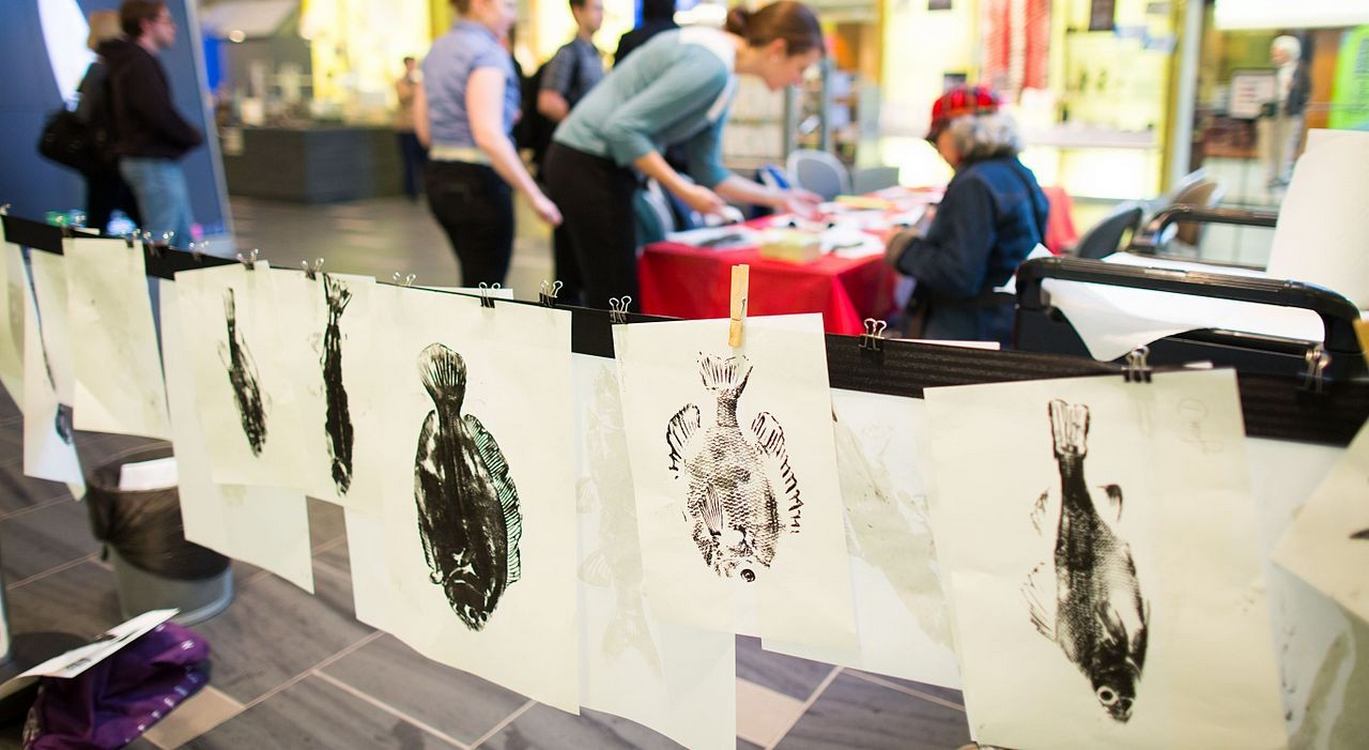
In early 19th-century Japan, fishermen wanted to preserve memories of their most remarkable catches—so they pressed their fish, still slick with sumi ink, onto delicate washi paper. This simple act of documentation became gyotaku, a printing technique born from the fisherman's pride, and it has evolved into one of the world's most captivating fine art forms.
Gyotaku embodies a distinctly Japanese sensibility: an obsessive commitment to craft, an intimate relationship with food, and a refusal to do anything halfway. What began as a monochrome record-keeping method gradually transformed as fishermen experimented with color paints and refined their techniques, learning how to manage the fish's natural slime and moisture that could destroy the delicate paper. The practice demanded discipline. Every detail mattered. The eye, for instance, could never receive pigment—it had to be added by hand afterward, a rule that remains absolute among practitioners. Any deviation toward painting rather than pure printing was considered a corruption of the form.
Today, gyotaku exists as a sophisticated artform with established schools, methods, and competing philosophies. Two chief techniques dominate: direct gyotaku, where the inked fish is pressed directly onto paper (creating a reversed image), and indirect gyotaku, where paper or cloth is secured to the fish with rice paste, allowing the artist to create a non-reversed composition. Both methods preserve the fish for eating afterward. What distinguishes master practitioners is their understanding of timing. Keisuke Matsunaga, grandson of a renowned gyotaku master, explained to the Japan Times that pigment application must be completed in approximately 30 minutes—a race against the fish's own moisture, which will otherwise degrade the work. Advanced artists have developed techniques to capture the iridescence of scales and the subtle variations in skin pigment across a fish's lifespan, transforming documentation into poetry.
The artform has crossed oceans. Gyotaku now thrives in Australia, Italy, America, Hawaii, and Brazil, each region adapting it to local waters and sensibilities. In Liguria, Italy, artist Elena Di Capita has become the primary force introducing gyotaku to Europe. Rather than simply replicating tradition, she has expanded it. Di Capita focuses on anchovies, the region's most economically vital fish, but she deviates from classical gyotaku by creating large, dynamic compositions that mix different biological environments. More provocatively, she works deliberately with bycatch—fish caught incidentally and killed without purpose. "My work with them is about giving them dignity. It's a way to celebrate life," she told the Times. Through gyotaku, these discarded creatures receive a second meaning, a visual tribute to their accidental loss.
In the United States, gyotaku has found unlikely champions in aquariums and elementary school classrooms, where children discover that the technique, in its most basic form, is surprisingly accessible. The artform's global spread suggests something profound: that a 19th-century Japanese fishing practice speaks to something universal—the human impulse to honor what we take from the world, to transform utility into beauty, and to leave something permanent behind.