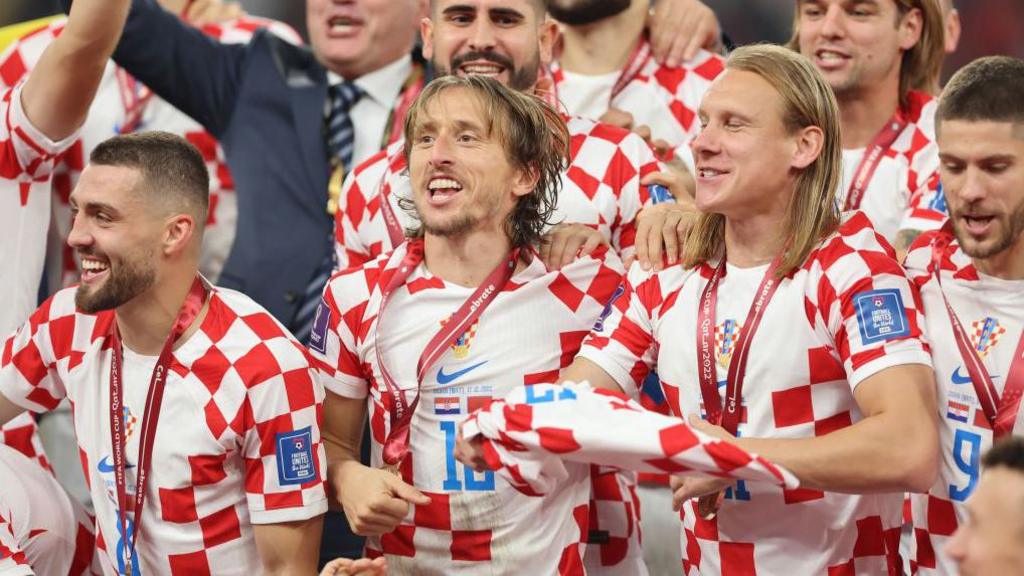
Luka Modrić steps onto the pitch in Zadar, his silver-streaked hair catching the Adriatic light, a 40-year-old captain preparing to lead Croatia into their 2026 World Cup opener against England—nearly two decades after his international debut. Once a scrawny teenager with a mop of hair he refused to cut, Modrić has become the enduring heartbeat of a nation that keeps rewriting football’s script. His journey—from a child fleeing war, sleeping in refugee hotels, to lifting the Ballon d’Or and captaining Croatia to a World Cup final—is not just personal triumph. It’s a mirror of a country of fewer than four million people that consistently punches above its weight on the global stage.
Modrić’s story is rooted in resilience. At six, he watched Serbian forces kill his grandfather near the Velebit mountains. His family home burned. His father went to war. They fled to Zadar, where young Luka played football barefoot on hotel terraces with other displaced children. Meanwhile, Croatia—newly recognized by FIFA in 1992—was building a team from the ashes of conflict. Legends like Davor Šuker and Zvonimir Boban carried the flag, finishing third in 1998. But it was Modrić, overlooked by Hajduk Split as a teen, who would one day carry that legacy into a new era.
Coached by Romeo Jozak at Dinamo Zagreb’s academy, Modrić was not the most promising prospect—short, slight, more known for guarding his hair than dominating midfield. "You couldn’t say he was going to be a superstar," Jozak recalls. But he was relentless: reliable, tenacious, always fighting. Loans to Zrinjski Mostar and Inter Zaprešić sharpened him. By 2008, he joined Tottenham; by 2018, he’d won five Champions League titles with Real Madrid and the Ballon d’Or—the first player not named Messi or Ronaldo to do so in over a decade.
Now, at 198 caps and counting, Modrić is closing in on 200 appearances for his country, a symbol of perseverance and pride. His career embodies what Jozak calls "built-in motivation"—a quiet fire stoked by war, memory, and national identity. Croatia’s success isn’t just about talent; it’s about character forged in hardship. As the team prepares to face England, the message is clear: size doesn’t define strength. And sometimes, the boy who played football in a refugee hotel becomes the man who leads his nation into battle, again and again.