Mohamed Salah's first coach opens the dark green gates of a newly upgraded youth centre in Nagrig, a farming village three hours north of Cairo, and the memories flood back. "Whenever I walk in here, I can't help but recall how he used to move and the way he controlled the ball," says Ghamry Abd El-Hamid El-Saadany. "It was something else." This modest artificial pitch, now named in Salah's honour, is where a seven-year-old boy from the Nile Delta began his extraordinary journey to becoming one of the world's most prolific forwards—and Egypt's first global football superstar.
The story of Salah matters because it shows what determination and family support can achieve, even from the humblest beginnings. In a country of 115 million people where football is woven into the national fabric, Salah has become far more than an athlete. He is a symbol of possibility, a proof that a child from a small farming village can reach the pinnacle of global sport without losing the values that shaped him.
Growing up in Nagrig, surrounded by jasmine fields, water buffalos, and dirt roads, young Salah would play football with friends, imagining himself as Brazil's Ronaldo, France's Zinedine Zidane, or Italy's Francesco Totti. "Mohamed was small compared to his team-mates, but he was doing things even the older boys couldn't manage," El-Saadany recalls, gesturing to the newly resurfaced pitch. "His shots were incredibly powerful, and it was obvious that he had determination and drive." As a teenager, Salah would leave home at 10am and not return until midnight, making the exhausting and expensive commute to training at Arab Contractors. "That journey required someone strong," El-Saadany says. "Only someone with a clear goal could bear such a burden."
That clarity of purpose carried Salah all the way to Liverpool, where he joined in 2017 and has since scored a remarkable 257 goals. He has won every domestic honour with the club and lifted the Champions League, cementing his legacy as one of the greatest forwards of his generation. Yet despite these extraordinary achievements on the global stage, Salah has not yet tasted success with the Egyptian national team—a gap that looms larger as the 2026 World Cup approaches.
Back in Cairo, the Dentists Cafe has become a gathering place for Liverpool fans to watch matches together. Lamisse El-Sadek, wearing a Liverpool shirt with her late father's name on the back, remembers watching Salah's matches with him before he passed away two years ago. "Every Liverpool game was some of the happiest two hours in our household every week," she says. "My father used to text me minute-by-minute updates if I had to miss any of the game. Salah didn't come from a class of privilege. He really worked hard and sacrificed a lot to reach where he is now. A lot of us see ourselves in him."
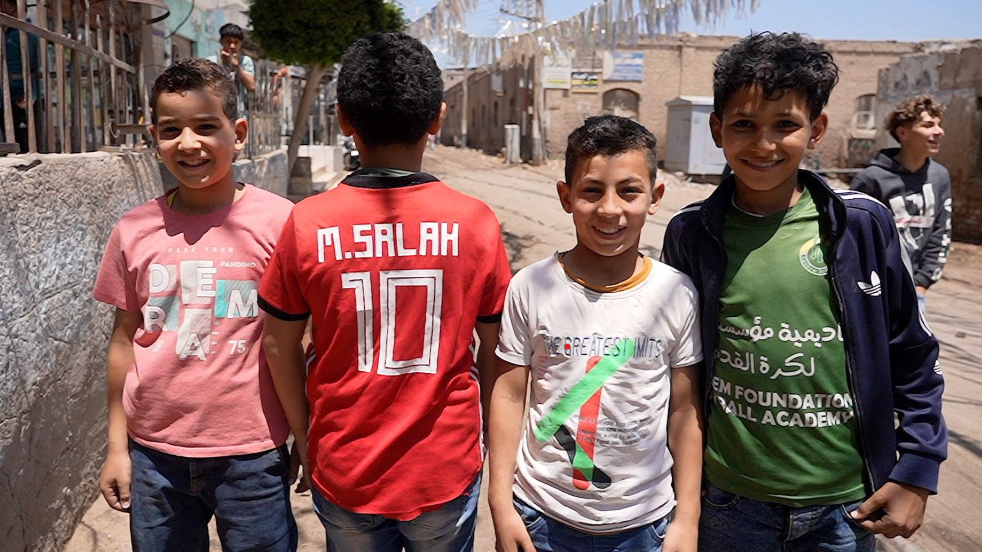
Salah's footprint is everywhere in Nagrig. Children run through streets wearing Liverpool and Egypt shirts bearing his name. A mural decorates his old school. Even Ahmed El Masri, the village barber, claims credit—"I'm the one who gave him that curly hairstyle and the beard," he says with quiet pride. The upgraded youth centre stands as a tribute to one boy's journey, but also as an inspiration for the next generation. "Salah's family is the foundation and secret behind his success," El-Saadany says. "They still live here with humility, values and respect. That's one reason people love them so much."