The word "free" was etched in tiny letters onto Maja Chwalinska's left hand—a tattoo so small that most spectators at Roland Garros never noticed it, but one that carries the weight of five years of reclaimed life.
The 24-year-old Polish qualifier stands one win away from becoming the first player to win the French Open as a qualifier in the Open era, a feat that seemed impossible just weeks ago when she was playing modest tournaments in Italian cities like Brescia and Bari. What makes her journey to Saturday's final against eighth seed Mirra Andreeva so arresting is not merely the improbability of her run—though winning nine consecutive matches at Roland Garros is remarkable in itself—but the darkness she had to climb out of to get here.
Five years ago, Chwalinska took an indefinite break from tennis after losing in the opening round of qualifying at Wimbledon. She was in the grip of depression so severe that she felt lifeless, unable to get out of bed. She retreated to her family home in Poland and began working with mental health specialists. When recovery finally felt possible, she added running and boxing to her toolkit. After four months away, she cautiously returned to tennis—not to the glory courts of Grand Slams, but to grinding through the lower levels of the professional tour, fighting to rebuild her game and, more importantly, her relationship with the sport itself.
The breakthrough came through mental compartmentalization. Chwalinska had come to associate tennis with "pressure, stress and crying." Learning to separate her career from her identity, to find joy in competition rather than torture, proved to be her real training ground. And then, quite suddenly, she arrived in Paris and began to play with a freedom that seemed to electrify the Parisian crowds. She defeated Olympic champion Zheng Qinwen, the former French Open semi-finalist Maria Sakkari, and three seeded players—Diana Shnaider, Anna Kalinskaya, and Elise Mertens. Her game is a kaleidoscope of precision: lobs, drop shots, moonballs that confound opponents, but also the pace to finish points decisively.
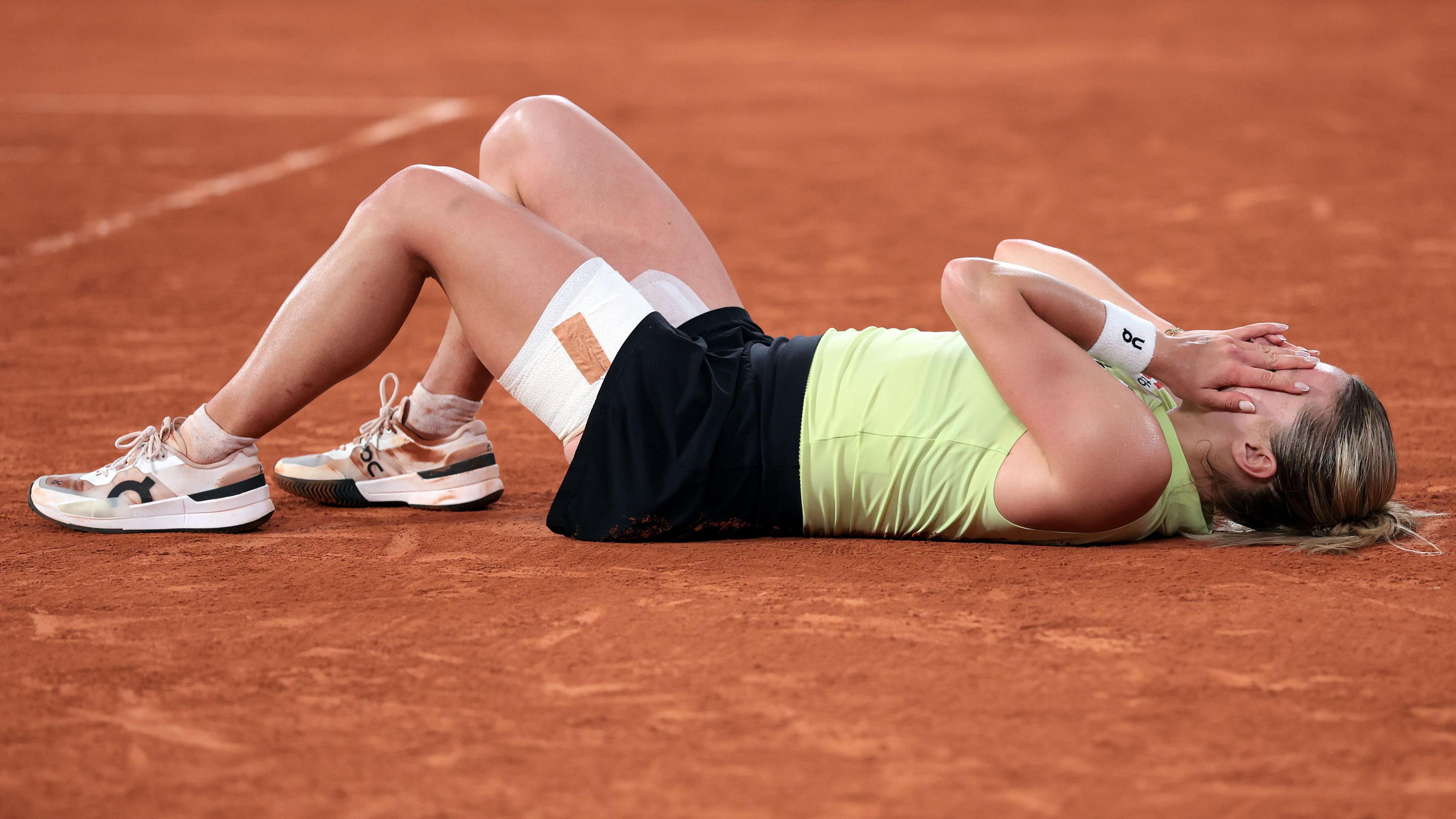
When Chwalinska secured her semi-final victory over Shnaider on Court Philippe Chatrier, she collapsed to the clay in what was unmistakably genuine emotion. "Joy, surprise—so many emotions. I felt so overwhelmed," she said. The court was filled with thousands of Polish fans, many of whom had bought tickets assuming they would be cheering for four-time champion Iga Swiatek, Chwalinska's childhood friend and fellow professional debut-maker at a small ITF event in Zawada, Poland, in 2015. Instead, Chwalinska had inadvertently become the nation's torch-bearer at Roland Garros.
When asked about the meaning of her tattoo, Chwalinska demurred: "I will keep it to myself. You can make your own stories." But perhaps the word speaks for itself. Freedom, after all the work to reclaim it—the therapy, the running, the boxing, the slow relearning of how to play without breaking. If she beats Andreeva on Saturday, she will join Emma Raducanu as only the second qualifier ever to win a Grand Slam title, and the French Open will have another Polish champion. But the real victory has already been written on her skin.