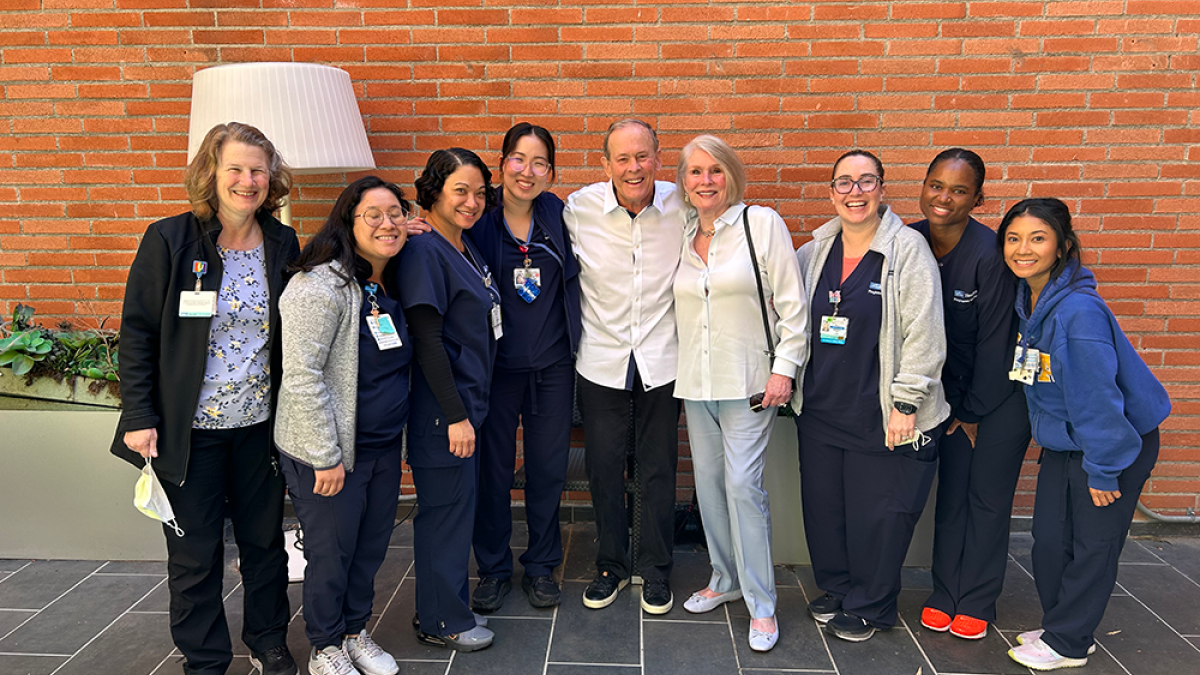
Marsh Bull was suffocating in Colorado when his wife Peggy spotted him struggling on the security camera, gasping and forced to sit down again and again. What started as a terrifying moment in a snowbird's winter became, once he returned to Los Angeles, a diagnosis that would change his life: myelodysplastic syndrome, a blood cancer his UCLA Health hematologist Steven Tsai, MD, PhD, explained as bone marrow failing to produce enough healthy cells. But instead of accepting standard treatment alone, Bull—now 82, fiercely competitive, already a six-time survivor of joint replacements and prostate cancer—enrolled in something rarer: a clinical trial testing a new drug overseen by his doctor's colleague, Wanxing Chai-Ho, MD.
Every week, Bull made his way to the UCLA Clinical and Translational Research Center (CTRC), one of a dozen programs within the larger UCLA Clinical & Translational Science Institute. There, in a sprawling hospital-grade clinic built into a subterranean emergency room that survived the 1994 Northridge earthquake, he received three-hour infusions alongside hundreds of other patients in the fight of their lives. The CTRC itself supervises anywhere from 400 to 450 active clinical trials across all ages and diseases—a staggering pipeline from laboratory discovery to human bodies.
"We're doing some of the heavy lifting of bringing inventions and laboratory discoveries to the bedside," said Noah Federman, MD, medical director of the CTRC for the last decade. That translation is no small feat. Since 2011, the UCLA Clinical & Translational Science Institute has enabled 32 drugs approved by the U.S. Food & Drug Administration, a testament to infrastructure that co-directors Arleen Brown, MD, PhD; Arash Naeim, MD, PhD; and Mitchell Wong, MD, PhD, have built around principles of precision, speed, and equity. "We use translational and open-science principles to build an effective, efficient and community-engaged research infrastructure," they said, "so new treatments reach people faster."
The CTRC's reputation for excellence draws rigorous pharmaceutical and industry sponsors who fund about two-thirds of its studies. When they arrive unannounced, they inspect everything: the refrigerators, the bolts, the personnel qualifications. The center handles what many struggle with—more than 35 "high risk, high reward" gene and cellular therapy trials—while managing the relentless precision required to track how drugs move through the human body, hour by hour. Dr. Federman himself leads a groundbreaking precision therapy study for osteosarcoma, a rare bone cancer devastating teenagers and young adults, testing a monoclonal antibody engineered at UCLA. Two days after it opened in February, a patient enrolled. More than 20 others are screening now.
At the heart of the CTRC's 12,000 square feet is a human-centered approach. Marjorie Weiman, RN, MSN, the unit director for a decade, oversees 14 nurses who administer therapies, draw blood, and monitor patients with clinical expertise drawn from emergency medicine, pediatrics, and oncology. Even Jonas, a golden retriever and facility dog, works the halls. "Everybody can relate to Jonas," Dr. Federman said. "He really changes the energy in a room in a positive way."
The institute's mobile program, CTRC-WOW ("without walls"), sends nurses and coordinators to hospitals and clinics across UCLA Health—a model other research centers now want to replicate. For patients like Bull, it means precision care arrives wherever they are. For medicine itself, it means discovery travels faster from bench to bedside, and hope travels faster than disease.