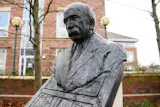
In 1898, English urban planner Ebenezer Howard looked at the grimy, overcrowded cities of the Industrial Revolution and imagined something radically different: compact, walkable satellite towns ringed by farmland, where families could enjoy fresh air and green space without abandoning the social and economic benefits of city life. His vision, laid out in the book To-Morrow: A Peaceful Path to Real Reform, diagnosed the urban crisis of his time—smog-choked streets, crumbling medieval buildings buckling under surging populations, and residents both unhealthy and unhappy—and offered a third way: the garden city, neither strictly urban nor strictly rural.
What made Howard's concept revolutionary wasn't just the physical design. At its heart lay a social reform agenda. Each garden city would house around 30,000 people, connected by rail to neighboring towns and organized around a radial plan with civic buildings and commercial areas surrounding a central green space. Housing would line tree-lined streets, integrated with private gardens. But the most radical element was this: land would be owned collectively by the community and managed for residents' benefit, ensuring that rising property values funded public improvements rather than enriching private landlords. In wrestling with questions of public versus private space, and how to design cities less dependent on cars, Howard's framework speaks directly to contemporary urban challenges.
Letchworth, founded in 1903 in Hertfordshire, England, became the first garden city, translating Howard's diagrams into lived reality. Designed by Arts and Crafts architects Barry Parker and Raymond Unwin, Letchworth wove together modest houses with generous private gardens along curving streets that followed the land's natural contours. Beyond the town lay a permanent agricultural greenbelt—farms and fields meant both to supply residents and to act as a hard boundary, preventing endless sprawl. A publishing house, corset factory, and steel foundry anchored the economy, fulfilling Howard's vision of self-sufficiency.
A second garden city, Welwyn Garden City, refined the model in 1920 with more formal street planning, neo-Georgian architecture, and a community-owned store designed to service all households. Both towns demonstrated the magnetic appeal of low-density housing, abundant green space, and escape from congested urban centers. Yet they also revealed tensions between ideology and reality—even as the garden city promised healthier environments and better housing, planners often used these new communities to regulate working-class life through design, dictating recreation and daily routines according to middle-class ideals of discipline and respectability.
Howard's concept crossed the Atlantic in the 1920s. Radburn, New Jersey, adapted his principles for the motor age, introducing the influential "superblock"—a layout that separated pedestrian pathways from car traffic through interior greenways and cul-de-sacs, with front doors facing shared parks rather than streets. Though the Great Depression halted Radburn's completion, its innovative layout shaped American urban design for decades, influencing the New Deal's Green Towns program and countless postwar subdivisions.
By the mid-20th century, garden city principles had traveled globally. Jardim América, a São Paulo suburb designed by Parker and Unwin themselves, adopted curved streets and landscaped residential zones. The model's influence reached Tokyo and beyond, proving that Howard's vision—of walkable, green, community-centered towns—resonated across cultures and continents. Today, as planners champion car-free streets and 15-minute neighborhoods, they're essentially circling back to ideas a 19th-century reformer sketched more than a century ago.