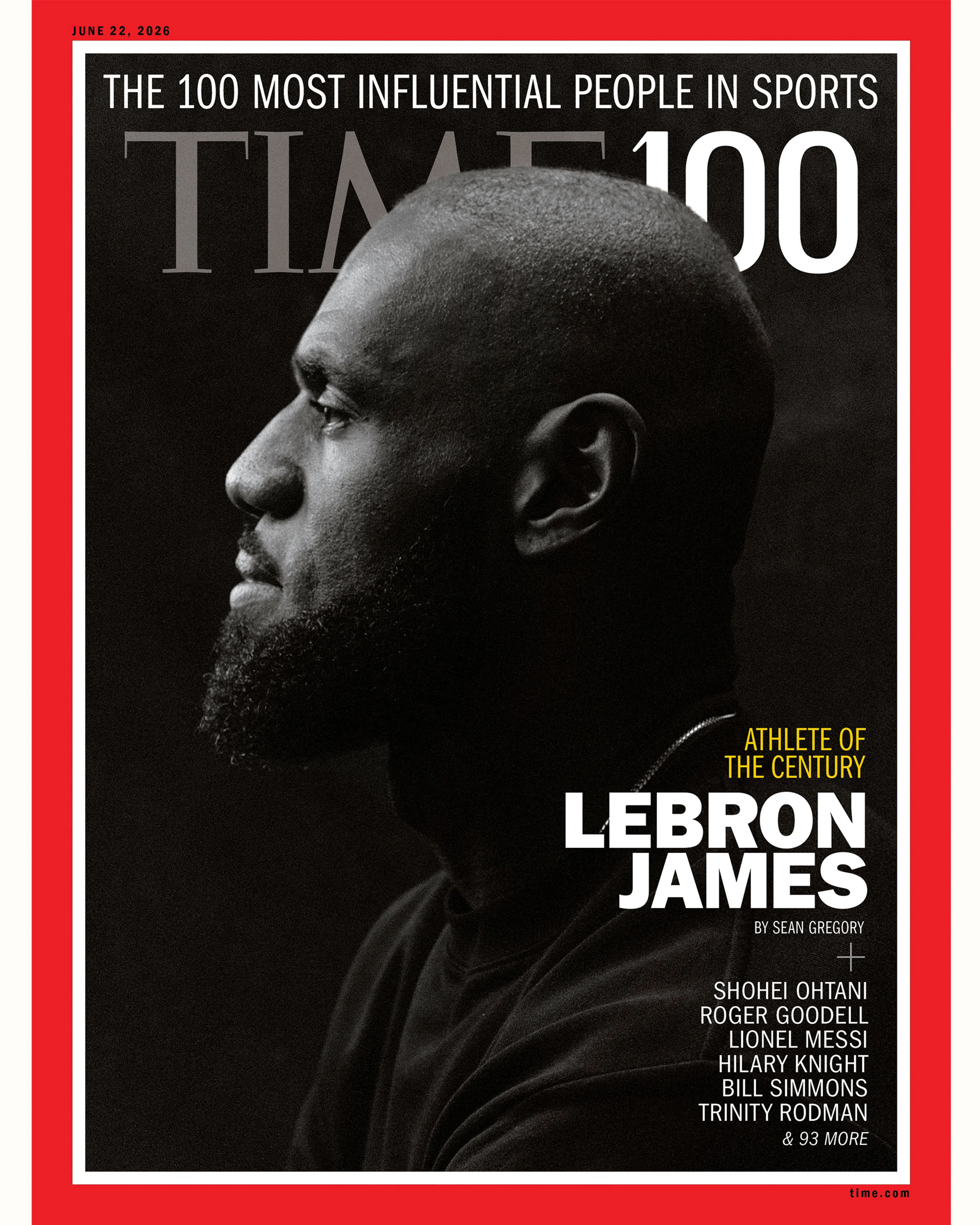
In July 2003, roughly 2,500 people gathered on the campus of UMass Boston to watch a young prospect run the floor during an NBA Summer League game—$15 tickets in a gym that felt more high school than professional, fans pressed so close they seemed to bend the rules of personal space. That prospect was LeBron James, and two decades later, he has become TIME magazine's embodiment of the modern athlete: not just a player of extraordinary skill, but a figure who has redefined what it means to wield influence beyond the court.
Now TIME magazine has launched its inaugural TIME100 Sports list, and James claims his third appearance on the publication's pages as the athlete of the century. Yet his distinction reflects something far deeper than statistics and championships. Over his career, James has set a new standard for professional athletes in public life, combining on-court excellence with political engagement and business acumen—a template that has rippled through the sports world and shaped the generations who follow.
The timing of TIME's entry into the sports influence space speaks to a broader cultural shift. In an increasingly fragmented media landscape, sports remains one of the few realms where massive global audiences gather in real time. The past year underscored this pull: the Olympics and World Cup commanded center stage, the Bad Bunny Super Bowl halftime show captivated millions, and a UFC fight at the White House demonstrated how sports can dominate cultural conversation in ways few other domains can match. As industries have drawn closer to live sports, athletes have seized increasingly larger platforms, and TIME recognized that this moment demanded its own reckoning with that power.
The magazine's deepening commitment to sports journalism has been substantial. In the past decade alone, 43 athletes have graced TIME's cover. The publication named its first Athlete of the Year in 2019, and last year, TIME Studios released "Under Pressure: The U.S. Women's World Cup Team," a documentary that earned an Emmy nomination. This expansion of coverage reflects a historical continuity as well—TIME placed athletes on its cover twice in its very first year, including horseman Stephen "Laddie" Sanford and boxer Jack Dempsey.
Much of the groundwork for this inaugural list falls to senior sports correspondent Sean Gregory, whose byline appears more frequently in this issue than any other writer's. Since joining TIME in 2002, Gregory has become a fixture in sports journalism, having covered ten Olympics across his tenure. In 2024 alone, he authored 15 cover stories about sports figures, including six who appear on the TIME100 Sports list: Caitlin Clark, Erling Haaland, Lindsey Vonn, A'ja Wilson, Eileen Gu, and Dana White. Gregory has paid particular attention to female athletes—work recognized by his selection as a finalist for the Billie Jean King Award for Excellence in Women's Sports Coverage—and the rise of women's sports has emerged as one of the defining stories of recent years.
That focus on women's athletics reflects a broader truth: as sports continues to reshape culture and capture unprecedented attention, the voices that shape and celebrate those stories matter enormously. The inaugural TIME100 Sports list, edited by Lori Fradkin, Cate Matthews, and Mark Selig, arrives at a moment when athletes wield influence that extends far beyond scoreboards and championship rings.