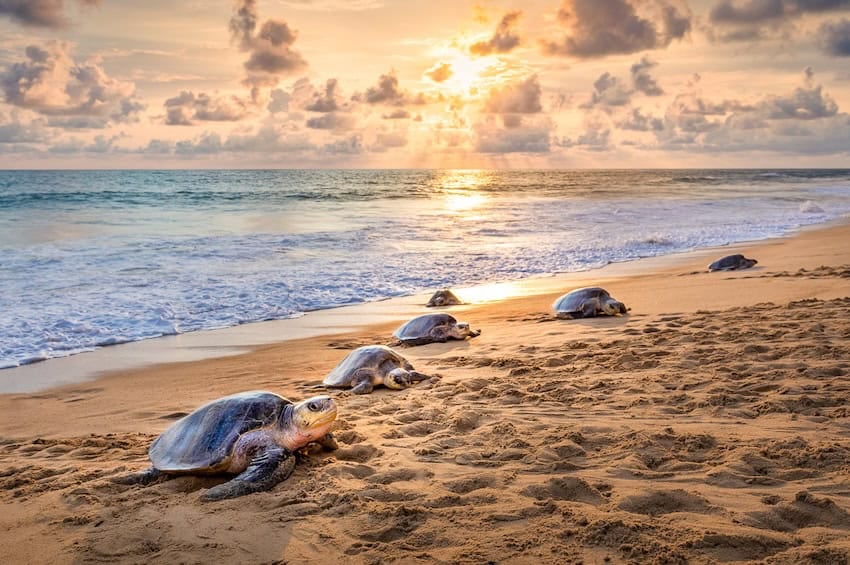
On a moonlit beach in Ixtapilla, Michoacán, the sand itself seemed to move. Gilberto Reyes, head of the local Campamento Tortuguero, was leading a predawn walk in August 2010 when the writer first encountered the olive ridley sea turtles — not dozens, but hundreds of them, their massive shells half-buried in sand, having hauled their 80-pound bodies from the Pacific Ocean to lay their eggs in the place they were born. It was the beginning of what locals call an arribada — a synchronized mass nesting event that transforms this unassuming stretch of Mexican coastline into one of nature's most dramatic gatherings. "It's like a turtle convention," Reyes explained, "but with no set date."
Thirty years earlier, that scene would have been unimaginable. By 1994, fewer than 500 sea turtles were coming to nest on Ixtapilla Beach. Poaching of adult turtles and the sale of their eggs — believed by some to hold aphrodisiacal properties — had pushed the olive ridley to the brink of local extinction. The elderly residents of this indigenous village grew frightened that their grandchildren would never witness the phenomenon their ancestors had known for generations.
So the community decided to act. Without government support, without funding, the villagers of Ixtapilla began organizing beach patrols to prevent poaching. They relocated eggs to a protected, fenced area where hatchlings could safely mature before venturing into the sea. For fifteen years, they carried on as volunteers, motivated only by the rising tide of turtles returning year after year. "If the turnaround were to happen, it had to be in Ixtapilla," the writer notes, "because the olive ridley only comes to this beach, even though to the human eye, there are numerous other beaches along the coast which look just as good. But for the turtles, only Ixtapilla would do."
That stubborn devotion eventually drew outside support. Government programs and NGOs like Costa Salvaje joined the effort. Eco-tourism grew, with visitors from June through October paying a small fee to witness baby turtles make their scramble toward the waves — a spectacle the community now offers as both an educational experience and a sustainable income source. Tourism and conservation became allies rather than adversaries.
The results have been staggering. In 2010, over two thousand turtles arrived in a single night, launching an arquivada that would last two to three days. The writer watched exhausted females — who had just completed what he describes as "the animal kingdom's equivalent of a triathlon," swimming hundreds of miles and dragging themselves fifty yards through sand — dig two-foot-deep nests with only their flippers before laying clutches of eighty to 110 leathery eggs. Today, projections indicate that over 400,000 sea turtles will nest on Ixtapilla's shores in 2026 alone. What began as a grassroots rebellion against extinction has become a model for community-led marine conservation, proving that when people decide to protect a place, the creatures who need it most will find their way home.