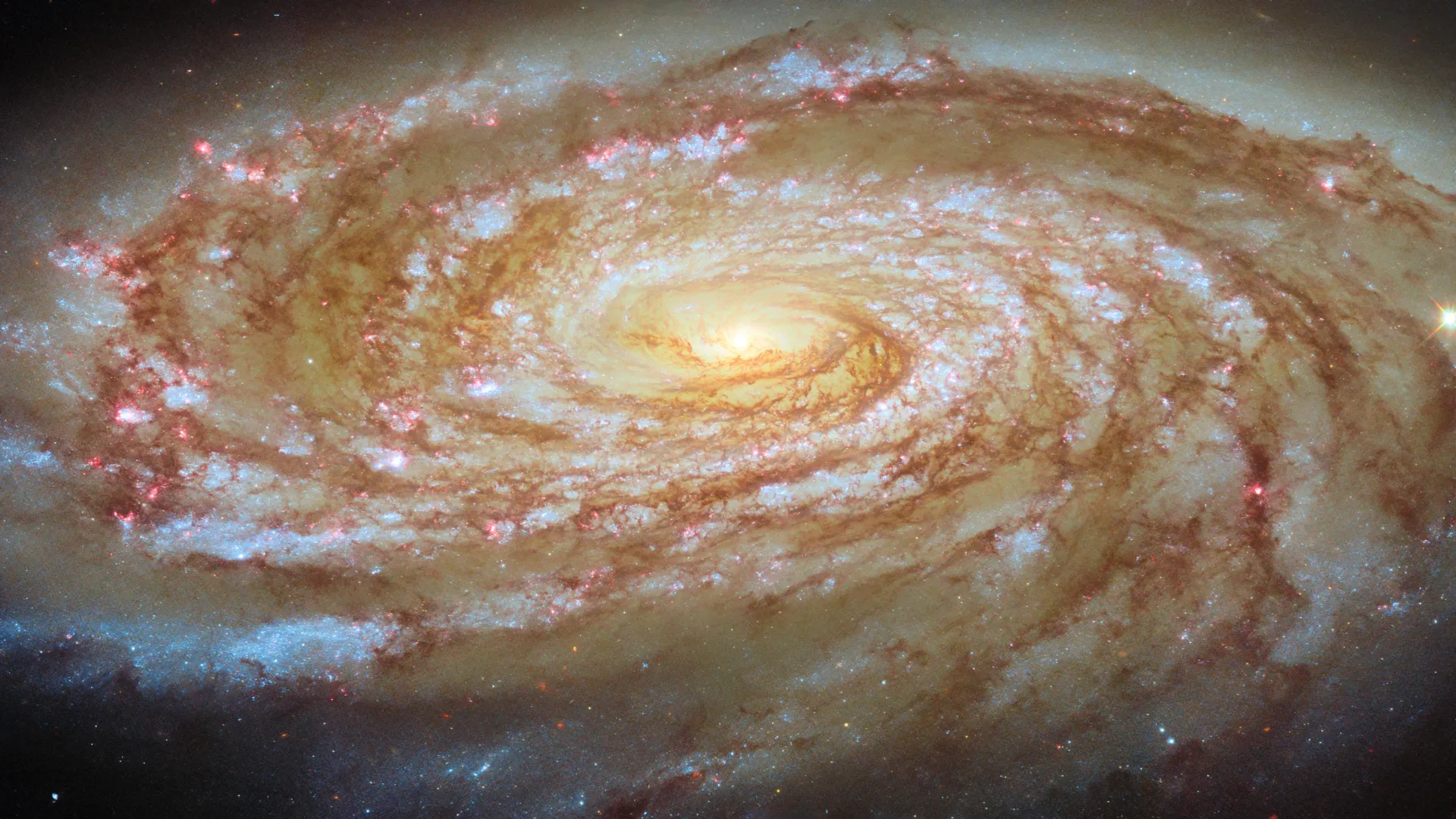
Fifty-three million light-years from Earth, in the constellation Coma Berenices, a spiral galaxy called Messier 88 is being slowly transformed by the cosmic forces around it—a process that began long ago and will continue for hundreds of millions of years to come. The NASA/ESA Hubble Space Telescope has captured M88, also known as NGC 4501, in remarkable detail, revealing a galaxy caught between two profound states: its glorious present and an uncertain future.
M88 is a masterpiece of cosmic geometry. Tightly wrapped spiral arms extend outward in remarkably symmetrical patterns, their structure punctuated by bright pink and blue star clusters and dense clouds of dust. At the galaxy's heart lies a supermassive black hole—a gravitational monster containing roughly 100 million times the mass of our Sun—actively feeding on surrounding gas and dust. This activity drives powerful streams of gas outward from the core, while older, reddish stars create a warm central glow that anchors the entire structure.
But M88's true story is not about what it is—it's about where it's going and what will be lost along the way.
The galaxy resides within the Virgo Cluster, a gravitationally bound collection of more than a thousand galaxies orbiting a shared center of mass. Currently positioned about two million light-years from the cluster's heart, M88 is on an inward trajectory that will culminate in a dramatic encounter with Messier 87, the giant elliptical galaxy that dominates the Virgo Cluster. That closest approach will occur roughly 200 to 300 million years from now.
What makes this journey perilous is a phenomenon called ram pressure stripping. As M88 pushes through the hot gas that fills the galaxy cluster, the pressure generated by its motion acts like a cosmic wind, sweeping away the cold gas that fuels star formation. Gas and dust pile up along the galaxy's leading edge, compressed much like snow gathering before a plow. The damage is already underway. Hubble observations reveal that M88's rotating gas disk appears shortened and compressed on its leading edge, and the galaxy contains significantly less cold gas than astronomers would expect for a spiral galaxy of its size—a shortage particularly pronounced in its outer regions.
This depletion matters profoundly. Cold gas is the raw fuel that births new stars. As M88 loses this reservoir, its capacity to create new stellar generations diminishes, fundamentally altering its long-term evolution. The Hubble team, led by principal investigator D. Thilker, observed M88 using the space telescope's Wide Field Camera 3 as part of a broader program to understand how spiral galaxies transform when they move through crowded cosmic environments. By resolving individual star clusters and nebulae across tens of millions of light-years, astronomers gain insight into the invisible forces reshaping galactic architecture.
M88's story is not one of catastrophe but of inevitable change—a cautionary tale written in the language of gravity and gas, light and dust. Over the coming eons, this elegant spiral will be subtly rewritten by the universe around it, a reminder that even the grandest structures in the cosmos are subject to forces far greater than themselves.