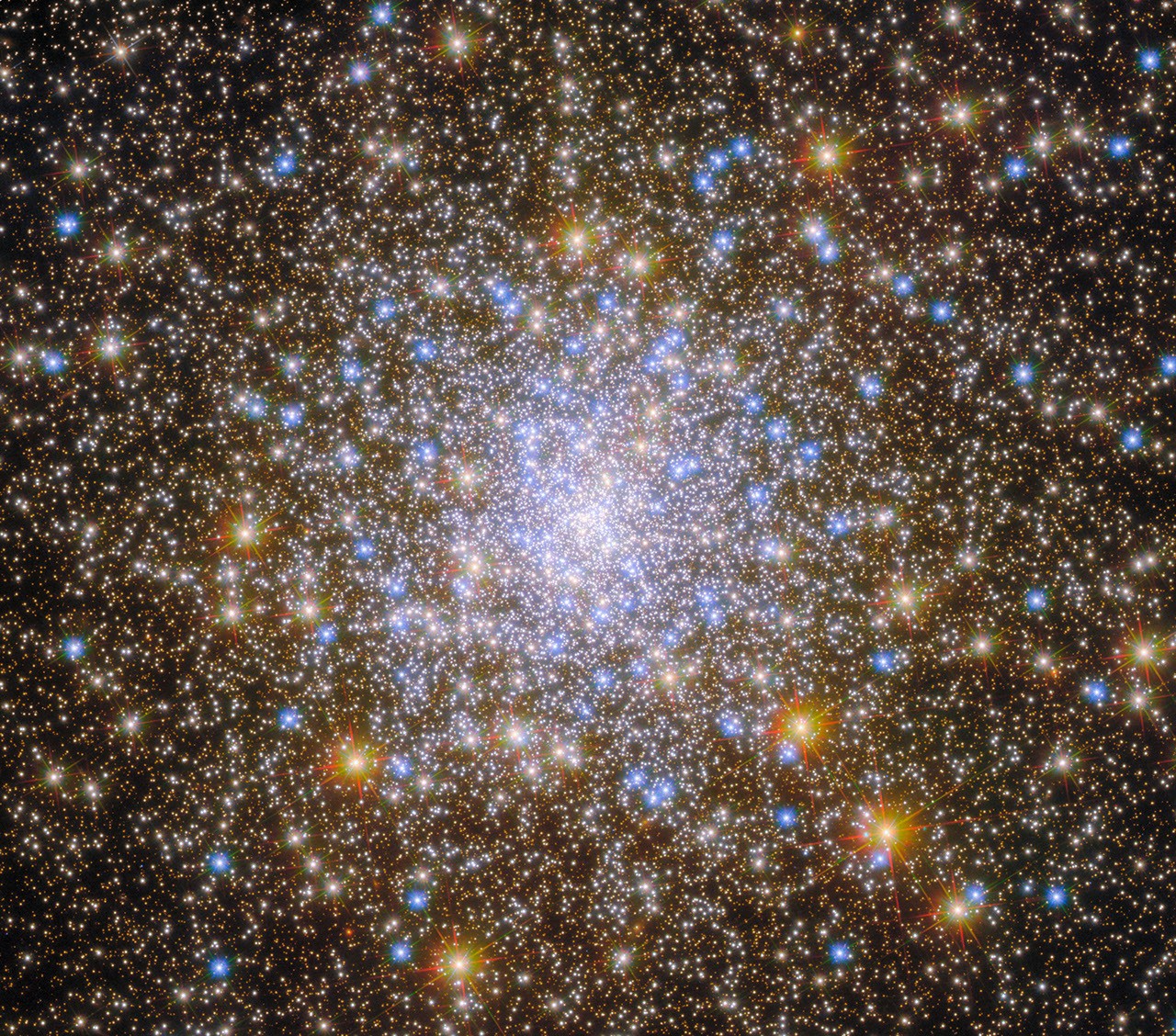
At 27,500 light-years away, in the constellation Capricornus, the globular cluster Messier 30 holds clues to the Milky Way’s distant past. Its tightly packed stars appear as a bright gathering in images from the Hubble Space Telescope, but their paths may tell a surprising story: M30 could have formed beyond our galaxy before the Milky Way captured it long ago.
Globular clusters are roughly spherical groups containing tens of thousands to millions of stars. They usually orbit far from a galaxy’s center, in a broad region called the halo. The Milky Way has at least 150 of them, and the closest lies about 6,000 light-years from Earth. These clusters are also among the oldest objects in the galaxy. Astronomers estimate that globular clusters are between 11.5 billion and 13.5 billion years old, so some formed nearly as early as the universe itself.
That age makes clusters like M30 useful records of how the Milky Way grew. Those that formed inside our galaxy may preserve the chemistry of its early years, like time capsules made of stars. But researchers have found that M30 and many other globular clusters travel around the Milky Way in the direction opposite to the galaxy’s spin. That unusual motion suggests they may not all have been born here. The Milky Way may have drawn some of them in from elsewhere in the distant past.
The clusters have already helped astronomers reshape their picture of the galaxy. More than a century ago, Harlow Shapley used a type of changing star to estimate the positions and distances of dozens of globular clusters. His work showed that the Sun is not at the Milky Way’s center and pointed to the galactic center near the constellation Sagittarius. Shapley’s size estimate was too large—about twice the galaxy’s actual size—but his observations established the importance of these ancient star groups.
Hubble has returned to M30 several times, using different instruments and kinds of light to reveal different details. An earlier survey with its Advanced Camera for Surveys studied dozens of Milky Way clusters in red and near-infrared light, detecting stars as small as 20 percent of the Sun’s mass. A later program used Hubble’s Wide Field Camera 3 and three filters that captured bluer light. Those observations helped researchers study unusual “blue straggler” stars and the distinct groups of stars that can live within one cluster.
In a further set of observations, Hubble looked again at many of the clusters to track how their star populations had moved over 15 years. Comparing those positions is possible because the telescope can resolve tiny details in distant objects and has observed the clusters over many years. The featured image combines data from all three programs, spanning ultraviolet, visible and near-infrared light.
Each wavelength offers another way to study how these stellar groups formed and changed. As Hubble’s long record of observations grows, M30 can help astronomers test whether the Milky Way assembled some of its oldest residents from beyond its own borders.