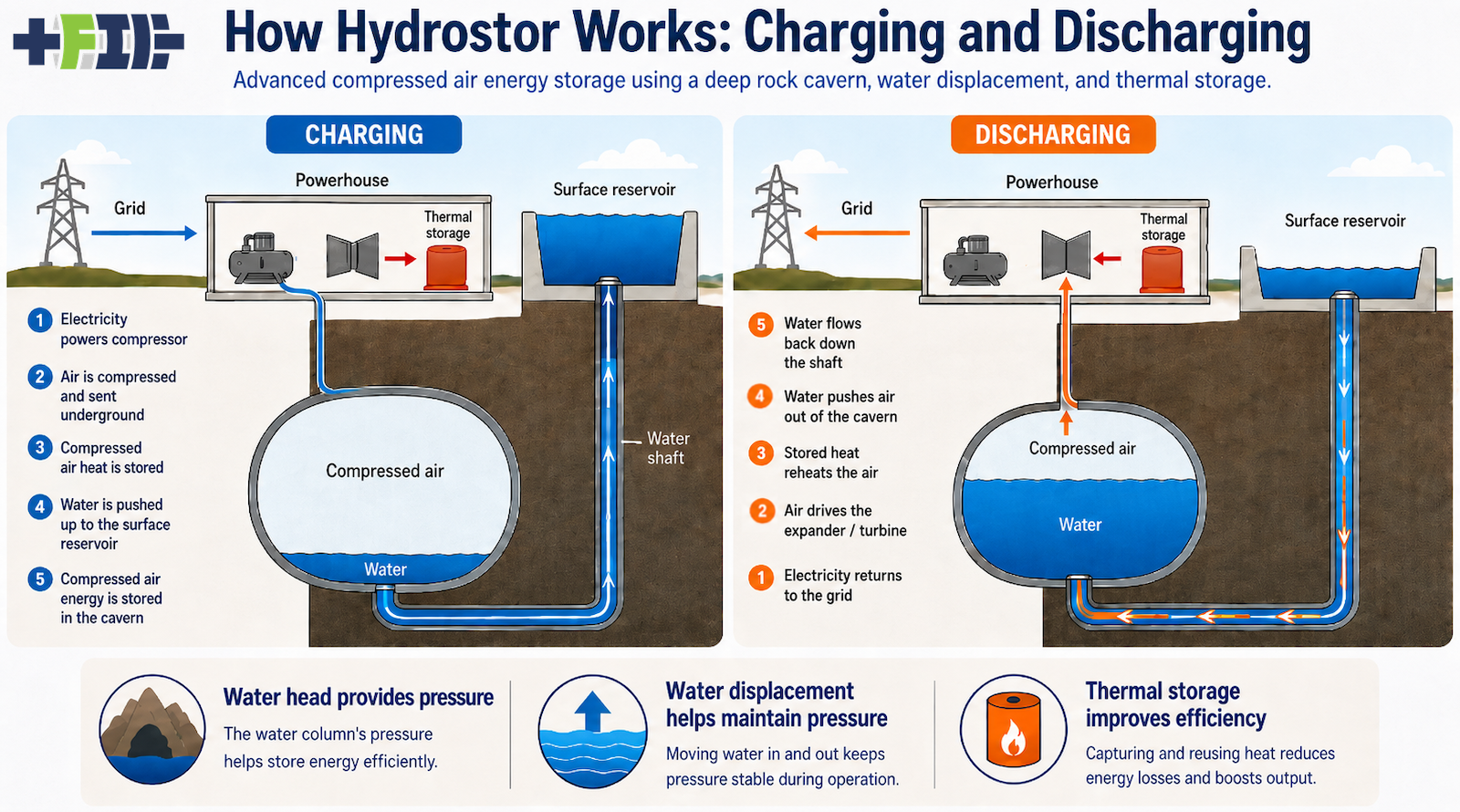
Hydrostor's proposed Quinte Energy Storage Centre sits atop a real problem: eastern Ontario's transmission grid is constrained, and the Napanee and Lennox transformer station area desperately needs local capacity and flexibility that conventional solutions cannot deliver quickly enough. Rather than another abstract storage technology debate, this 500 MW advanced compressed air energy storage facility represents a targeted answer to a specific grid choke point where dispatchable capacity has genuine value.
The challenge Ontario faces is fundamentally locational. A megawatt-hour of storage in the wrong place is far less useful than one positioned where transmission constraints, load pockets, or reliability requirements are actually showing up. Traditional pumped hydro—which needs two elevation-separated reservoirs, vast quantities of water, suitable geology, and years of permitting—rarely aligns with where the grid truly needs help. Eastern Ontario has no convenient mountain valley beside a transmission node, yet the grid constraint is real and pressing. Hydrostor's technology is partly an attempt to bring pumped hydro's most useful characteristics to places where pumped hydro itself cannot physically exist.
The Quinte project is being positioned for the Independent Electricity System Operator's Long Lead-Time RFP, which targets resources requiring more than five years of development, including certain long-duration storage technologies. Successful projects can receive 40-year contracts—a runway long enough to make high-capital infrastructure projects financeable for lenders and investors, though it also locks ratepayers into the consequences of any cost or performance miscalculations.
Hydrostor's advanced compressed air energy storage, or A-CAES, differs fundamentally from older compressed air plants that burned natural gas to reheat expanding air. Here, electricity drives compressors that push air underground while capturing the heat of compression. During discharge, compressed air moves through the thermal system and an expander, generating electricity while water shifts back into the cavern to maintain pressure stability. At its core, this is more physics than marketing flourish: a water column 600 to 800 metres deep creates roughly 60 to 80 bar of pressure—the core of the system's structural logic. That depth is not decorative; it is the pressure source.
The water does a second critical job too. In a simple compressed air vessel, pressure drops as air leaves, making the tail end of discharge less useful because turbines see a changing pressure gradient. Hydrostor's water displacement system acts like a hydraulic piston, keeping pressure more stable as air releases. That improves energy output quality and makes the system genuinely useful to the grid operator.
The engineering sits at an intersection between pumped hydro, compressed air, thermal storage, and underground civil works—a position that demands rigorous execution. Hydrostor's demonstration facility in Goderich, Ontario, proved a version of the concept could work at smaller scale, but moving to 500 MW and 4 GWh capacity is a step of different magnitude. The physics appears sound. The question is execution—and that question will determine whether Quinte becomes a model for bringing proven storage principles to places where conventional solutions simply cannot fit.