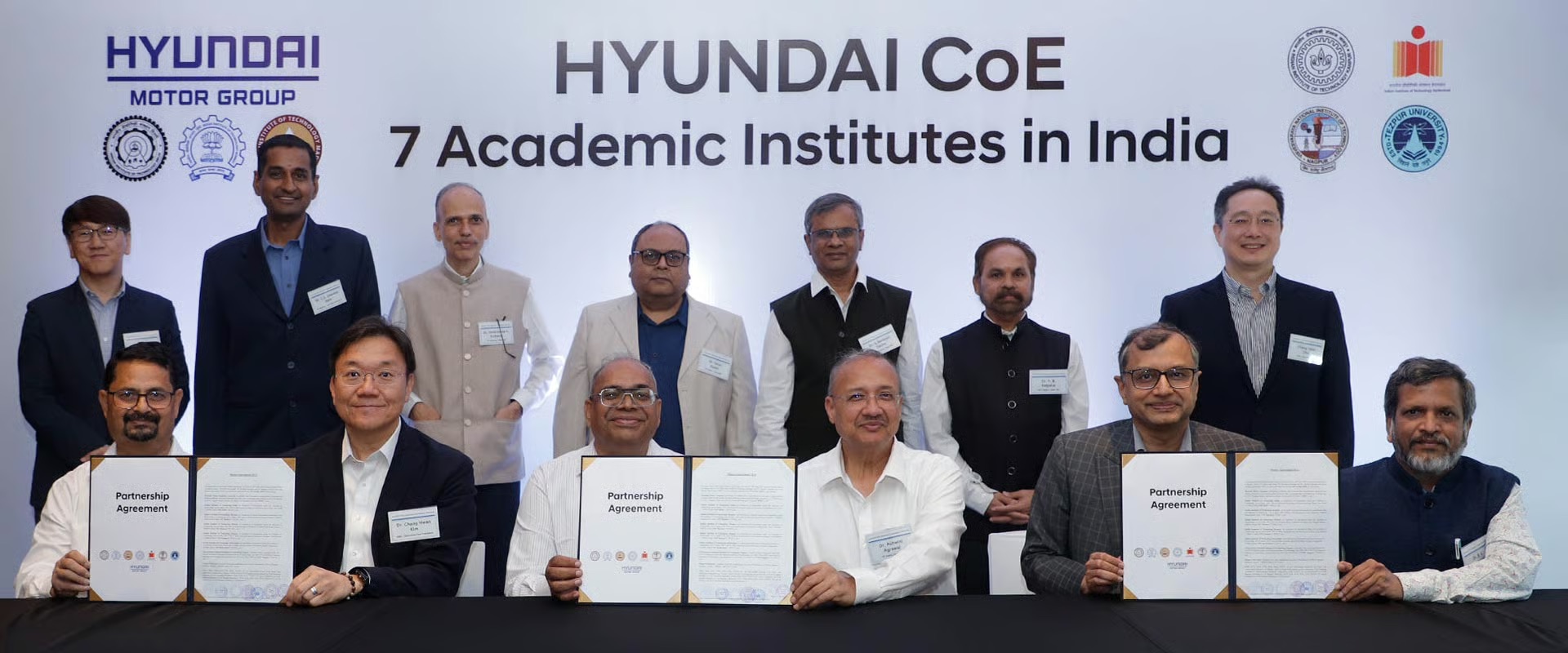
When Hyundai Motor Group formalized agreements with four new Indian universities this year, it quietly expanded something bigger than a corporate research initiative—it wove together some of India's most prestigious engineering institutions into a unified network racing to solve the country's battery and electrification challenge.
The Hyundai Center of Excellence, which launched its first partnerships in 2025 with IIT Madras, IIT Delhi, and IIT Bombay, has now grown to encompass seven universities after adding IIT Kanpur, IIT Hyderabad, Visvesvaraya National Institute of Technology (VNIT) Nagpur, and Tezpur University. This expansion matters because India's electric vehicle transition depends not just on manufacturing capacity, but on developing homegrown battery technologies and solutions tailored to Indian roads, climates, and infrastructure. Right now, most EV battery expertise flows from China and South Korea. By anchoring research at India's top institutions, Hyundai is helping reverse that dependency.
The scale of the work underway is substantial: 39 joint research projects are already advancing across the seven-university consortium. These projects span the technical foundations that will determine whether Indian EVs can compete globally—battery cell design, battery management systems, energy density optimization, safety protocols, durability testing, and diagnostic technologies. More concretely, researchers are developing battery designs and materials tailored specifically for India's market conditions, and building an AI-powered Vehicle-to-Grid platform that could reshape how the country manages grid demand as EV adoption accelerates.
What makes this initiative distinct is its deliberate structure for knowledge exchange. A Korea Visiting Program will rotate Indian and Korean researchers between countries, accelerating the transfer of EV technology expertise. Global e-conferences will convene academics discussing cutting-edge developments, while upcoming tech forums will bring together government officials, industry leaders, and professors—creating the rare spaces where policy, commerce, and research actually inform each other. Chang Hwan Kim, Head of Hyundai's Electrification Energy Solutions Tech Unit, sees it as building something permanent: "By bringing together the distinguished professors and emerging researchers from these seven institutes, we can create powerful synergies that will yield immense value for both Hyundai and India's sustainable growth."
The university deans who signed on—from IIT Delhi's Bijaya Ketan Panigrahi to IIT Bombay's Shrikrishna Vyankatesh Kulkarni—represent generations of engineering talent that India has cultivated but often exported. Now that talent is being mobilized at home, on problems that matter locally. Hyundai's strategic investment program, initiated in 2025 to fund research across the network, provides the resources to retain and deploy this expertise.
India faces a peculiar challenge in its EV transition: it cannot simply import foreign battery technology and call it done. The country's charging infrastructure, grid capacity, climate zones, and driving patterns demand locally-optimized solutions. By positioning itself as a convener rather than just a vendor, Hyundai is betting that the future of Indian electric mobility will be written in laboratories across Delhi, Mumbai, Kanpur, and Nagpur. The initial results suggest the consortium model is already working—39 active projects is not symbolic science, but substantive research momentum. If these seven universities can deliver breakthrough insights on batteries and electrification, India stops waiting for solutions and starts building them.