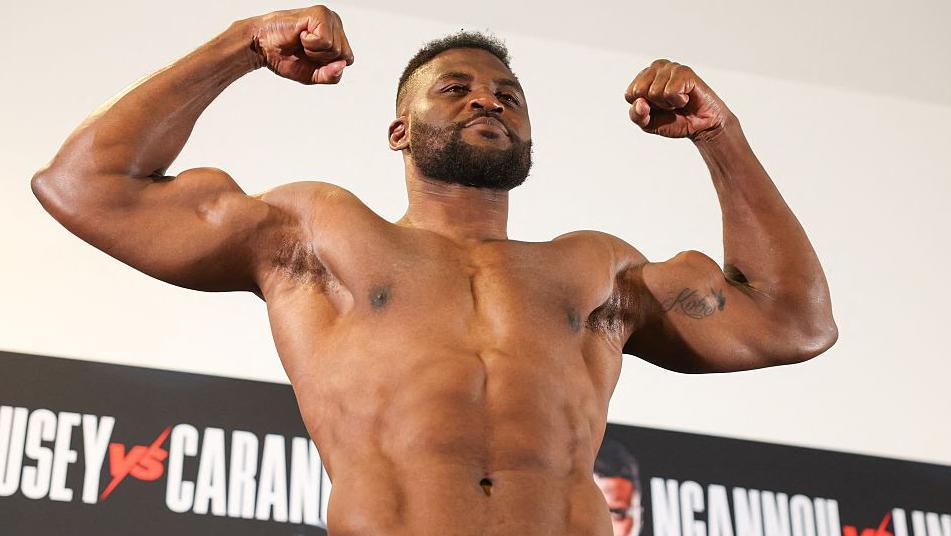
At 39, Francis Ngannou walks into a California ring on Saturday carrying a title that no official body has granted him but that many in fighting believe he never truly surrendered. The Cameroonian heavyweight is defending his claim as the lineal champion against Philipe Lins on an MVP-Netflix card, a symbolic moment for a fighter who walked away from the UFC at the peak of his dominance to demand something simpler: a fair deal.
When Ngannou left the UFC in 2023, he was their reigning heavyweight champion. He has fought once since in the Professional Fighters League, winning that bout, and sees no reason why a loss should erase a title he never lost. "I never lost the UFC title but I didn't lose the PFL title either," he said, speaking with the quiet certainty of someone who has already sacrificed enormously for his convictions. While mixed martial arts has no official lineal championship system like boxing does, Ngannou is widely regarded as the world's best heavyweight—a claim that stands despite Jon Jones and Tom Aspinall becoming UFC champions in his absence.
But the fight itself matters less than what it represents. Ngannou's departure from the UFC was driven not by injury or decline but by principle. He describes his exit as "horrible," marked by a bitter falling out with Dana White and the promotion's brass. What drove him out was a question of fairness: UFC contracts, he argues, are fundamentally unbalanced, handing all rights to the promoter while leaving fighters vulnerable. "The contracts are not fair—they give all the rights to the promoter and don't protect the fighter," he told BBC Sport. "The fighters are just an asset and they can get rid of you when they want. If you don't fight you don't get paid and you have no right to do anything else."
Outside the UFC's walls, Ngannou has prospered. He earned millions from boxing matches and has now secured a platform on Netflix through MVP, the promotion fronted by Jake Paul and Nakisa Bidaria. That alternative—rare as it is—has allowed him to operate with leverage that fighters trapped inside the UFC system can only dream of. He is not alone in this migration. The same MVP-Netflix card features Ronda Rousey, the former champion making her return to MMA after a decade away, and other ex-UFC fighters seeking better terms.
Ngannou sees his own path as a template, even as he acknowledges the toll it took. "It's very important that fighters have an alternative. I've been out there for a little while now and I understand why so many fighters are scared," he said. The fear is real: step away from the UFC and you risk obscurity, lost earnings, damaged marketability. The system is designed to discourage defection.
Yet his message to younger fighters carries the weight of hard-won experience. "If someone asks my advice I would say 'stand your ground and believe in yourself.' When making your decision you have to consider the worst case scenario and as long as you are OK with that scenario then you can live with that decision." It is pragmatic counsel—not a call to recklessness, but a reminder that the status quo is not immutable. This Saturday's fight against Lins is about far more than a lineal crown. It is about whether the alternative Ngannou built can become genuine precedent, or whether it will remain the exception that proves the rule.