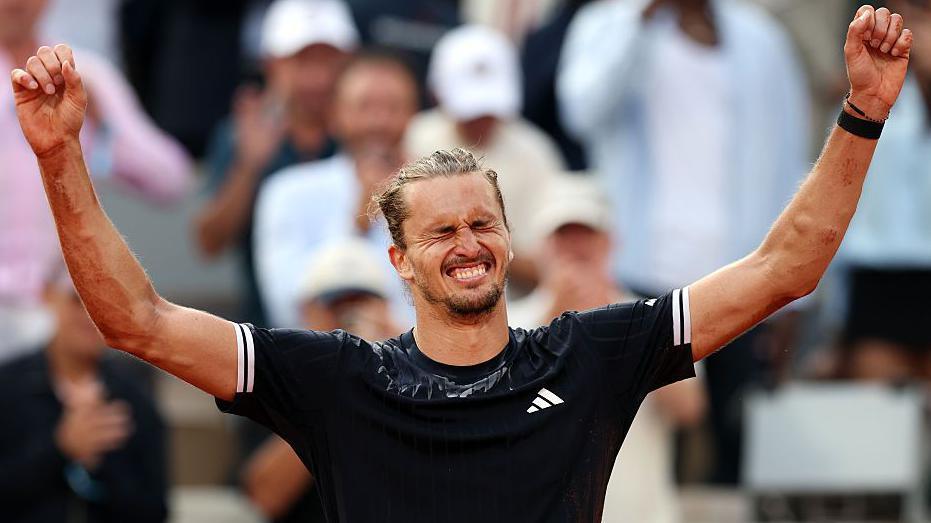
Alexander Zverev walked off Court Philippe-Chatrier with the Grand Slam trophy he'd chased for nearly a decade, on the exact same court where four years earlier he'd left in a wheelchair, seven torn ligaments and two fractured bones ending his dreams at 5-3 down in a match he was serving to win.
The German's victory at Roland Garros — a five-set defeat of Italy's Flavio Cobolli — represents one of sport's most compelling redemption stories. Zverev had become the cautionary tale of modern tennis: the generational talent cursed by the Grand Slam gods. At 29, he had lost three major finals, including a two-set collapse against Carlos Alcaraz at this very tournament last year. At the Australian Open just weeks ago, Jannik Sinner dismantled him so thoroughly that Zverev described himself as mentally "empty" afterward. He had also surrendered a two-set lead at the US Open in 2020, serving for the championship against Dominic Thiem and watching it slip away.
But on this Paris clay, 1,465 days after that devastating ankle injury, Zverev finally broke through.
"I have had the best moments and the worst moment of my life on this court," Zverev said immediately after the win, his voice heavy with the weight of what those words meant. He reflected on lying in that corner of the stadium, watching his career hang in the balance. He had lost a Grand Slam final here two years prior. And yet, standing there with his trophy: "But now, finally, it is a happy ending."
The path to victory was genuinely difficult in the moment, though circumstances had aligned unusually in his favor. Top seed Sinner, the heavy favourite who had won three of the last four majors, fell shocking early to Juan Manuel Cerundolo in the second round. Two-time defending champion Carlos Alcaraz had withdrawn with a wrist injury a month before the tournament. Novak Djokovic, the tournament's three-time champion, exited in the third round to Joao Fonseca. When Zverev reached the final, Cobolli was the first top-25 player he had faced all tournament. This was unmistakably his best chance — perhaps his only realistic chance — and he seized it.
The final itself tested his famous emotional fragility. Cobolli, just 24, forced a fifth set by fighting back from a set down twice. But Zverev held his nerve where he had failed so many times before, finally claiming what should have come years earlier.
His first words after his collapse of joy on the court were for his team — his father, his brother, the people who had walked with him through injury and heartbreak. "We have been losers at times in the most important moments," he said. "At the end of the day, we are Grand Slam champions now and that is what counts."
Rafael Nadal, the man who helped Zverev off the court in 2022, was among the first to congratulate him on social media. "So well deserved after all the hard work and perseverance," Nadal wrote. "You've been chasing your first Grand Slam for a long time and you absolutely deserve it."
For Zverev, those injuries, those final losses, those moments of doubt — they remain part of him. But now they share the court with something greater: a Grand Slam champion's name.