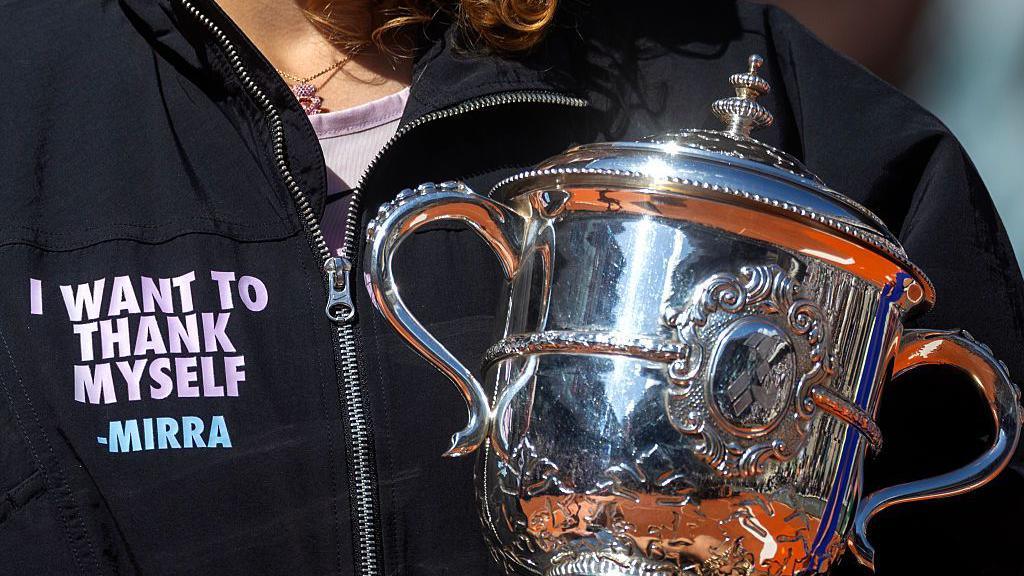
Mirra Andreeva lifted her first Grand Slam trophy at Roland Garros with the phrase "I want to thank myself" emblazoned across her black jacket—and she meant every word of it. The 19-year-old Russian defeated Polish qualifier Maja Chwalinska 6-3, 6-2 in the French Open final, becoming the youngest woman to win the singles title at Paris since Monica Seles in 1992. But what made Andreeva's victory remarkable was not just the dominant scoreline or the history she carved into the Roland Garros record books; it was the emotional maturity and self-awareness she displayed in her journey there.
That self-knowledge has been hard-won. Andreeva, a former world number one in juniors long tipped for Grand Slam success, has struggled with emotional outbursts on court that fractured her focus and derailed her performances. Last year she combusted in her Roland Garros quarter-final defeat to home favorite Lois Boisson, and just months before arrived at Paris, she had smashed a racquet and sworn at the crowd at Indian Wells. Those demons followed her to the courts of Roland Garros this year—but this time, she faced them differently.
Working with psychologist Alexis Castorri, who previously supported Andy Murray, Andreeva developed a simple but powerful tool: imagining "a big stop sign" whenever her emotions threatened to overwhelm her on court. She also drew inspiration from studying Roger Federer's matches at Roland Garros, adopting his composure and grace. "My psychologist says you can always choose how you're going to be on the court," Andreeva explained. "I decided to choose to be a fighter." Even in the final, when Chwalinska's unpredictability and blustery conditions tested her resolve, Andreeva kept her composure to deliver a remarkably mature performance.
The first person she hugged after her victory was her coach, Conchita Martinez—a Wimbledon champion in 1994 who joined Andreeva's team in 2024 and has overseen all five of her WTA Tour titles since then. The bond between them runs deep, built on shared moments of triumph and struggle, punctuated by pranks, endless games of Uno, and Andreeva's homemade "Let's go Senorita" sign cheering Martinez on at Wimbledon. When Martinez told her, "I'm very proud of you," Andreeva's eyes welled with tears. "To hear those words from her is very, very special to me," she said.
Andreeva is the first player born after 2005 to lift a Grand Slam trophy, and she arrives at this pinnacle having won 22 of her last 25 matches on clay—more than any other player on the WTA Tour this season. Maria Sharapova, the last Russian woman to win a major singles title, acknowledged the significance with a post on Instagram: "Proud of you Mirra Andreeva. The celebration says it all. Excited, but not satisfied." Andreeva echoed that sentiment, her mind already turning to the grass season ahead. This triumph, she seems to understand, is not the destination but the beginning.