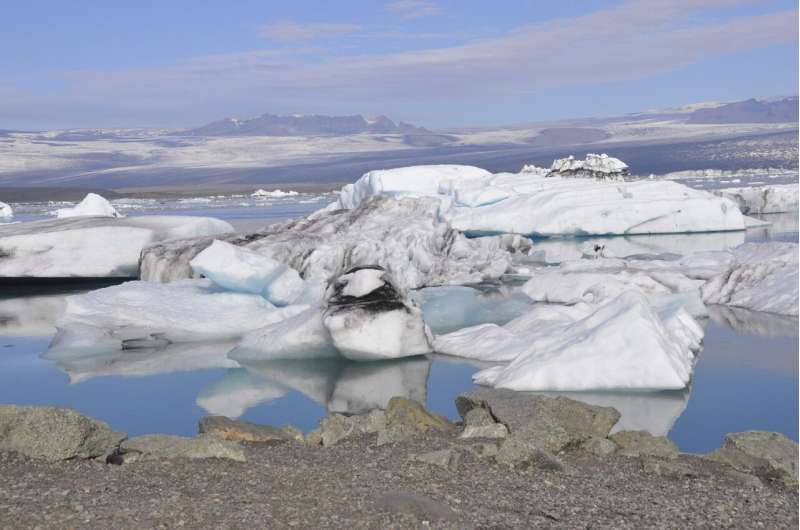
When Jean-François Boily's team at Umeå University froze salt solutions with iron minerals, they discovered something that climate scientists have been missing: ice is not inert. It is a powerful chemical amplifier, speeding up the breakdown of iron minerals far beyond what happens in liquid water. The findings, published in the Proceedings of the National Academy of Sciences, reveal a mechanism that could reshape how we predict nutrient cycles, carbon storage, and water quality across polar and mountain regions as the planet warms.
Most environmental models treat ice as a passive, unchanging backdrop. But this research shows the chemistry inside ice is active and consequential. Roughly 17% of Earth's land surface sits on permafrost, and vast additional areas experience seasonal freezing. As climate change increases the frequency of freeze-thaw cycles and causes permafrost to degrade, the ice-driven release of iron and other trace elements could exceed current projections — with rippling effects across entire ecosystems.
Iron is no minor player in the story of planetary health. It controls algae growth in lakes and oceans, binds carbon in soils, and affects water color and quality. The team focused specifically on goethite, a rust-colored iron mineral abundant in soils, sediments, and dust. When they tested how different dissolved salts — the kind found everywhere in nature — affect this mineral's breakdown, the pattern was unmistakable.
Fluoride, the strongest binder tested, released more than four times as much iron in ice as in liquid water. Sulfate, a weaker binder, showed a smaller but still measurable boost. Perchlorate, which barely interacts with iron at all, produced no dissolution in either phase. The mechanism lies in what happens at the microscale. When water freezes, substances that cannot be incorporated into the ice crystal structure are concentrated into tiny pockets of remaining liquid trapped between the crystals. In these environments, salt concentrations can increase up to 500-fold, creating what the researchers call "microscale hot spots" where chemical reactions proceed at vastly accelerated rates.
"What surprised us most was how consistent this effect appeared across the compounds we tested," Boily reflected. "If the pattern holds more broadly, we could potentially predict ice-enhanced mineral breakdown based on a single chemical property. That would be a valuable tool for environmental modeling." This consistency suggests a simple rule: if you know how strongly a substance binds to iron, you can likely estimate how much ice will amplify its dissolution.
The implications stretch across landscapes already under stress from warming temperatures. Mountain streams, Arctic coastlines, and thawing permafrost regions all stand to see changes in iron availability that current models do not capture. These changes could trigger cascading effects through food webs and carbon cycles. As freeze-thaw cycles intensify with climate change, understanding the hidden chemistry of ice becomes not an academic curiosity but a practical necessity for predicting how natural systems will respond to a warming world.