Every second, about 100 billion neutrinos pass through each square centimeter of your body—and almost all of them leave no trace. Now, the IceCube Neutrino Observatory in Antarctica is helping scientists study especially energetic examples of these “ghost particles,” which can carry clues from some of the universe’s most extreme places.
Neutrinos are elementary particles with no electric charge and an extraordinarily small, though nonzero, mass. They come in three types: electron, muon and tau. Because they interact so rarely with matter, they can cross planets and travel vast distances through space. That makes them hard to catch, but also useful: unlike light, neutrinos can escape dense regions around collapsing stars and black holes, bringing information from places that are difficult to study in other ways.
Physicist George Fuller of the University of California San Diego, who has studied particle astrophysics for decades and worked with IceCube scientist Francis Halzen on an early paper about the observatory, calls neutrinos “truly ghost-like particles.” Their interactions rely on the weak interaction, a force about 20 orders of magnitude weaker than electromagnetism. Fuller has noted that, depending on their energy, neutrinos could pass through light-years of lead.
The particles were first proposed in the 1930s by physicist Wolfgang Pauli to explain energy that seemed to vanish during radioactive decay. Pauli worried that his idea might be impossible to test, saying, “I have done a terrible thing, I have postulated a particle that cannot be detected.” In 1956, physicists Clyde Cowan and Frederick Reines finally detected neutrinos in an experiment called Project Poltergeist.
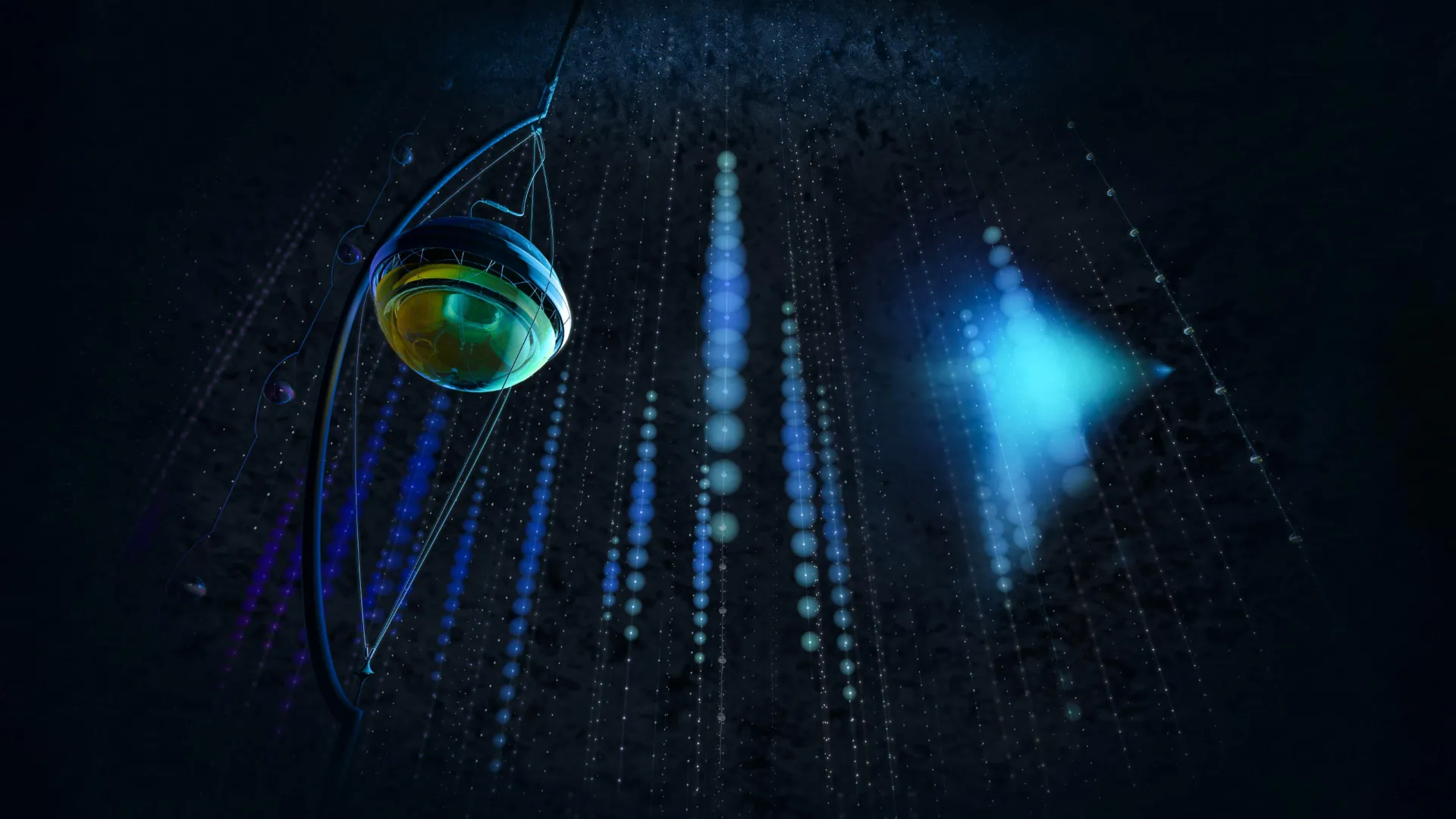
Finding neutrinos from space takes a much larger instrument. In the 1990s, Halzen saw that the clear ice deep below the South Pole could provide a vast, natural detector. IceCube was built within that ice to spot faint flashes produced when a neutrino occasionally interacts with matter. Those rare signals let researchers investigate particles arriving from beyond Earth, including ones with energies far above neutrinos from the Sun—the difference described as about 10 billion times in the observatory’s latest detection.
That scale matters because higher-energy neutrinos can point scientists toward powerful cosmic events. The source of any one particle may not be immediately clear, but each detection adds evidence about the universe’s most energetic environments. Neutrino research has already contributed to five Nobel Prizes in Physics. This year, Halzen received the prize for his decisive contributions to IceCube and the discovery of high-energy neutrinos of astrophysical origin.
IceCube’s work turns a remote stretch of Antarctic ice into a way to study particles that pass through Earth unnoticed. As researchers keep collecting rare signals, they hope to better trace where the universe’s most energetic neutrinos come from—and what those invisible messengers can reveal about the cosmos.