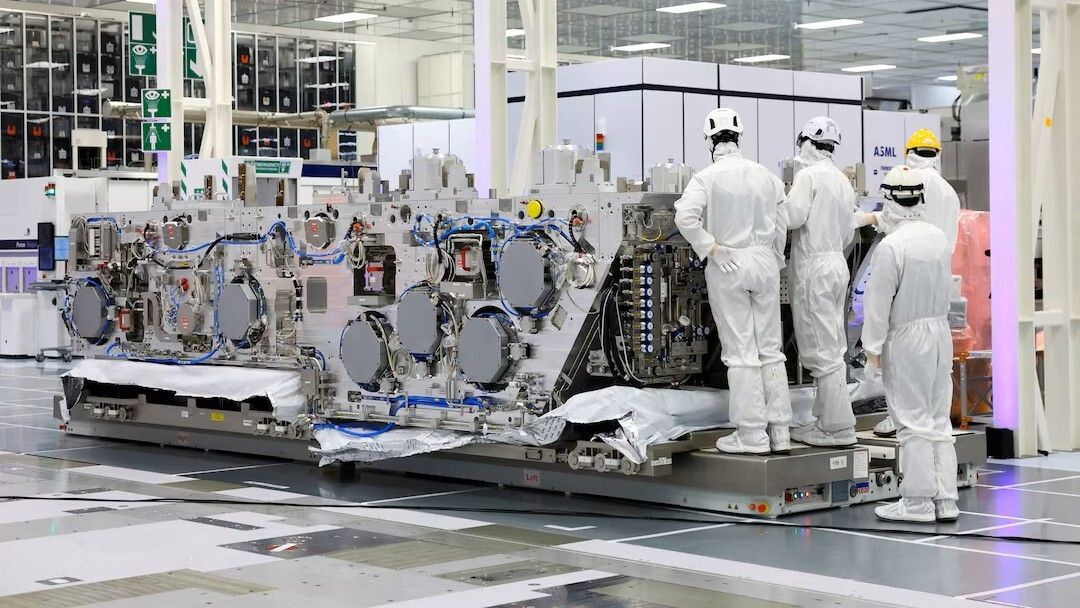
In a laboratory in Leuven, Belgium, researchers at imec have just accomplished something that seemed impossible a year ago: building a working quantum computing device using the exact same cutting-edge manufacturing technology that produces today's most advanced AI processors. On May 19, the Belgian semiconductor research giant unveiled the world's first quantum dot qubit device fabricated with High-NA EUV lithography, a breakthrough that dissolves the boundary between experimental quantum hardware and industrial-scale production.
This matters because quantum computing has long suffered from a fundamental problem: it exists in a parallel universe from practical manufacturing. While AI processors benefit from decades of refinement in semiconductor fabs—factories that have learned to squeeze ever-smaller transistors onto silicon—quantum computers have remained largely handmade curiosities, built in university labs by teams of specialists. The gap between a working prototype and something millions could use has seemed unbridgeable. Until now.
The device imec unveiled uses silicon quantum dot spin qubits, nanoscale structures that trap individual electrons and exploit their quantum spin states to store information. These qubits were patterned with astonishing precision at gate gaps of just 6 nanometers—thin enough that conventional manufacturing equipment couldn't reliably produce them even five years ago. High-NA EUV lithography, the same technology companies like TSMC and Samsung are deploying to manufacture the world's most advanced chips, made these dimensions possible. The patterning was so precise that imec could integrate the quantum device on the same architectural roadmap that already powers next-generation artificial intelligence processors.
What imec has demonstrated is a kind of technological synergy. Quantum computing no longer needs to wait for its own manufacturing revolution. Instead, it can ride the coattails of the chip industry's existing momentum. Every time semiconductor manufacturers improve their fabs for faster AI processors, quantum hardware becomes easier and cheaper to produce as a byproduct. The two industries—long running parallel races—have suddenly merged onto the same track.
This compression of timelines could reshape the quantum computing industry's trajectory. Companies that have invested heavily in proprietary manufacturing approaches suddenly face a question: why build from scratch when the semiconductor industry's existing ecosystem can do it better, faster, and cheaper? For venture capital, government funding agencies, and corporate labs pursuing quantum computing, the imec announcement signals that the manufacturing bottleneck—long considered the barrier between labs and the real world—may finally be breaking.
The breakthrough also underscores something often overlooked in breathless quantum computing coverage: the real progress isn't always about quantum algorithms or achieving higher qubit counts. Sometimes it's about the unsexy work of manufacturing, about fitting experimental science into industrial processes, about making something that can be produced reliably not just once but millions of times over. Imec's achievement isn't the flashiest quantum computing announcement, but it may be the most important one in years. It suggests that practical, widely-available quantum computers might be less of a distant dream and more of an industrial problem waiting to be solved.