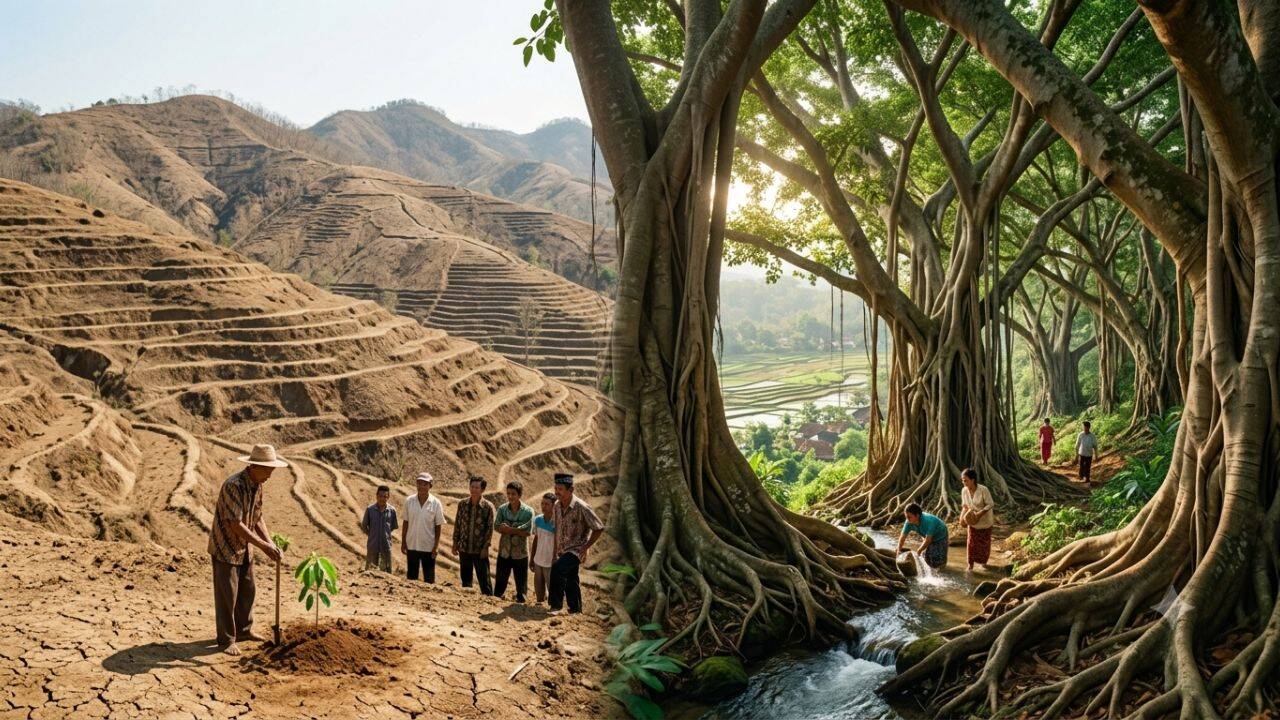
In the dry hills of Wonogiri, Central Java, Indonesia, visitors today walk through dense green forests without knowing what these slopes once looked like. Years ago, the hills were bare and brown, the rivers had run dry, and farmers could grow crops only once a year because there simply wasn't enough water. That changed because of one man who spent more than two decades planting trees while his neighbors laughed at him. His name is Sadiman, and his story shows what one person with patience can accomplish for an entire community.
Sadiman was a farmer who watched the local forests disappear as people cleared trees for farming and burned vegetation for agriculture. Without forests, the soil could no longer hold rainfall. Water ran quickly down the slopes and vanished, leaving villages without reliable sources of drinking water and farms without enough moisture to grow food. Some families could farm only during a single cropping season each year.
When Sadiman noticed springs drying up and water becoming scarce, he decided to do something about it. He started planting trees on the barren hillsides, choosing banyan and ficus species because their roots grow deep and wide, helping the soil absorb and hold water. He focused on higher ground, where restoring vegetation could benefit the widest surrounding area.
His neighbors thought he was crazy. Some avoided banyan trees because traditional beliefs associated them with spirits. Others could not understand why anyone would give up farmland or livestock for slow-growing trees whose benefits would take years to appear. Sadiman ignored the mockery and continued his work, financing much of it himself. He sold plants like cloves and jackfruit from his nursery, and at times traded livestock, just to buy more young trees to plant.
Over more than two decades, Sadiman planted at least 11,000 trees across roughly 250 hectares, an area about the size of 600 soccer fields. The work was slow and steady. There were no dramatic shortcuts, just year after year of planting and waiting for seedlings to grow strong.
The results, however, were dramatic. New springs appeared in areas that had been completely dry before. Villages installed pipes to carry clean water directly into homes. Farmers who once could grow crops only once a year could now farm two or three times annually because water supplies became reliable. The soil stayed moist longer because tree roots held it in place and helped rainwater seep underground instead of washing away.
Eventually, the people who once mocked Sadiman became his supporters. They could see the green hillsides and the restored water sources with their own eyes. Villages that had struggled with drought for generations now had dependable clean water, all because one patient farmer refused to give up. The transformation did not come from government programs or large investments. It grew slowly from the ground up, one tree at a time.