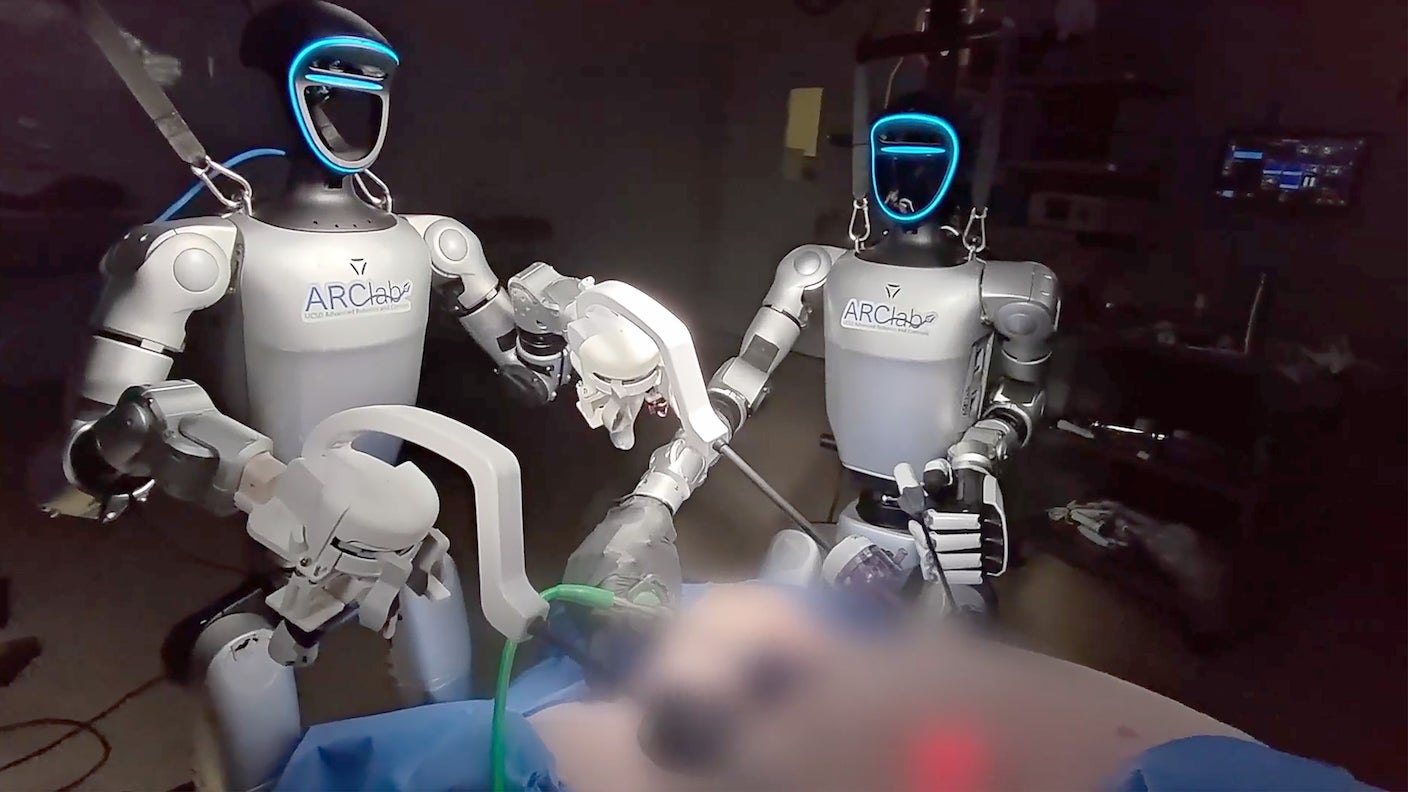
Surgie made its debut on the operating table. The humanoid robot — standing just over four feet tall and weighing about 77 pounds — smoothly removed a gallbladder from an anesthetized pig while being guided by a human surgeon miles away. The surgery marked the first time a humanoid robot performed a procedure in a standard operating room setting, a milestone that researchers at the University of California, San Diego say could eventually bring critical surgeries to communities that lack enough doctors.
The team used a commercially available robot called the Unitree G1, which they modified to hold and switch between standard surgical tools. Unlike the bulky, multi-armed robots common in hospitals today, this humanoid fits into existing operating rooms without expensive renovations. "You can imagine these robots being deployed in remote communities where staffing is challenging, or in austere environments like search and rescue scenarios," said Michael Yip, a study author at UC San Diego.
The researchers ran two successful surgeries. A human surgeon wore a headset showing a magnified, 3D view of the surgical field and controlled Surgie's movements in real time. Though doctors stood nearby just in case, the robot completed both procedures with almost no help. After testing, surgeons said they felt less physical strain and less frustration compared to traditional methods. They also reported better overall performance.
The robot still has kinks to work out. It overheated sometimes and needed frequent repositioning. But researchers say recent advances in how robots move and balance have made machines like Surgie faster and steadier than versions from just a few years ago. Humanoid robots are already stocking warehouse shelves and even competing in marathons. Surgery, however, sets a much higher bar for precision.
Today's surgical robots typically require their own specially designed rooms and tools. They use multiple independent arms mounted on carts, each controlled from a separate console. Humanoid robots like Surgie can theoretically slip into standard operating rooms and use the same instruments already on hand. The team spent months mapping the robot's range of motion to ensure it could move safely inside a patient's body during laparoscopic surgery, which uses tiny incisions to reduce pain and speed recovery.
Researchers acknowledge there is still a long road ahead. They don't yet know exactly how close humanoid robots are to meeting all the strict requirements for human surgeries. But the early results suggest they have a viable future — one where a skilled surgeon in San Diego could help guide a robot in a rural clinic hundreds of miles away.