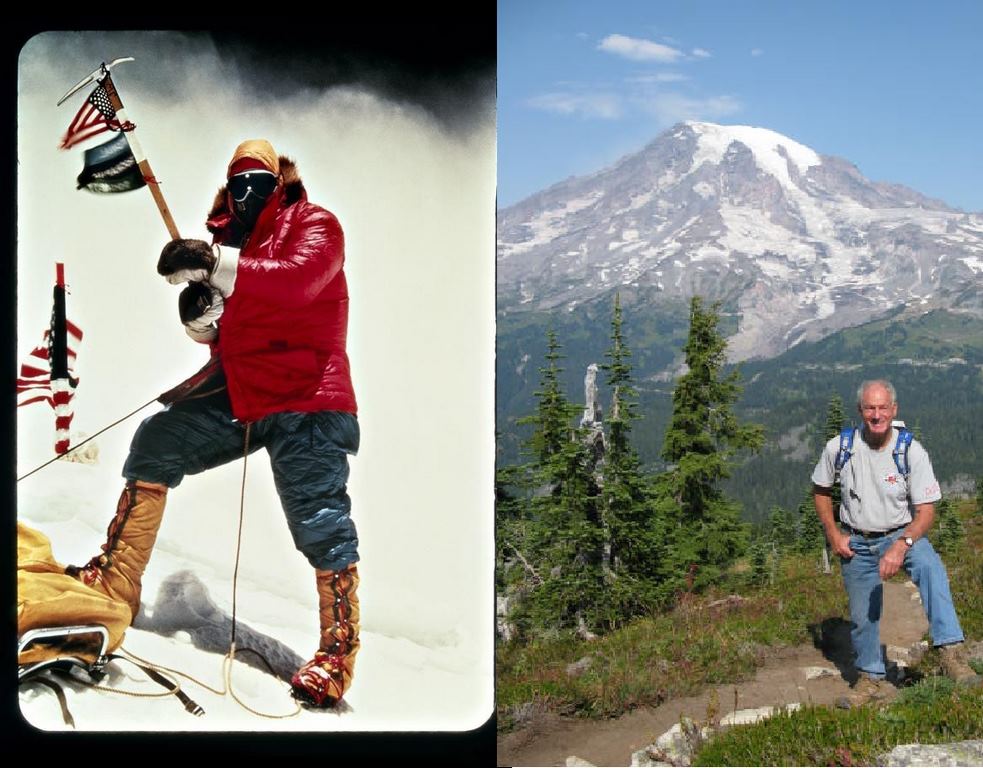
On February 10, 1929, in a small town in Washington state, two identical twins entered the world together — and together, they would spend their lives reaching for the sky. Jim Whittaker and his brother Lou shared a birthday, a passion for mountain climbing, and a determination that would eventually carry one of them to the roof of the world. At just 16 years old, the Whittaker brothers climbed Mount Rainier together. By 34, Jim had done something no American had done before: he stood on the summit of Mount Everest, joining an exclusive club of just eleven humans who had ever reached that peak — and he did it breathing borrowed oxygen and carb-loading on JELL-O. He climbed alongside Nawang Gombu, a nephew of Tenzing Norgay, who had himself made that first ascent with Edmund Hillary a decade earlier. The year was 1963, and the expedition was funded by National Geographic. President John F. Kennedy awarded Jim the Hubbard Medal for the achievement, recognizing the very best in American exploration and discovery.
But Jim Whittaker was only getting started. In 1978, he became the first American to summit K2, the world's second-highest peak. Then came the feat that perhaps defines his legacy best. In 1990, he led the Mount Everest International Peace Climb, guiding climbers from the United States, the USSR, and China — three nations that had been Cold War adversaries — to the summit together. The expedition put twenty climbers on the brow-line of the world and hauled off a substantial amount of trash left by previous expeditions. "We took the three countries that were enemies during the Cold War and demonstrated what could be done through friendship and cooperation," Whittaker told National Geographic in 2003. That line reads like an epitaph for what he believed mountaineering could achieve.
Away from the Himalayas, Whittaker was the first employee of Recreational Equipment Co-op, better known as REI — a mail-order business that he helped build into a multi-billion dollar international outfitter. He stocked shelves, rang up sales, and made bank deposits. He eventually became president and chief executive in 1971, riding a wave of enthusiasm for outdoor recreation that his own expeditions had helped ignite. In 1965, he guided then-Senator Robert F. Kennedy to the top of Mount Kennedy in the Yukon, and later served as a pallbearer at Kennedy's funeral.
Jim Whittaker died at his home in Port Townsend, Washington, at 97. He is survived by his sons Leif, Bobby, and Joss, and his second wife Dianne Roberts, who photographed his K2 expedition. His twin brother Lou, who died in 2024 at 95, became the most experienced Cascades Range guide in the country. Their nephews, Peter and Win, now guide climbers on Mount Rainier — Peter has summited Everest three times. Two Washington mountains, Big Jim and Big Lou, bear the brothers' names. The Whitmores reached for the highest places on Earth — and in doing so, showed the rest of us how cooperation can carry us there.