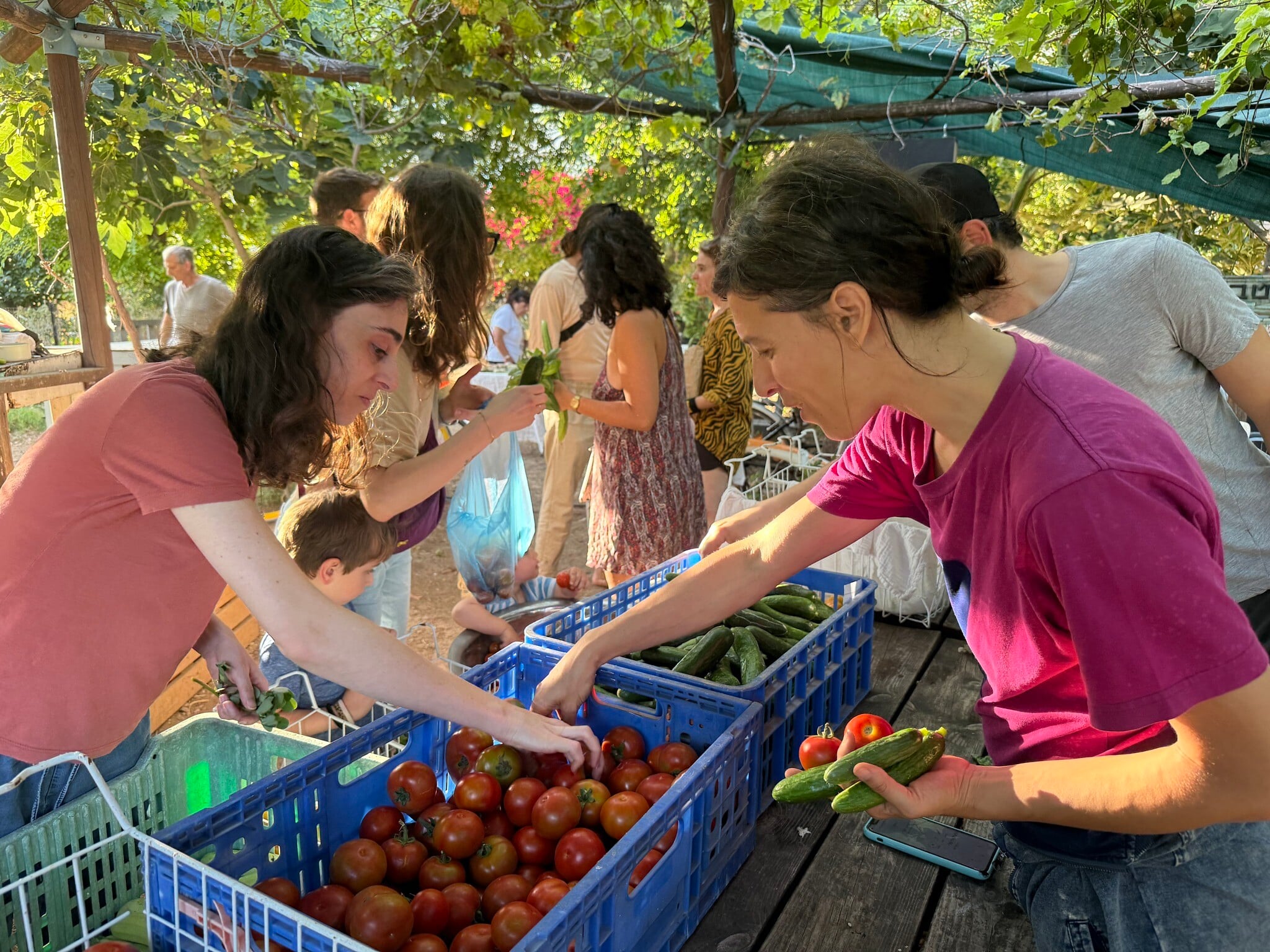
On a Thursday evening in late May, Dora Kaikov stood at a wooden picnic table in a three-quarter-acre garden in south Tel Aviv, exchanging paper vouchers for a bottle of olive oil. Behind her stretched rows of tomatoes, cucumbers, and zucchini growing where there was once only sand. What made this moment distinctive wasn't just the fresh produce or the warm community gathering — it was the currency itself. The Lira Shapira, named after the Shapira neighborhood and Israel's official currency from 1952 to 1980, has transformed how residents of one of Tel Aviv's poorest neighborhoods think about waste, value, and each other.
The system works with elegant simplicity. Residents deposit organic waste into containers scattered throughout the Shapira neighborhood. For every kilogram of compost-bound scraps, they receive one Lira voucher — worth about 34 cents and exchangeable for fresh vegetables, artisanal breads, specialty oils, soaps, and even therapeutic treatments. Founded by Perry Samnon, the program has enrolled 300 households, most from the neighborhood itself. The twice-monthly markets at Tel Hubbes, the community garden that was established four years ago, draw an extraordinary human mosaic: religious and secular Israelis, Bukharian Jewish immigrants like Dora, migrant workers from Nigeria, and bohemian residents watching gentrification arrive.
The environmental math is straightforward but significant. By keeping organic waste out of landfills — where it would generate methane, a major driver of global warming — and converting it into compost instead, the system saves municipalities one shekel in waste treatment costs for every kilogram diverted. The Tel Aviv-Jaffa Municipality has recognized this, subsidizing the courses and providing the land and services that keep the operation running. The annual budget of 200,000 shekels, roughly $70,000, is sustained largely through educational courses on gardening and replicating the model, which draw steady interest.
But the Lira Shapira is about more than environmental accounting. Locals can rent one of 22 garden strips, each 33 feet long, for 10 Liras a month to grow their own food — the waiting list is long. Orly Nackler tends her vegetables with her children, watching them grow alongside neighborhood bonds. Idan Goldberg, one of just three garden activists earning a salary, coordinates tours and events that breathe life into the space. A community filmmaking group even produced a movie about the initiative, featuring the confident nine-year-old Israeli-born daughter of a Nigerian migrant worker.
What began as an experiment in one neighborhood has already sparked replicas across Israel. Haifa's Bat Galim neighborhood operates ShtarGalim — "shtar" means banknote in Hebrew. The city of Harish is establishing Lish Harish. Kibbutz Tziv'on is launching AsimonTziv'on, named after Israel's iconic public telephone tokens. In Beersheba, activists have created Groo-v, a wordplay on grushim, or small change. Each variant adapts the core idea to local conditions: linking communities, creating markets for local creators, and transforming what was once considered waste into something genuinely valuable.
In south Tel Aviv, where gleaming business district towers loom just beyond the overpass, a small garden market shows what's possible when a neighborhood sees its own potential — and when currency, quite literally, becomes a tool for connection rather than extraction.