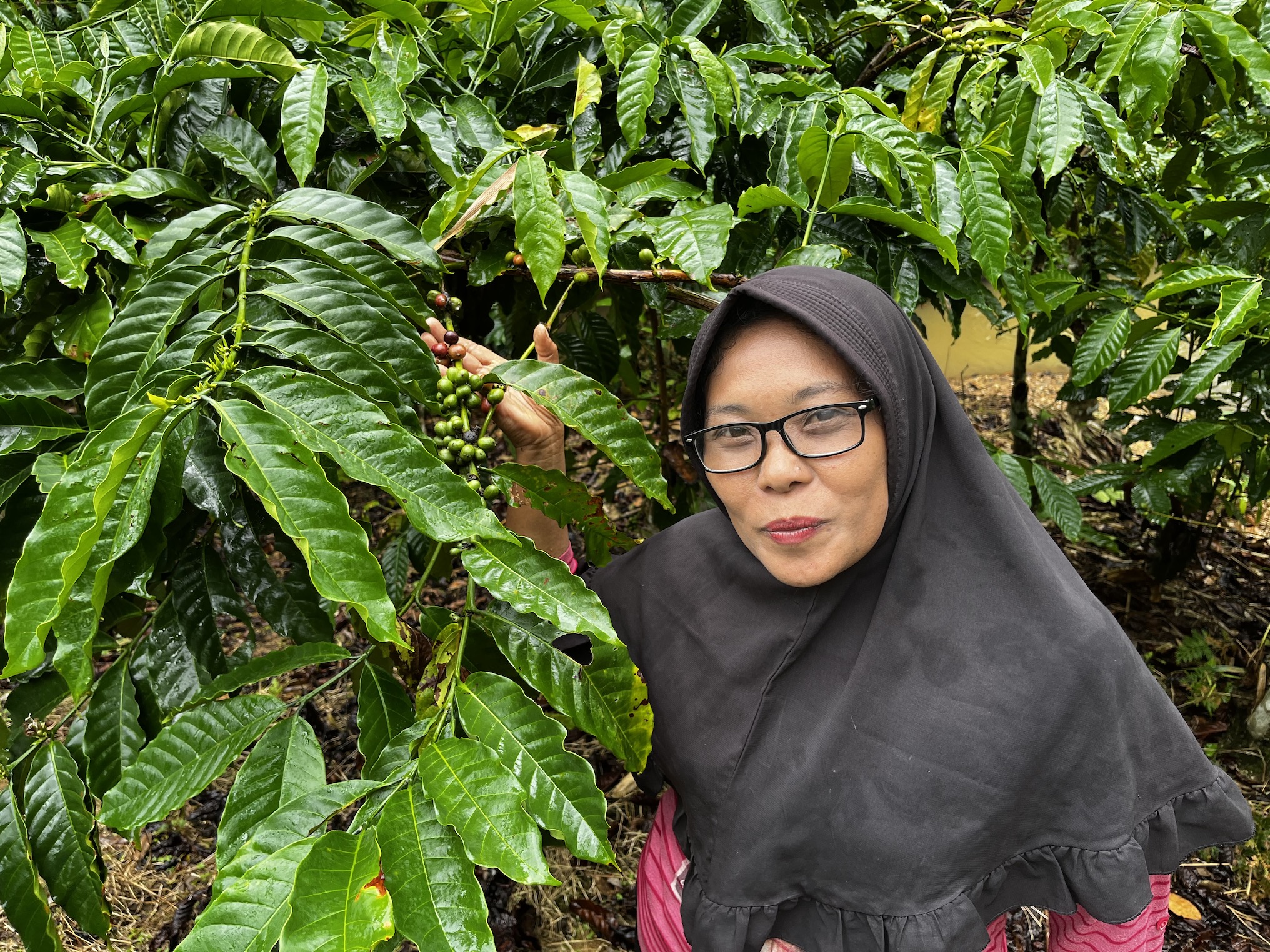
Sri Atmiatun climbs the same uphill path through the Batutegi hills every morning, tending coffee trees that now flourish on land she once thought was lost to the forest. Nearly a decade ago, she left the exhausting work of oil palm plantations in central Sumatra to restore her uncle's neglected plot in the 1,400-hectare Sumber Makmur social forestry area. Now 45, she manages more than three hectares of state-owned forest that she has legal rights to cultivate and care for—a shift that would have been unimaginable in Indonesia just years before.
Sri's story captures something profound happening across the Batutegi forest landscape in Lampung province, southern Sumatra. The 80,000-hectare region, protected since before Indonesia's independence in 1945, faced decades of uncontrolled clearing as farmers rapidly expanded coffee cultivation with few alternatives and little regulation. By the early 2000s, encroachment had become the dominant pattern. Then the government introduced something different: social forestry permits that formalized community cultivation within the forest while imposing sustainable management rules designed to protect ecological function.
The results have been striking in places like Sri's plot and across the broader landscape. Where clearing once seemed inevitable, land is now being restored. Forest edges that were once advancing into protected core areas have stabilized. Native wildlife has safer habitat. Communities like Sri's have gained legal recognition that was previously denied to them—access to government training, private sector support, mentoring, and the institutional resources that had treated them as illegal squatters for generations.
"I stayed because this land feeds us," Sri told researchers in March. "If I leave, who will take care of it?" That sense of stewardship, multiplied across hundreds of farmers in the region, has reshaped Batutegi's trajectory. Rommy Qurniati, a forestry lecturer at the University of Lampung, points to legal recognition itself as the program's fundamental contribution: it replaced the constant threat of eviction with the security of formal rights, enabling families to invest in their land and their future.
The transformation has also opened new economic roles for rural women, whose growing involvement in farming enterprises and community organizations is reshaping local decision-making and economic life in these villages. What was once entirely male-dominated farm work has become a space where women are claiming voice and stake.
Yet the fragility of progress is real. Much of Batutegi's roughly 58,000 hectares has been converted from primary forest to cultivated land, leaving forest cover fragmented rather than continuous. In the early stages of the program, perverse incentives—where only landholders could join farmers' groups—actually encouraged communities to reopen abandoned land that had begun regenerating naturally, so it could be registered for cultivation. Clearing intensified again between 2013 and 2017 as a result.
Today, many farmers' groups with permits still face problems ranging from weak institutional capacity to poor land management practices. Markets remain unstable, farming practices need strengthening, and the pressure to push deeper into the remaining forest hasn't disappeared. Success depends on whether communities can sustain stable livelihoods, local institutions can deepen their capacity, and government support can remain consistent. Sri Atmiatun's morning walk matters precisely because it's part of a larger choice—one that must hold.