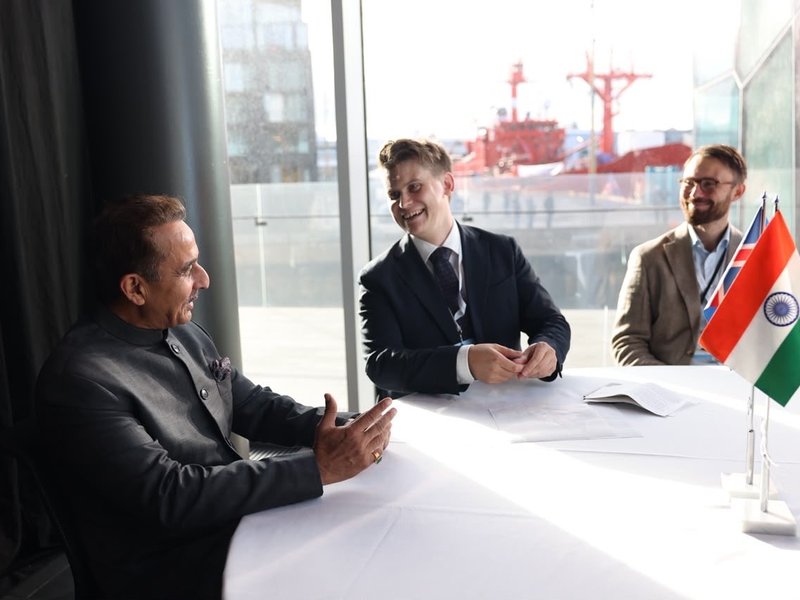
Kirti Vardhan Singh planted an English oak sapling by the quiet shores of Lake Hvaleyrarvatn in Hafnarfjordur, Iceland, its roots taking hold in volcanic soil half a world away from home. The gesture, part of Prime Minister Narendra Modi’s ‘Ek Ped Maa Ke Naam’ initiative, was more than symbolic — it marked a growing green partnership between India and Iceland. During a visit to Reykjavik, Singh, India’s Minister of State for External Affairs and Environment, met with Iceland’s Minister for the Environment, Energy and Climate, Johann Pall Johannsson, to discuss how two nations with vastly different landscapes could share solutions for a cleaner planet.
Climate change doesn’t recognize borders, and neither should innovation. India, now the world’s most populous country, is racing to expand clean energy while lifting millions out of poverty. Iceland, a global leader in geothermal power, runs nearly 100 percent of its electricity and heating on renewable sources. Their meeting opened doors for knowledge sharing, especially in geothermal technology — a field where Iceland’s expertise could help India tap into its own underground heat reserves.
A key moment in the visit was Singh’s tour of the Hellisheioi Power Plant, one of the world’s largest and most advanced geothermal facilities. Nestled near Mount Hengill, the plant harnesses steam from deep within the Earth to generate 303 megawatts of electricity — enough to power over 300,000 homes. The visit offered Indian officials a firsthand look at how volcanic activity, often seen as a hazard, can be transformed into a reliable, low-emission energy source.
The talks also highlighted India’s growing role in Arctic climate research. As an Observer State in the Arctic Council, India is expanding scientific missions in the region, studying everything from melting ice sheets to black carbon pollution. Singh delivered India’s opening statement at the Arctic Circle Assembly, emphasizing a science-first approach to understanding climate impacts that affect not just the far north, but monsoon patterns and coastal communities in South Asia.
This collaboration is still young, but the foundations are forming — through shared projects, plantings, and policy talks. As geothermal pilot projects begin in India’s Himalayan regions, the lessons from Iceland could prove invaluable. And as both nations face the intensifying effects of climate change, their partnership offers a model: small actions, like planting a single tree, can grow into something much larger.