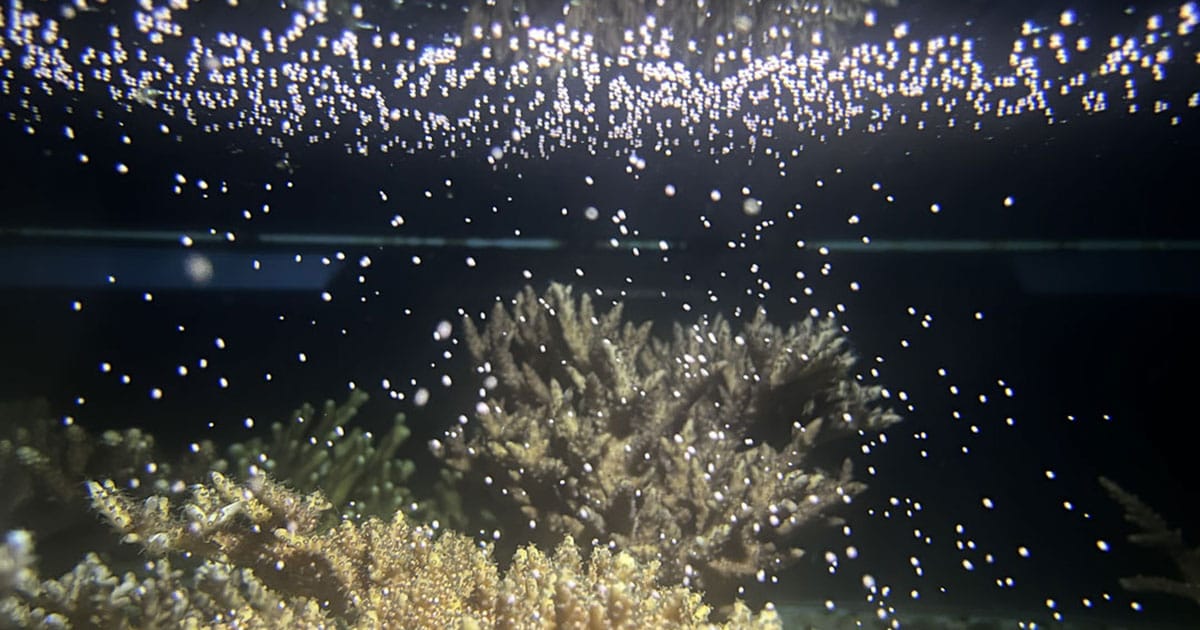
Along the Red Sea coast, the moment coral spawns arrives like clockwork each year—a brief, precious window when millions of eggs and sperm flood the ocean in synchronized bursts. At King Abdullah University of Science and Technology (KAUST), scientists have now learned to harness that moment in controlled laboratory systems, dramatically expanding what's possible for reef research and restoration.
This season, KAUST's team successfully collected and cultivated approximately two million eggs from six coral species, a leap forward for a region where natural coral spawning remains a largely untapped resource. The achievement matters because coral spawning events—when the reef releases its reproductive potential in a single coordinated flush—last only days or even hours in nature. By recreating the conditions that trigger spawning indoors, researchers have opened a new door to understanding and ultimately protecting the Red Sea's ecosystems.
The Red Sea's coral reefs face mounting pressures from warming waters, coastal development, and pollution. Yet they remain among the world's most resilient ecosystems, with unique adaptations shaped by centuries in one of the ocean's harshest environments. Capturing spawning in controlled systems allows scientists to study larval development, genetic diversity, and the conditions that help corals thrive—insights that could prove crucial as reefs face a warming planet.
KAUST's approach represents a shift in marine science strategy. Rather than waiting for nature's narrow window and hoping to catch the event, the team created the right environmental triggers—temperature, light, and chemistry—to encourage coral reproduction on their timeline. This isn't about forcing corals unnaturally; it's about understanding the signals they respond to and replicating them precisely enough that spawning occurs reliably in the lab.
The work carries immediate practical applications. The eggs and larvae produced this season are being used to deepen understanding of coral reproduction and early development. That knowledge feeds directly into restoration programs, where growing new corals from larvae—rather than transplanting fragments—offers the promise of stronger, more genetically diverse reef populations. For a region like the Red Sea, where coral degradation threatens fisheries, tourism, and the livelihoods of millions, this capacity matters enormously.
Six species may sound modest, but each represents a different ecological role on the reef. Corals vary wildly in their growth rates, habitat preferences, and resilience traits. By mastering spawning induction across multiple species simultaneously, KAUST scientists have created flexibility for future work—the ability to choose which species to propagate based on restoration priorities.
The broader significance lies in what this makes possible next. With reliable access to millions of coral eggs and larvae, researchers can run experiments that were previously impossible. They can study how larvae respond to different water temperatures, how genetic variation affects survival, and which traits correlate with resilience. That knowledge, accumulated season by season, could ultimately reshape how the world approaches coral conservation.
For the Red Sea—a body of water that already defies expectations by hosting some of the planet's healthiest reefs despite brutal conditions—KAUST's spawning program represents something hopeful: the moment when human ingenuity amplifies nature's own solutions rather than replacing them.