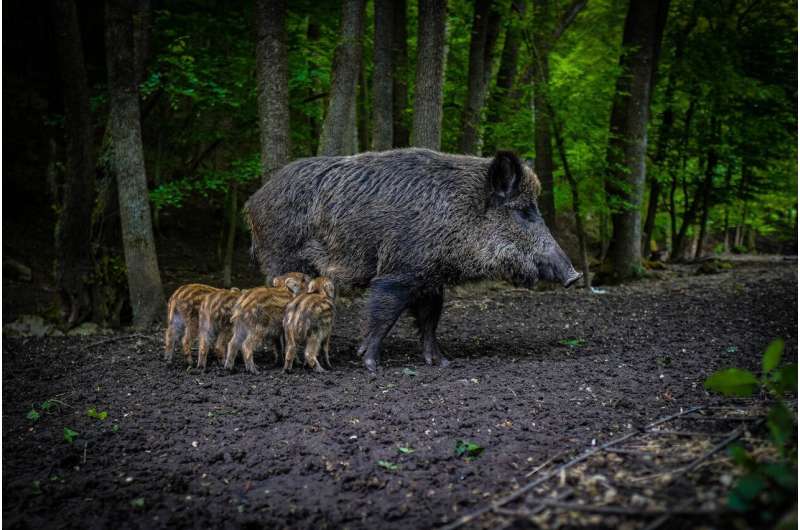
A massive study of over 68,000 forest plots across the eastern United States has upended one of conservation's most stubborn assumptions: that introduced species are inherently more destructive than native ones. Researchers at Aarhus Universitet discovered something counterintuitive—wild pigs, widely branded as one of the world's most problematic invasive mammals, are actually reducing invasive plant species in eastern forests, while native white-tailed deer are doing the opposite.
The findings matter because they challenge how we think about ecological damage and native versus non-native species. For decades, the assumption has been simple: if an animal didn't evolve in a place, it must be harmful. But ecology is messier than that, and this research shows why feeding behavior and functional traits matter far more than a species' passport.
Ming Ni, who led the study published in Proceedings of the Royal Society B, found a striking pattern. Areas with high numbers of wild pigs—a category that includes feral pigs, wild boars, and their mixes—showed lower abundance and lower species richness of invasive plants in forest understories. Native white-tailed deer told a different story: they were associated with higher invasive plant abundance and diversity, while simultaneously reducing native tree seedlings. The contrast is stark because the two species forage so differently. Deer are picky eaters, selectively browsing foliage and seedlings of certain species. Wild pigs are omnivorous foragers that root through soil searching for roots, plants, and other food sources.
That rooting behavior may be the key. "One possible explanation is that pigs' rooting behavior and broad diet may disadvantage some invasive plants, but this mechanism requires further testing," Ni notes. What matters is that the ecological impact cannot be read from a species' origin alone. The study drew on data from over 32,000 forest plots for pigs and involved information from Snapshot U.S. 2021, the largest annual national mammal camera-trap survey in the United States.
The researchers emphasize that context shaped everything. Climate, topography, and human influence all played important roles in determining how strongly the animals affected forest ecosystems. This contextualization is crucial because it rejects simplistic blanket policies in favor of evidence-based understanding.
Jens-Christian Svenning, senior author and director of the Center for Ecological Dynamics in a Novel Biosphere at Aarhus Universitet, sees the implications extending far beyond North America. "A species' impact on ecosystems does not mainly depend on whether it is native or non-native, but on what it actually does in nature." In Europe, wild boars—the native cousins of feral pigs in North America—are at the center of heated debates over growing populations and agricultural damage. This research suggests those conversations need rethinking too.
The study adds vital nuance to a debate that has historically been dominated by the logic of exclusion. Rather than assuming all introduced species are villains and all native species are heroes, the evidence suggests we need more sophisticated, case-by-case approaches to ecosystem management. As human-changed landscapes become the global norm, understanding what animals actually do—not where they came from—becomes essential for protecting forests and the biodiversity they contain.