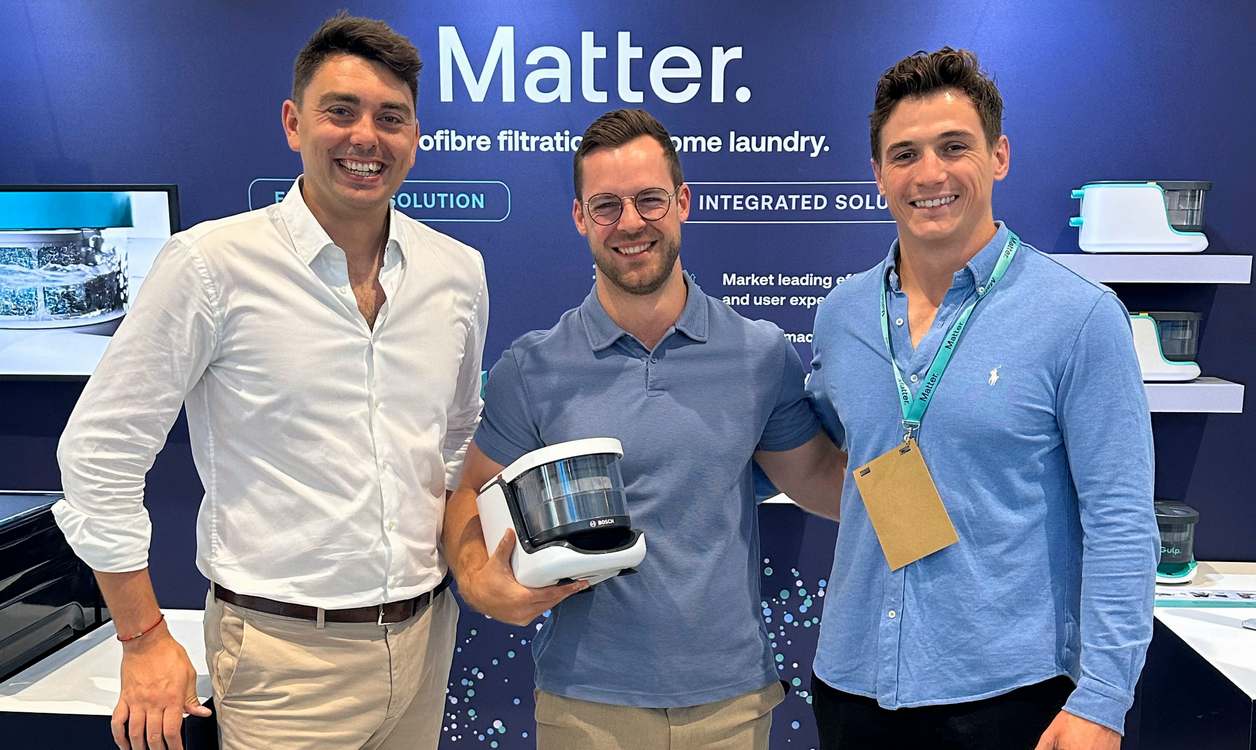
Adam Root's kitchen-appliance-sized device hooks onto a home washing machine with a deceptively simple promise: stop microplastics before they ever reach the ocean. Since launching in June, the filter has already captured 4.6 tons of microfibers—a tangible victory in what scientists now recognize as one of the world's most pressing public health threats.
Microplastics have infiltrated every human organ and tissue, from the brain to the placenta, yet their full health consequences remain unknown. What researchers have established is troubling enough: these particles dysregulate hormones and are linked to stunted growth, reduced fertility, and damage to the stomach, kidney, and liver. While plastic bottles command public attention, the real culprit is microfibers shed from artificial clothing and textiles—and every single load of laundry releases roughly one gram of these fossil-fuel-based filaments into the sewage system, eventually reaching rivers and oceans.
The inventor behind the breakthrough is Adam Root, an English engineer whose partnership with German manufacturing giants Bosch and Siemens has transformed a garage-scale solution into industrial-scale action. The home device carries a $250 price tag—a commitment for eco-conscious households—but Root and his company, Matter Industries, recognized early that asking millions of households to purchase filters would never rival the impact of tackling the problem at its source: textile factories.
"The most common thing we hear is: 'I cannot believe how much material is coming out of the washing machine,'" Root told the Guardian. "Somebody sent me [photos of] dinner-platefuls." That visceral testimony mirrors the scale of industrial operations, where the dyeing and washing processes alone release 360 metric tons of microfibers annually from a single factory. These operations represent prime intervention points—far more efficient than waiting for consumer adoption.
Matter Industries hasn't waited for slow policy changes either. With $20 million in fundraising already secured, Root has pursued a three-pronged strategy: equipping homes that can afford the investment, retrofitting industrial textile plants where the volume justifies the technology, and campaigning in the UK to install filtration devices at wastewater treatment plants to capture fibers from household machines at the point of discharge. The approach bypasses the stalled waiting game of mass consumer adoption and strikes at the infrastructure level.
Beyond the microplastics themselves, Root's filter captures synthetic dyes and chemicals released during washing—compounds that pose their own risks to human biology and aquatic ecosystems. The self-cleaning, filterless design means less maintenance and less waste compared to traditional capture methods. In 2025, Matter Industries finished as a finalist for the prestigious Earthshot Prize, recognition that the solution addresses both the scale and urgency of the problem.
The numbers matter. Four and a half tons of microfibers captured since June signals genuine momentum, but the math also reveals what's possible: if industrial adoption accelerates, the prevention opportunity dwarfs what home devices alone could ever achieve. Root's path forward suggests a lesson increasingly clear across environmental innovation—the biggest impact often comes not from asking individuals to change, but from redesigning the systems where the damage originates.