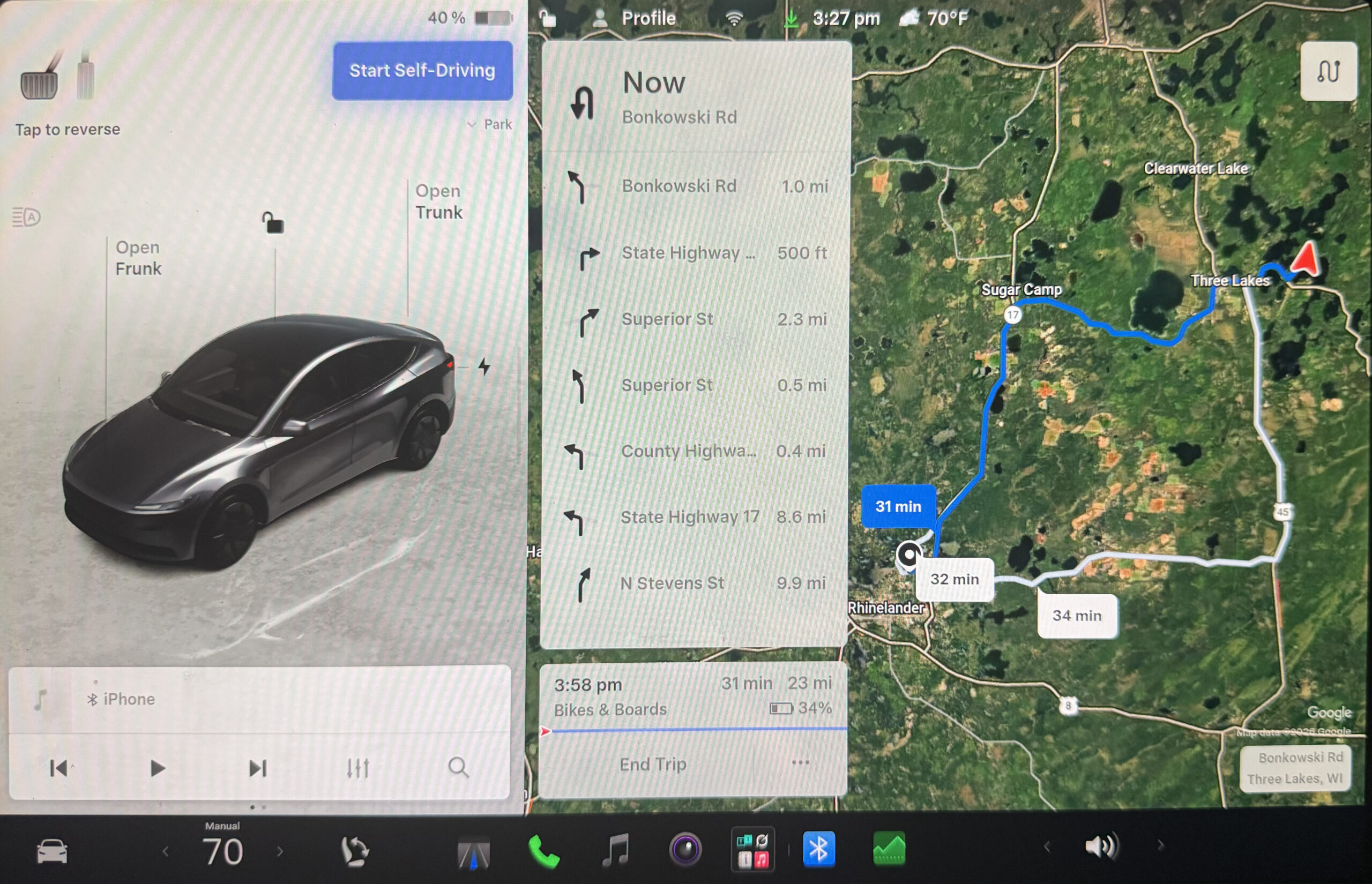
The evening light slants across Camp Hasler in Three Lakes, Wisconsin, where Fritz Hasler plugs his 2026 Tesla Model Y into his home charger and watches the progress of Full Self Driving V14 on the navigation screen. It's a ritual the retired NASA scientist has performed for years—but now, something feels different. After nearly a decade of watching autonomous driving technology evolve from clunky interstate-only assistance into something that handles nearly every road in America, Hasler has a verdict: $99 a month is a fair price for the future of transportation.
"I've been kind of a techno nerd since I was 17," Hasler writes, tracing a path from a Bolex film camera in 1957 to his current role as an EV evangelist who leased a Nissan Leaf in 2014 for $200 a month and never looked back. When he bought his first Tesla Model 3 in fall 2019, he paid $6,000 upfront for permanent FSD access—money he scraped together by refinancing his house at 3.5% interest. He kept that car for 78 months, meaning his FSD cost him roughly $77 per month in hindsight.
Tesla has since discontinued permanent FSD licenses, moving everyone to the $99 monthly subscription model. For those who paid $8,000 upfront, Hasler calculates they'll need to hold onto their cars for more than six and a half years to come out ahead financially. The subscription democratizes access: new buyers no longer need to budget thousands upfront to experience the technology.
The gap between old and new is stark. Hasler's previous Model 3 ran FSD V12 on older HW3 hardware, a dead end that left him watching enviously as HW4-equipped vehicles received the far more capable V14 update. His rental Toyota Corolla offered a jarring contrast—generating what he describes as a "surprisingly limited" automation package compared to what he'd grown accustomed to. One evening, he returned to find the combustion engine had been running for 30 minutes, a small but telling reminder of how differently electric vehicles approach operation.
The new Model Y with HW4 and FSD V14 represents the culmination of that evolution. Tesla introduced innovations in 2015 and 2018—the phone-as-keyfob that unlocks doors automatically, the engine that never needs starting or stopping—that once seemed like science fiction. Now they're simply how the car behaves.
For Hasler, the question of value comes down to perspective. Having lived through every iteration of the technology, he argues that $99 a month for a system that can navigate nearly any American road represents genuine progress—technology that started as a luxury for early adopters and is now accessible to anyone with a monthly subscription and a Tesla in the driveway.