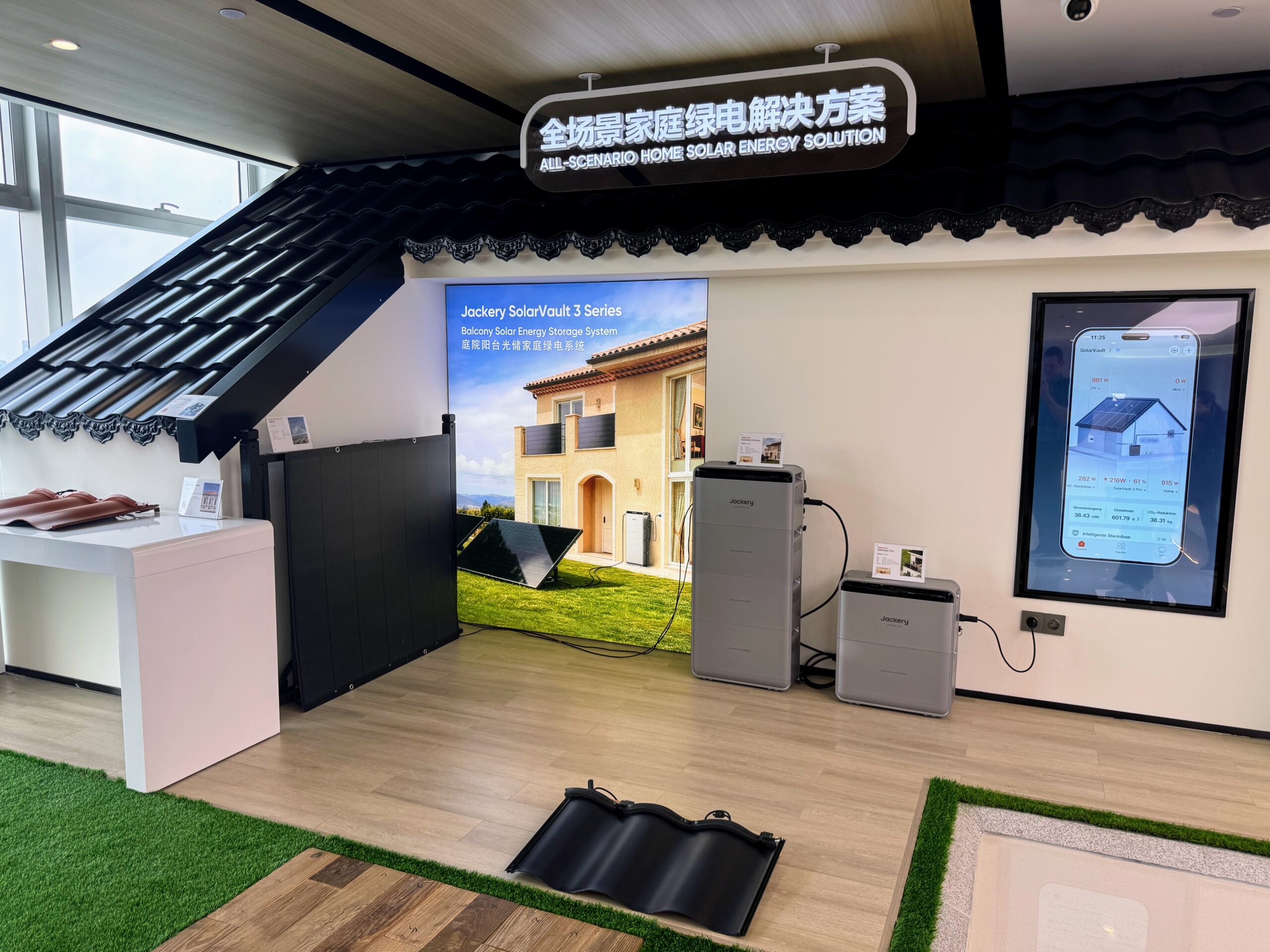
Kyle Field stood on a single Jackery solar roof tile in Shenzhen, bounced on it, and walked away with nothing broken — not the tile, not his dignity. That moment, equal parts absurd and revealing, captures the ambition behind Jackery’s new Solar Roof: a tile that doesn’t just generate power, but endures life. Unveiled at the company’s headquarters in Shenzhen, China, this dual-purpose innovation marks Jackery’s boldest step yet beyond portable power stations into integrated home energy systems. In a world where climate resilience demands smarter buildings, the ability to merge durability with clean energy generation isn’t just convenient — it’s essential.
The Solar Roof tiles, modeled after traditional terracotta, come in sleek black and warm orange, blending into architectural styles from Mediterranean villas to historic Chinese homes. Each black tile produces 45 watts, the orange 38 watts, and together they achieve a rated 25% efficiency. At 0.31 square meters per panel, that translates to about 145 watts per square meter. Priced at 3,980 RMB ($600) per square meter, the system comes in at roughly $4.14 per watt — not as cheap as conventional solar panels, but justified by the added value of a weatherproof, load-bearing roof. Unlike glass-based competitors, including Tesla’s version, Jackery’s tiles showed minimal flex under Kyle’s full weight, a testament to their rugged engineering.
Complementing the roof is the SolarVault 3, a modular home battery system launched in April. Built with LiFePO4 chemistry — known for its thermal stability and long lifespan — it starts at 2.5 kWh and scales up to 15 kWh in stackable units, like energy LEGO blocks. The system comes in three versions: the Pro (1,200 W output), the Pro Max (2,500 W), and the Pro Max AC, designed for retrofitting existing solar setups. With no built-in MPPT trackers, the AC model focuses on simplicity, integrating seamlessly into homes already generating solar power.
Still, challenges remain. The curved design of the tiles limits optimal sun exposure, and roof orientation locks in energy potential — a trade-off inherent to solar roofs. Yet for new construction, especially in regions prioritizing aesthetics and resilience, Jackery’s system offers a compelling package. As homes become power stations, the line between shelter and infrastructure blurs. Jackery isn’t just selling energy tech — it’s reimagining the roof as a living, breathing part of the clean energy ecosystem.
With solar adoption accelerating globally, solutions that combine affordability, durability, and design will shape the next decade of decarbonization. Jackery’s Solar Roof and SolarVault 3 may not be perfect, but they’re a bold signal: the future of energy is built into the walls — and roofs — around us.