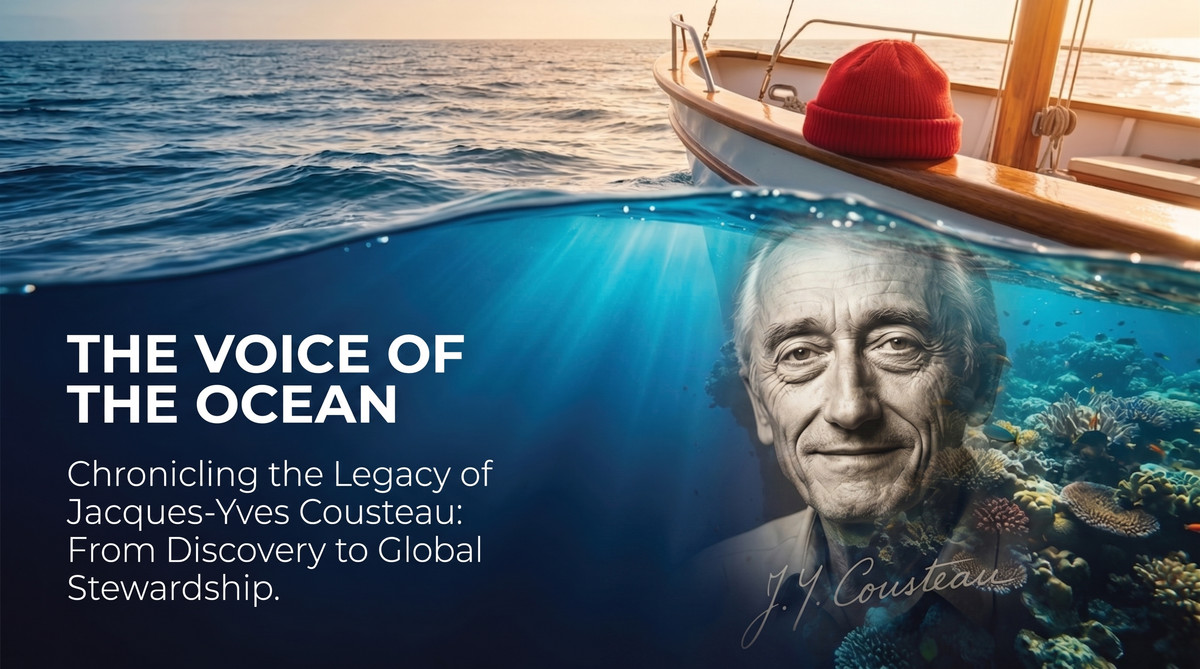
On June 11, 1910, in the small French town of Saint-André-de-Cubzac, a boy was born who would spend the next 87 years giving voice to a world most humans would never see. Jacques-Yves Cousteau was supposed to touch the sky—he trained as a naval aviator with every advantage of a privileged life. At 26, a violent car accident shattered both arms and ended that dream in an instant. But his doctors' prescription—daily swimming in the Mediterranean Sea—became the greatest gift the ocean could have received.
The accident forced Cousteau to solve a simple problem: saltwater stung his eyes. From that frustration came his first pair of underwater goggles, and with them, a glimpse of an alien world that would consume the rest of his life. By 1943, working with engineer Émile Gagnan, Cousteau had invented something far more revolutionary than goggles. The Aqua-Lung used a demand regulator to deliver compressed air only when a diver inhaled, finally freeing humans from the brass helmets and tethering surface hoses that had kept them earthbound. For the first time, divers could hover silently alongside fish, move freely in three dimensions, and actually observe the creatures they encountered. The sky had lost him, but the ocean had found its prophet.
Everything changed when philanthropist Loël Guinness leased Cousteau a wooden-hulled former minesweeper called the Calypso—for just one pound sterling per year. Over four decades, this floating laboratory traversed 155,000 miles, effectively mapping the unseen world. Cousteau equipped the Calypso with innovations ahead of its time: an observation bow that allowed continuous filming of marine life in motion, the SP-350 Denise, a two-person diving saucer capable of reaching depths of 300 meters, and even a helicopter pad for surveying reef structures from above. But the Calypso was just the beginning.
Cousteau didn't want to merely visit the ocean—he wanted humans to inhabit it. Through the legendary Conshelf missions, he proved it was possible. In 1962, a team lived for seven days inside a submerged steel cylinder called Diogenes at just 10 meters depth. By 1963, Conshelf II deployed an entire "Starfish House" in the Red Sea, where oceanauts lived for 30 days with a submarine garage and working laboratory. The final test came in 1965, when six oceanauts, including Cousteau's own son Philippe, survived 22 days at 100 meters depth while breathing a specialized helium-oxygen mixture. These weren't stunts—they were proof that humanity's relationship with the sea could be radically reimagined.
What made Cousteau immortal, though, was how he shared these discoveries. His films brought the underwater world into living rooms across the globe at a time when the deep sea was merely a dark mystery. He didn't just explore the ocean; he made people care about it, decades before the world understood climate change or ocean acidification. The technologies he pioneered, the warnings he issued, and the sense of wonder he cultivated remain more urgent today than ever. A boy who lost his wings found an entire world instead—and taught humanity to see it as his own.