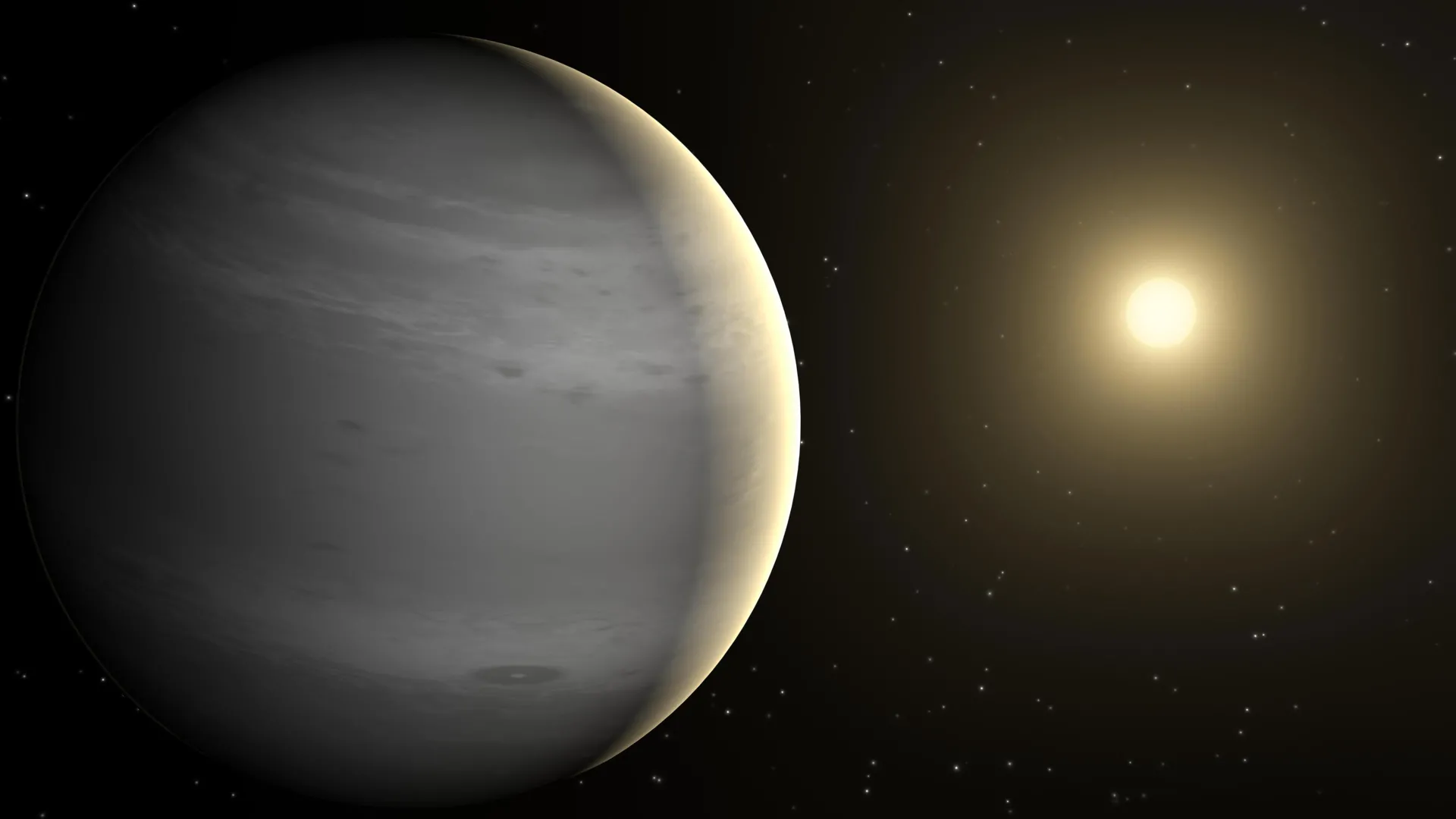
On a star 330 light-years from Earth, astronomers have found a gas giant that breaks all the rules—a world so perfectly temperate it might as well live in perpetual spring. TOI-199b, a Saturn-sized planet discovered through NASA's James Webb Space Telescope, orbits in the Goldilocks zone of planetary conditions, with atmospheric temperatures around 175 degrees Fahrenheit. While that would cook any living thing on Earth instantly, it represents an extraordinary rarity: a giant planet that is neither frozen solid like Jupiter and Saturn, nor scorched like the thousands of "hot Jupiters" that researchers have catalogued in recent decades.
This discovery matters because giant planets shouldn't exist in the middle ground. Everything astronomers have learned about planetary formation suggested they should cluster at the extremes—either orbiting so close to their stars that they become infernos, or floating so far away that they become frozen wastelands. TOI-199b shatters that assumption. It is one of only a small handful of known temperate giant planets, and more importantly, it is the first whose atmosphere has ever been studied in detail.
Led by Renyu Hu, an associate professor of astronomy at Penn State, along with researchers from NASA's Jet Propulsion Laboratory, the team used a technique called transmission spectroscopy to peer into TOI-199b's composition. As the planet crosses in front of its star from Earth's perspective, starlight passes through its atmosphere, leaving fingerprints in the light that reveal what gases are present. During approximately seven continuous hours of observation—much longer than the brief transits of hot Jupiters—JWST separated the starlight into wavelengths like a prism creating a rainbow. Different gases absorbed different colors, betraying their presence. The findings, published in the Astronomical Journal on May 20, confirmed what models had long predicted: methane fills the atmosphere of temperate giant planets. The observations also hinted at ammonia and carbon dioxide.
What makes this work genuinely transformative is its implications for how we understand planet formation itself. Aaron Bello-Arufe, a JPL postdoctoral researcher and lead author of the paper, explained that detecting methane confirmed decades of theoretical work. "Specific elements will absorb specific wavelengths of light, creating a fingerprint in the spectrum of light that JWST detects that reflects the atmosphere's composition," he said—a simple statement carrying enormous weight. Every new exoplanet helps refine our models of how planetary systems emerge and evolve. TOI-199b, sitting between the extremes we thought were inevitable, forces those models to expand.
The study builds on decades of discovery. Since the first exoplanet was identified in 1992 by a team that included Penn State's Aleksander Wolszczan, astronomers have catalogued thousands of distant worlds. Yet TOI-199b represents a new frontier: a temperate world whose atmosphere we can finally read clearly. As Hu emphasized, this success "gives us confidence to dedicate more resources" to studying similar planets—and potentially to understanding how Earth's own atmosphere formed and evolved. Future observations of TOI-199b could map the exact proportions of methane, ammonia, and other gases, painting an ever-clearer portrait of how worlds like ours come to be.