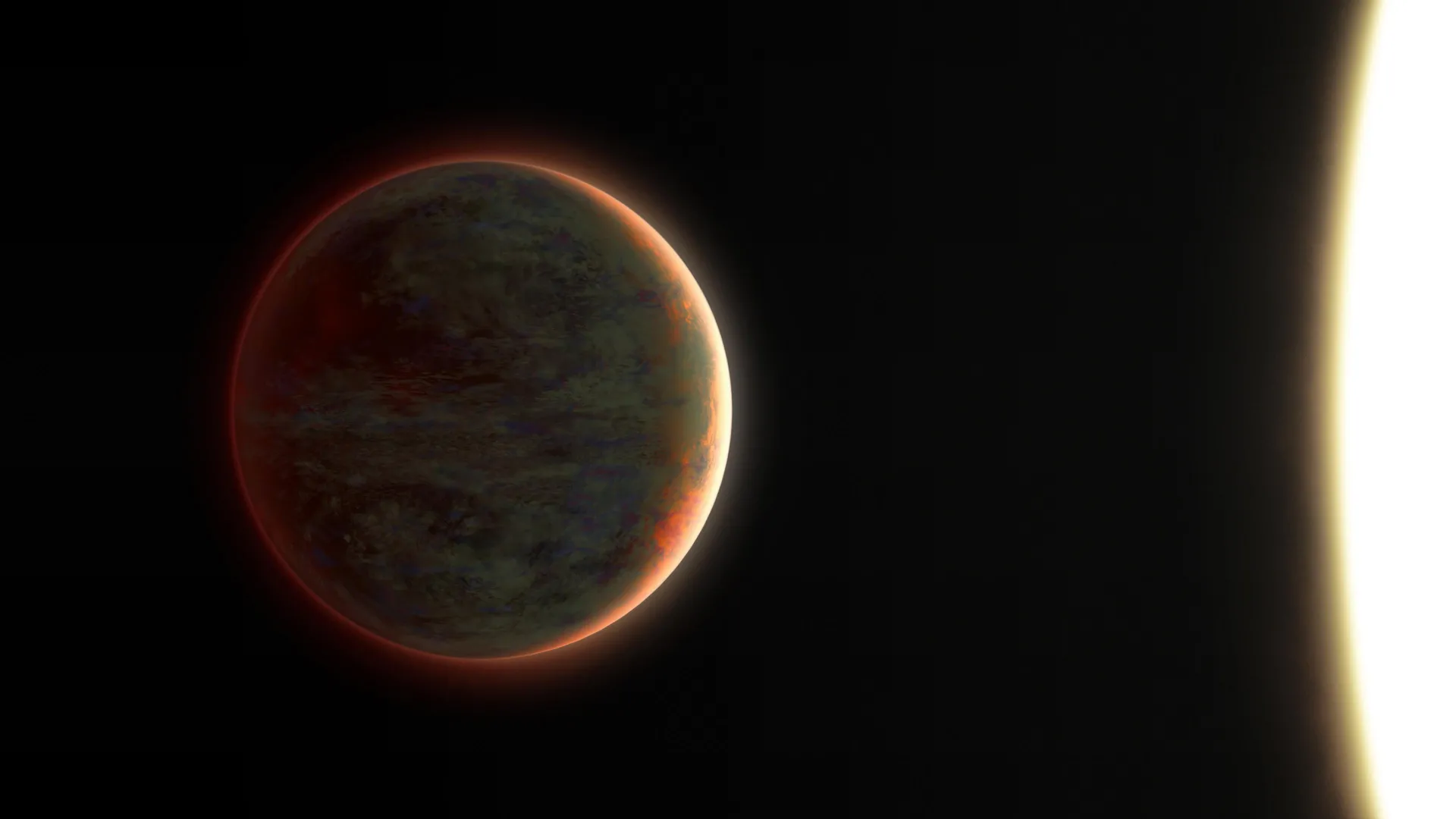
On an alien world 1,300 light-years away, sunrise and sunset operate under completely different rules. The James Webb Space Telescope has just revealed that the ultra-hot exoplanet WASP-121 b has strikingly different atmospheric conditions on its morning and evening horizons—a discovery that transforms theoretical predictions into concrete evidence of how extreme worlds actually work.
WASP-121 b belongs to a peculiar class of planets locked in a gravitational embrace with their host stars. Over time, tidal forces have synchronized the planet's rotation with its orbit, meaning one hemisphere faces the star permanently while the other bakes in eternal darkness. The result is two extreme sides: a day hemisphere roasting at nearly 2,500 degrees Celsius and a night hemisphere hovering around 725 degrees Celsius. Between these two realms lie the terminators—the twilight zones where dawn and dusk meet.
By measuring how starlight filtered through the planet's atmosphere during transit, astronomers led by Cyril Gapp at the Max Planck Institute for Astronomy discovered that the evening terminator absorbs significantly more light than the morning terminator. The explanation lies in ferocious winds. Powerful atmospheric currents transport heat eastward across the planet, in the same direction as its rotation, causing the evening side to heat up more intensely than the dawn side. As temperatures rise, the atmosphere expands, presenting a larger target to incoming starlight and absorbing more radiation in the process.
The JWST's near-infrared spectrograph revealed even finer details: carbon monoxide signals grew stronger toward the end of the transit, a change driven by temperature rather than actual differences in gas abundance. Water, however, told a different story. The observations suggest water molecules become genuinely less abundant in the hotter atmospheric regions—a finding that provides powerful confirmation of the temperature asymmetry. At those extreme temperatures in the upper atmosphere, water molecules break apart into their constituent elements, a process that only occurs where the wind-driven heating is most intense.
This precise atmospheric mapping was only possible because WASP-121 b rotates roughly 30 degrees during each transit of its star, allowing astronomers to glimpse different longitudes with remarkable precision. Rather than averaging all measurements together as astronomers typically do, Gapp's team allowed the signal to vary as the planet rotated. Statistical analysis showed this approach matched observations significantly better, providing robust evidence that these atmospheric differences are genuinely real and not artifacts of measurement.
The findings matter because they move our understanding of extreme exoplanets from the realm of computer models into observational reality. WASP-121 b's permanent day-night split represents an alien atmospheric system without parallel on Earth, yet the physics driving it—wind patterns, thermal expansion, molecular dissociation—are universal. By observing how heat-driven winds create these striking asymmetries between dawn and dusk, astronomers gain crucial insights into how planetary atmospheres behave under conditions far more extreme than anything in our solar system. The telescope's unprecedented observational quality is opening a new era in which the distant and the alien become precisely known.