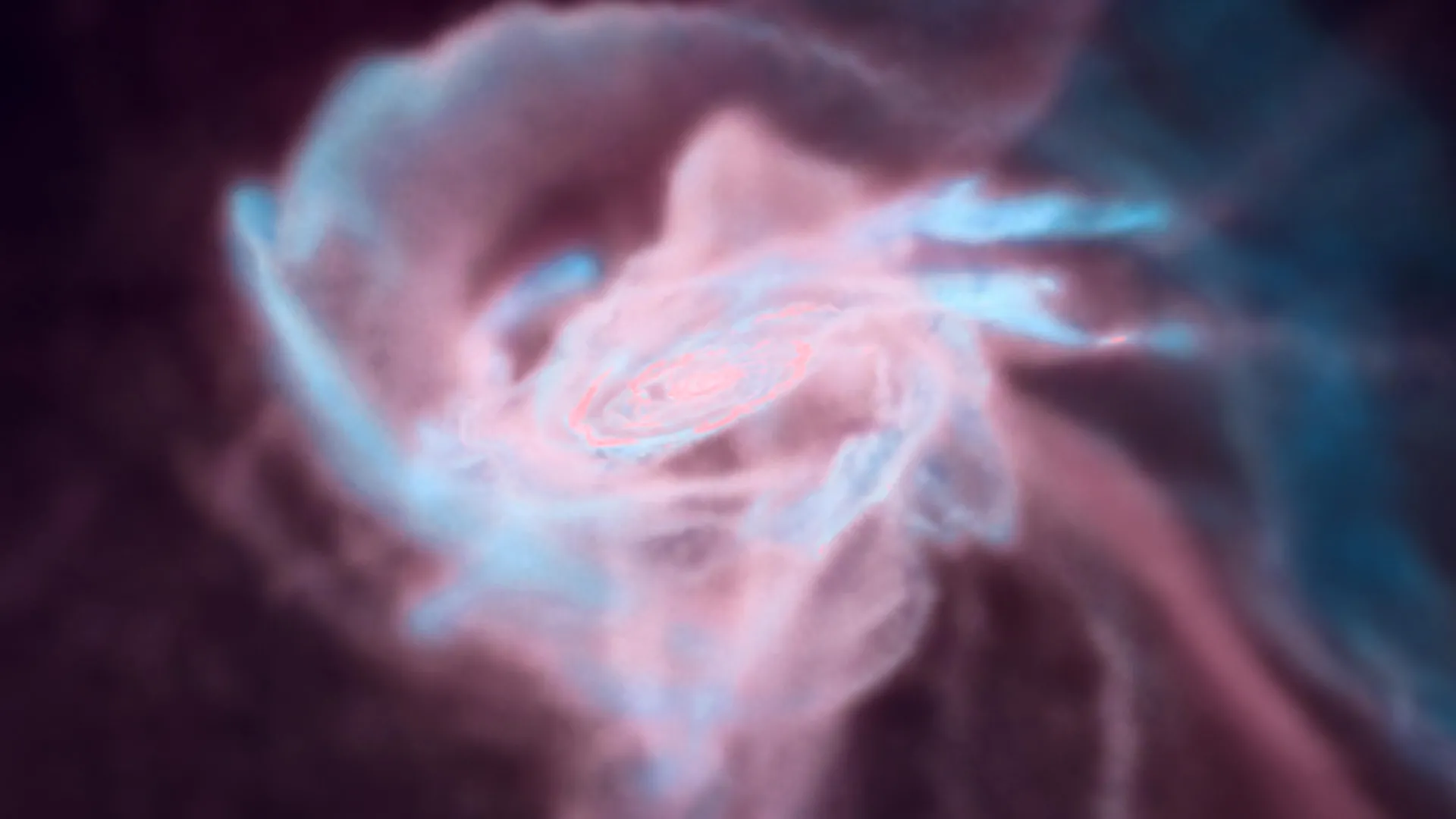
Somewhere deep in space, there are tiny red blips. To most of us they'd look like nothing at all — just faint specks of crimson against the dark. But to astronomers, these "Little Red Dots" have been one of the strangest mysteries the James Webb Space Telescope (JWST) has ever uncovered. Now, new simulations run on Japan's mighty ATERUI III supercomputer suggest these little dots may be something spectacular: black holes growing at speeds our Universe no longer allows.
The mystery began when JWST started peering farther back in time than any telescope before it. Because light takes time to travel, looking very far away is the same as looking into the past. So when astronomers observed these tiny red objects, they were seeing the Universe as it looked less than 600 million years after the Big Bang — a staggeringly young cosmos where black holes with millions or even billions of times the Sun's mass somehow already existed.
For years, scientists have struggled to explain how such enormous black holes could appear so early. JWST was supposed to help solve the puzzle. Instead, it revealed something nobody expected: a whole population of Little Red Dots, so common that they've become a headline feature of the telescope's discoveries.
The new work, led by Sunmyon Chon of the Max Planck Institute for Astrophysics, took on the task of explaining them. Using the ATERUI III supercomputer at the National Astronomical Observatory of Japan, the team built some of the most detailed simulations yet of the early Universe. They started at the scale of a young galaxy and zoomed in, region by region, until they reached individual clouds of gas.
What they found didn't require any exotic physics or lucky accidents. In the young cosmos, intense far-ultraviolet light from nearby galaxies could stop ordinary stars from forming inside certain gas clouds. Instead of splitting apart into many small stars, the gas collapsed into a single supermassive star — a star so enormous it then collapsed into a black hole seed.
Once formed, these seeds found themselves wrapped in thick disks of dense gas. That gas trapped radiation and let the black holes swallow material far more efficiently than any black hole can today. Under these conditions, they grew dozens of times faster than is possible in the modern Universe.
The simulated black holes look remarkably like the Little Red Dots JWST actually sees — which suggests these crimson specks may be an early stage of explosively fast black hole growth. And because such conditions developed naturally and commonly, it helps explain why the Little Red Dots are so widespread.
As JWST keeps finding more, and future telescopes peer even deeper into cosmic history, this model gives astronomers a valuable map for understanding how the Universe's earliest black holes formed, grew, and helped shape everything that came after.