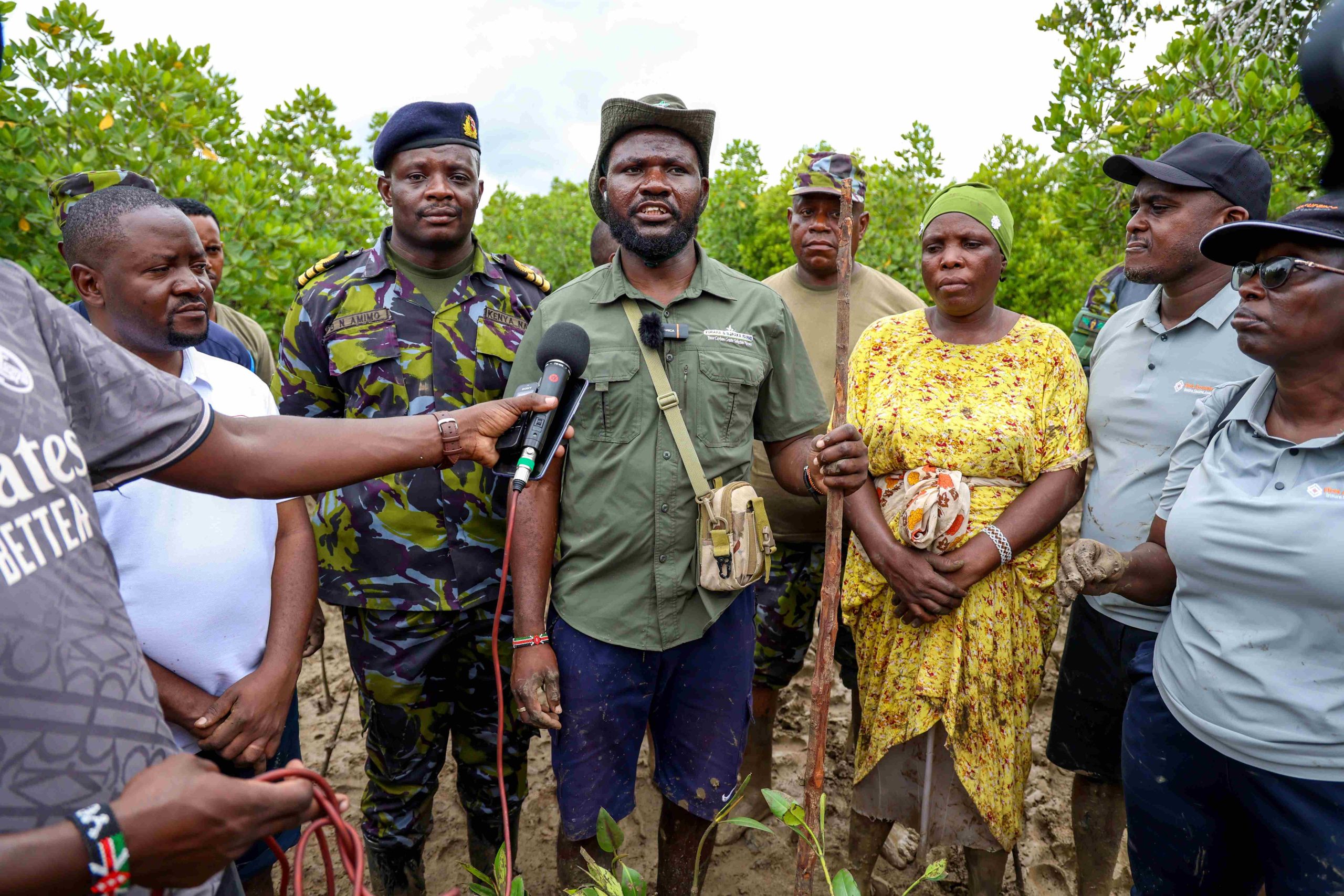
Along a 4,500-acre stretch of coastal Kenya in Tsunza, Kwale County, the Kenya Navy is quietly orchestrating one of the region's largest mangrove restoration efforts—a project that has already brought three million seedlings into the ground and drawn unlikely partners into the same mission: banks, insurance companies, and fishing communities working side by side.
The scale is significant. Kenya's defence forces have been tasked by President William Ruto with spearheading the country's ambitious 15-billion-tree reforestation target by 2032, and the Kenya Navy has made coastal restoration its priority. To date, 3.2 million trees—mangroves, indigenous species, and fruit trees—have been planted, with a target of eight million for the 2025-26 financial year alone. On a recent Tuesday, the Navy joined Furaha and Baraka Farms, Absa Bank, and First Assurance to plant 10,000 mangrove seedlings, a single day that reflected months of collaborative work.
Why mangroves? Lieutenant Colonel Boniface Amimo, who oversees the Navy's efforts, points to their ecological irreplaceability: they serve as fish breeding grounds, anchor marine biodiversity, and absorb carbon more effectively than almost any other tree species. "Mangroves also help the marine ecosystem where we are heavily invested," he explained, noting that protection and restoration remain the Navy's core commitment. James Sakwa, corporate communications officer for Furaha and Baraka Farms, emphasizes this carbon advantage: mangroves are among the most effective trees for climate change mitigation, absorbing more carbon than conventional forest species.
But the story extends beyond environmental science into economics and community resilience. Residents of Tsunza, including a woman named Khadija Kodi, have turned mangrove restoration into a livelihood. "We plant and sell the seedlings that these people come and buy from us," she said. "We then use the money to educate our children and feed our families." This model—where conservation partners purchase seedlings directly from local growers—transforms environmental restoration into an income stream, threading economic opportunity through ecological necessity.
The partnerships powering this work are equally notable. Absa Life Assurance has scaled its commitment from 10,000 trees last year to 50,000 this year, with a five-year target of 1.5 million mangroves across coastal areas. First Assurance has set a two-million-tree target. Both companies frame their investment in climate terms: as atmospheric carbon levels rise, capturing and sequestering it becomes a matter of breathing clean air. Absa's Brian Khamadi made the logic plain: "We are trying to capture as much carbon as possible so as to maintain clean and quality air for people to breathe."
The ambition extends beyond what's been planted. Sakwa noted that the Tsunza site still has space for another 30 million trees—enough to cover the entire restoration zone. This potential reflects not just a single project but a model that, if scaled, could reshape coastal ecosystems across East Africa. Yet it also depends on a shift in behavior. Sakwa warned against indiscriminate tree felling and deforestation, linking it directly to the urban flooding that affects entire regions regardless of who felled the trees. "The floods affect everyone. They do not choose only those who fell the trees," he said.
The Kenya Navy's commitment to this work signals something broader: that climate action and ecological restoration, when properly resourced and locally rooted, can serve multiple purposes at once—protecting marine life, storing carbon, creating livelihoods, and building resilience against environmental collapse.