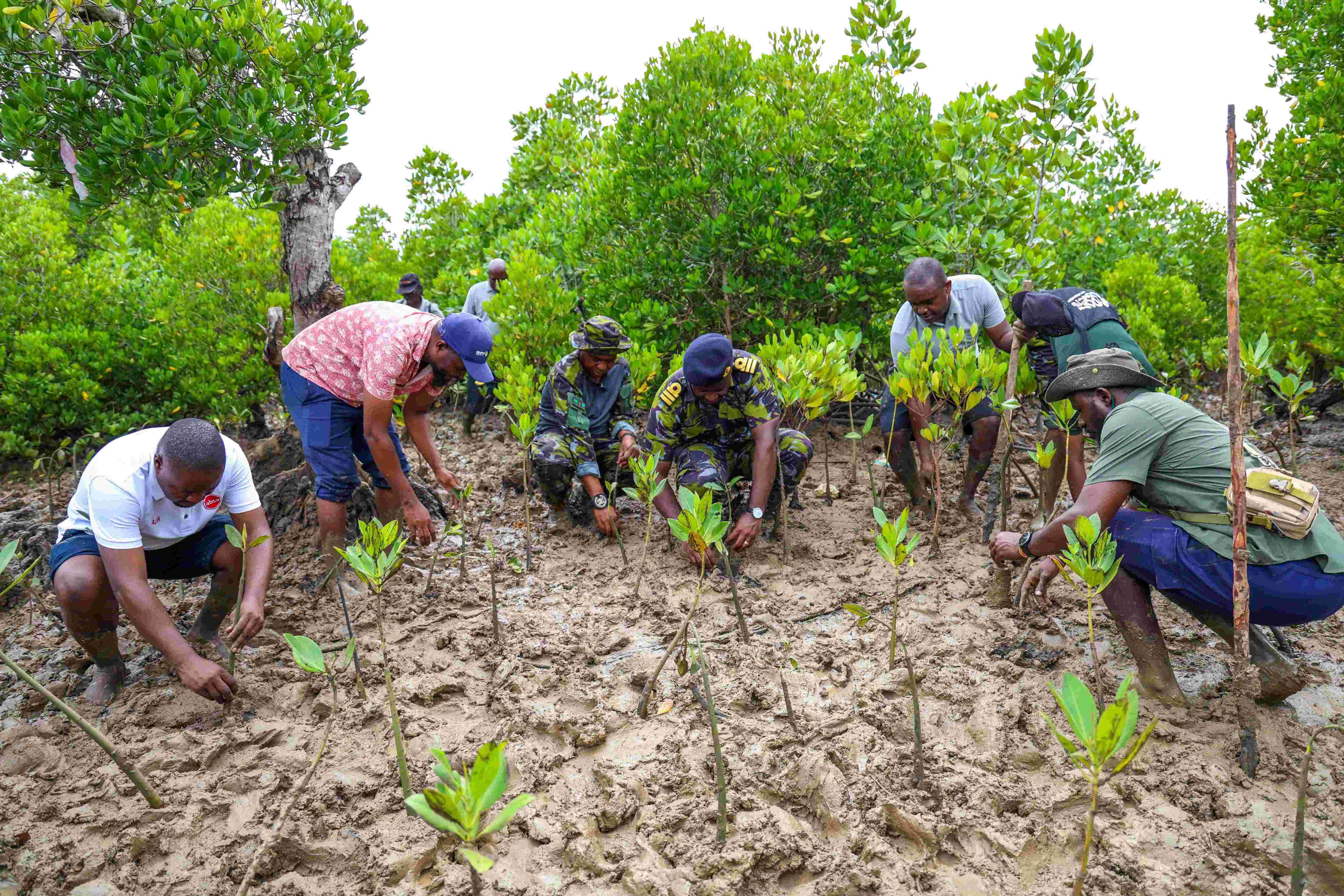
On a Tuesday morning in Tsunza, Kwale County, Lieutenant Colonel Boniface Amimo of the Kenya Navy knelt to press a mangrove seedling into the coastal soil, joining corporate partners and local residents in a planting session that would see 10,000 new trees take root. This single act reflects a much larger transformation unfolding along Kenya's coast—one where the military, private sector, and community members are working together to restore some of the ocean's most vital ecosystems.
The Kenya Navy has emerged as the unexpected leader of a national reforestation push, tasked by President William Ruto to help deliver the government's ambitious target of 15 billion trees by 2032. In just two years, the Navy and its partners have already planted nearly 3.2 million trees along the coast, with mangroves forming the ecological backbone of their efforts. The scale of ambition is striking: the Tsunza restoration site alone spans an estimated 4,500 acres, and partners envision planting another 30 million trees there to complete the landscape rehabilitation.
Mangroves are not chosen arbitrarily. These salt-tolerant trees function as the ocean's nursery, providing breeding grounds for fish and supporting the regeneration of entire marine ecosystems. According to James Sakwa of Furaha and Baraka Farms, they also possess an outsized role in climate action—mangroves absorb carbon more effectively than almost any other tree species, making them critical weapons against atmospheric warming. Lieutenant Colonel Amimo emphasized this dual purpose: "Mangroves are also a source of livelihoods, especially for communities that harvest seedlings."
This emphasis on community benefit distinguishes the initiative from top-down conservation efforts. Resident Khadija Kodi of Tsunza speaks to a transformation that ripples through daily life: "We plant and sell the seedlings that these people come and buy from us. We then use the money to educate our children and feed our families." By purchasing seedlings directly from locals, companies like Absa Life Assurance create income streams linked to conservation, turning environmental restoration into economic opportunity.
The corporate commitment has deepened substantially. Absa Life Assurance planted 10,000 trees last year and 50,000 this year, with plans to establish 1.5 million mangrove trees across Tsunza and other coastal areas over the next five years. First Assurance has committed to planting at least two million trees along the coast. These figures suggest that private-sector investment in reforestation is becoming part of standard corporate practice rather than peripheral philanthropy.
Yet the initiative carries an implicit warning. James Sakwa linked deforestation directly to urban flooding, noting that environmental destruction affects everyone indiscriminately. He called for stakeholders to reject indiscriminate tree-felling and embrace alternatives—noting that trees naturally shed usable wood without requiring destruction. The Navy's target for the 2025-26 financial year alone is eight million trees, underscoring the scale of planting needed to reverse decades of coastal degradation.
As Khadija Kodi and thousands like her continue to grow and sell seedlings, and as corporate teams join military personnel in the soil, Tsunza has become more than a restoration site. It is a model of how climate action, livelihood creation, and ecosystem recovery can advance together, one mangrove at a time.