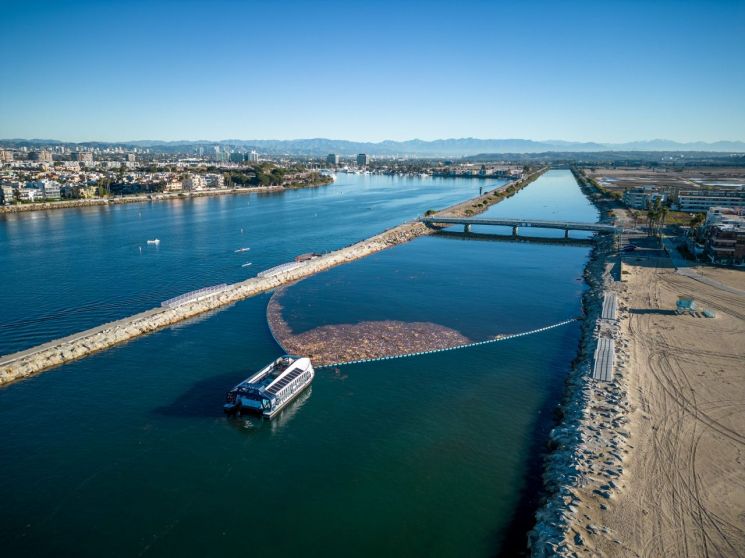
In a Long Beach aquarium last May, Kia America's Vice President of Sales stood alongside the Dutch founder of a nonprofit fighting marine plastic pollution and announced an ambitious plan: stop 570 tons of plastic a year from reaching the Pacific Ocean.
The partnership between Kia and The Ocean Cleanup, which began in 2022, represents a growing recognition that the greatest environmental threats demand corporate collaboration. The Los Angeles River and its tributaries have become a proving ground for a new approach to river cleanup that treats the waterway as the final frontier before waste becomes someone else's ocean garbage patch. Every year, hundreds of tons of plastic flow from LA's streets and neighborhoods into coastal waters—a problem that will only intensify if left unaddressed, particularly as the 2028 Olympics approach and the city seeks to demonstrate its environmental commitment.
The heart of the project is deceptively simple: install "Interceptor" facilities at strategic points along the LA River, Ballona Creek, and San Gabriel River to catch plastic before it ever reaches open water. The technology works. Interceptor 007, already operating in Ballona Creek, has prevented more than 175 tons of waste from flowing into nearby marine areas since its installation. The new expansion aims to build on this success by deploying additional facilities with the capacity to block up to 570 tons of plastic annually—a meaningful dent in a massive problem.
What makes this collaboration significant is its scope beyond simple collection. Kia and The Ocean Cleanup work together across the entire lifecycle of marine plastic waste: gathering it, sorting it, and transforming it into new products, ensuring that recovered materials don't simply return to the ocean in a different form. This closed-loop approach reflects a mature understanding that environmental cleanup must be paired with responsible reuse.
Boyan Slat, founder and CEO of The Ocean Cleanup, framed the work in ecological terms: "Rivers are a primary pathway for marine plastic pollution, and this LA project is a strategic approach that tackles the root of the problem." He's right. Most ocean plastic doesn't arrive by barge; it flows downstream from cities, carried by currents and carelessness. Addressing rivers before they become oceans is prevention at its most cost-effective.
The LA initiative is one piece of a larger ambition. The Ocean Cleanup is pursuing its "30 Cities Program," aiming to reduce marine plastic waste in 30 major coastal cities worldwide. LA is a logical starting point—a sprawling metropolis where environmental challenges are visible, urgent, and connected to global supply chains. The city's role as a logistics hub means that plastic waste here has outsized impact on Pacific ecosystems thousands of miles away.
As the 2028 Olympics approach, LA has an opportunity to demonstrate that a major city can simultaneously host world-class events and take genuine environmental action. The river cleanup project offers proof that infrastructure, corporate investment, and nonprofit expertise can converge on a shared problem. It won't solve marine plastic pollution—no single project can. But it's the kind of measured, specific, city-level intervention that compounds into real change.