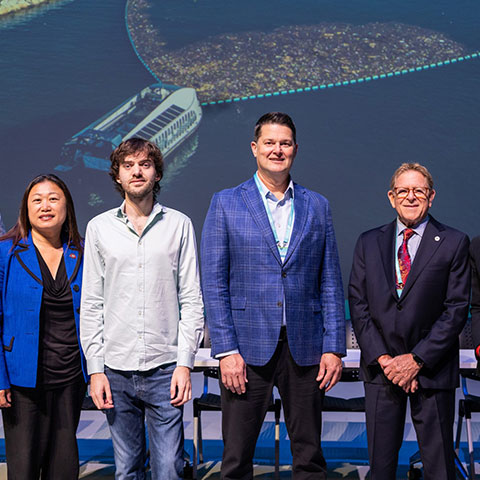
Interceptor 007 has already stopped nearly 400,000 pounds of plastic from slipping into the Pacific Ocean—and Kia and The Ocean Cleanup are now aiming to triple that impact across Los Angeles' three major waterways before the city welcomes the world for the LA28 Olympic Games.
The partnership marks an ambitious escalation of their joint mission, which began in 2022. The Ocean Cleanup, a nonprofit dedicated to removing plastic pollution at its source, has already deployed its signature Interceptor technology in Ballona Creek, where the autonomous floating system has intercepted 386,945 pounds of trash to date. Now, agreements signed with Los Angeles city and county leaders will bring new installations to the LA River and San Gabriel River, creating a coordinated network of three interception points that will work together to trap plastic before it reaches the ocean.
Los Angeles is one of 30 cities in The Ocean Cleanup's ambitious global initiative, which aims to reduce river plastic pollution worldwide by one-third. This scaled approach recognizes a simple but powerful truth: most ocean plastic doesn't come from the open sea—it comes from rivers. By intercepting waste at the source, before it enters coastal ecosystems, the technology addresses the problem at its root. For Los Angeles, a sprawling city with a critical network of waterways that ultimately feed into the Pacific, this means creating multiple barriers against one of the planet's most persistent environmental challenges.
Kia's role as global mission partner has been central to expanding the project's reach. The automaker has committed to supporting scalable solutions that address marine plastic pollution systematically, reflecting a broader corporate pivot toward environmental stewardship. As the Olympics approach, the timing carries symbolic weight—the LA28 Games will unfold in a city taking visible action to protect its coastal environment and the biodiversity that depends on it.
The Interceptor technology itself represents years of innovation by The Ocean Cleanup. These floating systems use river currents and momentum to passively funnel plastic into collection bins, removing hundreds of thousands of pounds annually without disrupting ecosystems or relying on constant human intervention. Each installation is tailored to the specific characteristics of its river—width, flow rate, and volume of waste—ensuring maximum effectiveness in diverse environments.
What makes this Los Angeles expansion particularly significant is its integrated approach. Rather than treating the three waterways in isolation, the initiative creates a unified system designed to intercept plastic at multiple points before it reaches the ocean. This reflects a growing understanding that climate and environmental problems require coordinated, multi-point solutions rather than isolated efforts.
The expansion also underscores how corporate partnerships can accelerate conservation work. Kia's financial and operational support allows The Ocean Cleanup to move faster and scale solutions that might otherwise take years to implement. As coastal cities worldwide grapple with plastic pollution, the Los Angeles model offers a replicable blueprint: identify the major sources, deploy proven technology, coordinate with local leadership, and measure results with precision.
With the LA28 Games less than two years away, the three Interceptors will stand as a tangible testament to what's possible when innovation meets commitment. Hundreds of thousands of pounds of plastic that would have drifted into the Pacific will instead be captured, collected, and removed from the environment. For a city preparing to host the world, it's both a practical environmental intervention and a statement about the kind of future we can build.