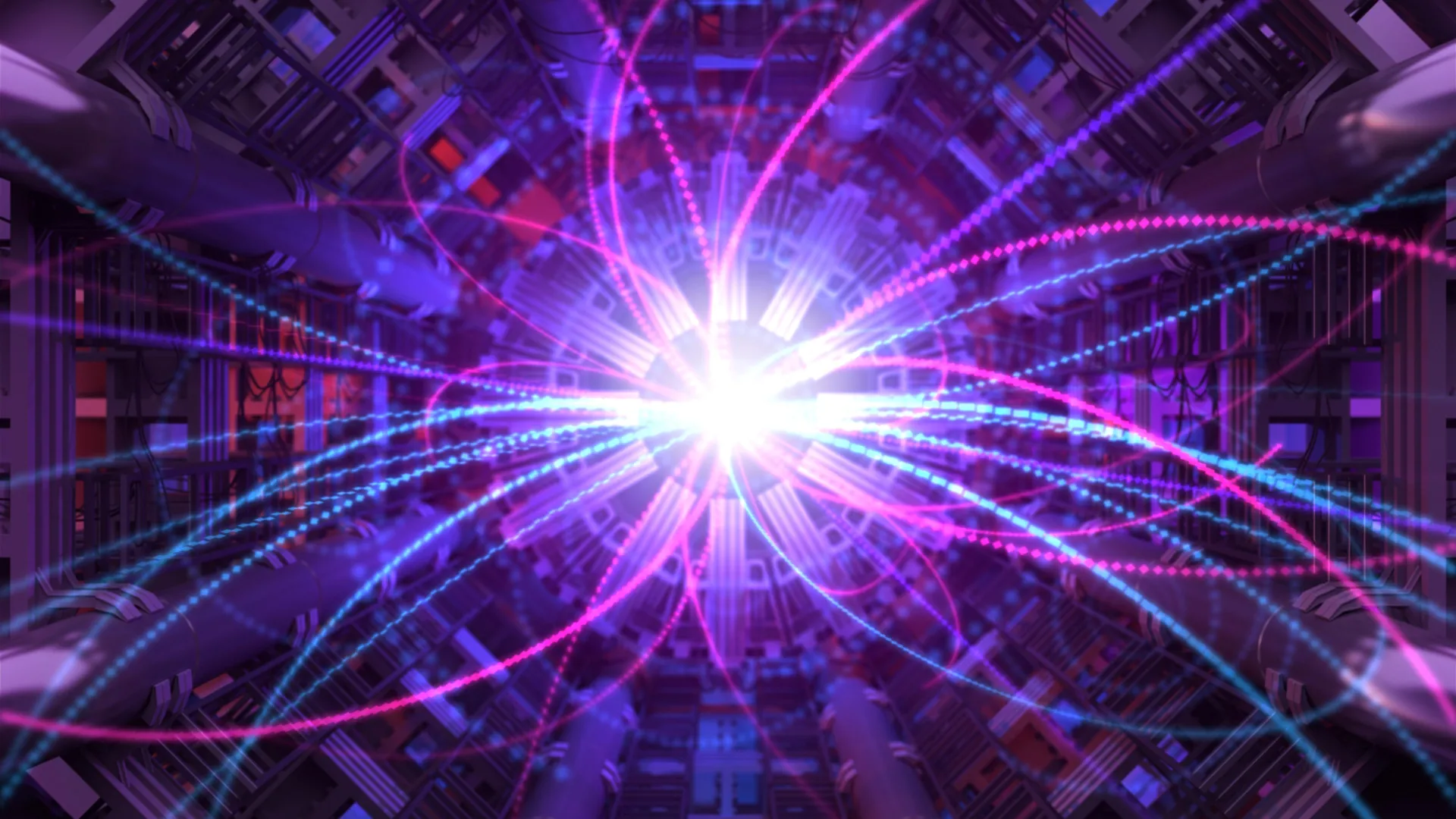
Deep in a 27-kilometer circular tunnel straddling the French-Swiss border, scientists at CERN's Large Hadron Collider have detected something that may finally crack open 50 years of physics orthodoxy. Researchers analyzing the decay of exotic particles called B mesons have found behavior that fundamentally disagrees with the Standard Model—the theory that has underpinned our understanding of matter and forces since the 1970s. The discovery, accepted for publication in Physical Review Letters, marks a rare moment when experimental evidence begins to genuinely challenge humanity's deepest physical assumptions.
This matters because the Standard Model, elegant though it is, cannot be the whole story. While built on the bedrock of quantum mechanics and Einstein's special relativity, it fails to explain gravity or dark matter, that invisible substance making up roughly 25 percent of the universe. For decades, physicists have deliberately smashed proton beams together in the LHC, racing to find hairline cracks in the theory. They have mostly failed—until now.
The new results come from the LHCb experiment, which studies what happens when protons collide at nearly the speed of light. The researchers examined a particular kind of particle transformation called an electroweak penguin decay, a whimsically named process where a B meson breaks apart into four other subatomic particles: a kaon, a pion, and two muons. This decay is extraordinarily rare—for every million B mesons, only one decays this way. By measuring the precise angles and energies of the particles produced, the team discovered a significant deviation from what the Standard Model predicts. The measurement shows a tension of four standard deviations from theoretical expectations. In statistical terms, this means there is only a one in 16,000 chance that such an extreme result would occur if the Standard Model were correct.
While this falls short of the gold standard of five standard deviations—which would signal a genuine discovery—the evidence is mounting. Corroborating results from an independent LHC experiment called CMS, published earlier in 2025, add weight to the finding. When two separate teams reach the same conclusion using different methods, the case strengthens considerably.
What makes this particularly intriguing is that penguin decays are uniquely sensitive to the effects of undiscovered particles too heavy to be created directly in the LHC. These hypothetical particles may still leave fingerprints on rare decays through subtle quantum effects. Physicists have proposed various explanations, many invoking mysterious new particles called leptoquarks that would unite two different categories of matter. This approach is not new to science—radioactivity was discovered and studied for 80 years before the W bosons responsible for it were directly observed.
The implications ripple forward. Such rare-process investigations allow physicists to explore regions of nature that might otherwise remain hidden until particle colliders planned for the 2070s become operational. If confirmed in future measurements, these findings could fundamentally reshape physics and point toward undiscovered laws governing the universe's deepest workings. For now, scientists press ahead with cautious optimism, knowing that the most transformative discoveries often begin as small tensions in the data.