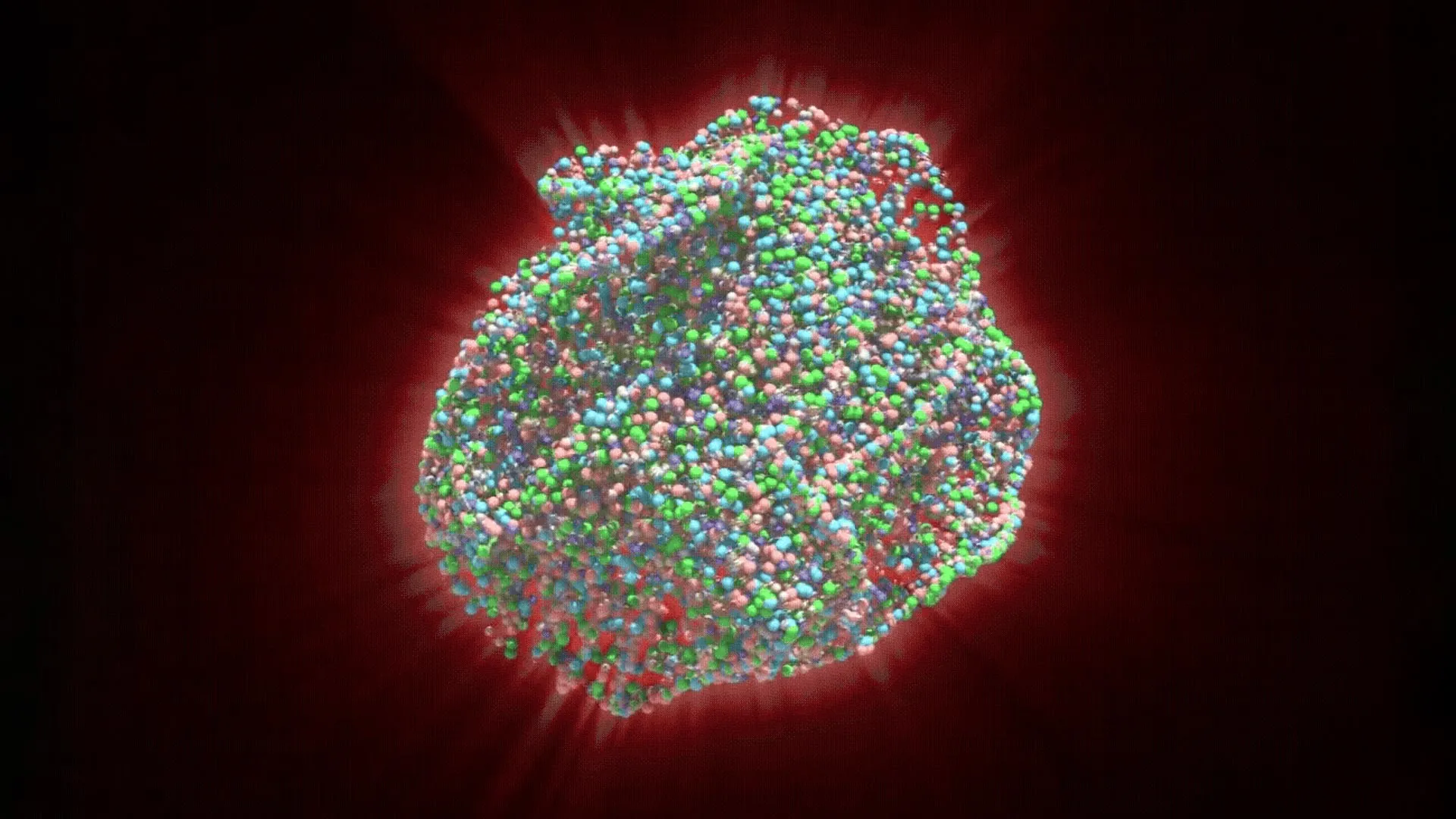
In oxygen and neon collisions at CERN’s Large Hadron Collider, particles may briefly have melted into a state last seen across the young universe. Four research teams—ALICE, ATLAS, CMS and LHCb—have now reported evidence that this extreme matter can form even when the colliding atomic nuclei are much lighter than lead.
The substance is called quark-gluon plasma, or QGP. It is thought to have filled the universe during the first millionths of a second after the Big Bang, nearly 14 billion years ago. At temperatures more than 100,000 times hotter than the center of the Sun, protons and neutrons cannot hold their usual shape. They break into quarks and gluons, the particles that make up and bind ordinary matter.
Scientists recreate such conditions by smashing atomic nuclei together at high speeds inside the LHC. For decades, researchers thought the plasma needed collisions between very heavy nuclei, especially lead, whose nuclei are more than 200 times heavier than a proton. But hints from proton collisions and earlier oxygen tests had begun to challenge that view. The latest studies, coming a year after the first oxygen collisions at the collider, add stronger evidence from both oxygen and neon.
One clue comes from the way energetic particles lose energy as they cross the hot material. ATLAS studied pairs of particle jets—narrow sprays of particles produced in collisions—and found differences in energy between the two sides. The pattern was clearest in more central, head-on collisions. Those impacts are expected to make a larger volume of plasma, so particles passing through it have more material in which to lose energy. Preliminary ATLAS work found a similar pattern by tracking charged particles that recoil opposite photons.
Other teams looked for a related effect in the number of particles produced. CMS found fewer charged particles in oxygen-oxygen and neon-neon collisions than in proton-proton collisions, a reduction consistent with energy loss in QGP. LHCb studied particles containing a charm quark and a lighter quark. Their production was more strongly suppressed in neon collisions than in oxygen collisions, as scientists would expect if the heavier neon nuclei created a larger volume of plasma.
Together, the results from ALICE, ATLAS, CMS and LHCb point to a striking possibility: the conditions for creating matter from the universe’s earliest moments may not require the heaviest nuclei. Each collaboration used different measurements, and the evidence is described as signs of plasma formation rather than a direct view of the fleeting substance. That makes the agreement across experiments especially useful to researchers.
The findings give physicists a new way to test how quarks and gluons behave in extreme heat and density. By comparing collisions involving different nuclei, they can probe how the size and shape of a collision affect the matter it creates. Further study can help clarify just how small a collision can be while still briefly recreating a state of the early universe.