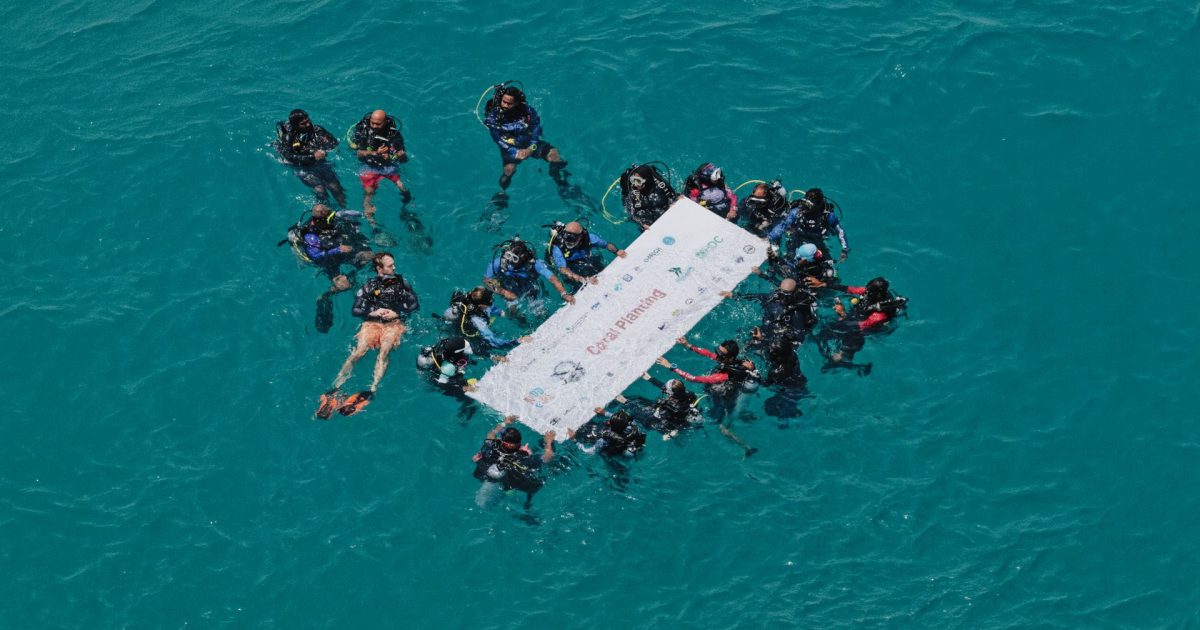
On May 14th, 300 journalists from 40 countries descended on the Dhoonier Wreck near Kudagiri Island not to interview someone, but to plant coral with their own hands—turning a sprawling underwater construction site into a living reef. The Asia Media Summit 2026, hosted by the Maldives' Public Service Media, had pivoted from conference halls into the ocean, bringing together the world's media to participate in one of the largest coral restoration activities the nation has ever undertaken.
The Dhoonier Wreck is no ordinary dive site. Since its launch in 2025, the project has been transforming two submerged aircraft into the scaffolding of an entirely new marine ecosystem. The vessels—including a Dornier, among the first aircraft that established domestic air connectivity in the Maldives—have been repurposed as structural reef elements, creating the foundation for an underwater landscape that blurs the line between conservation and experiential tourism. The airport-inspired layout gives the site an architectural purpose beyond passive observation: visitors don't just witness restoration; they become part of it.
When the media delegates arrived at the Dhoonier Wreck site, they weren't left to fend for themselves. Trained dive teams from participating tourism establishments, supported by the HDC team, provided structured instruction on how to handle coral fragments and position them on specially designed underwater frames. The participants learned the science behind the work—which corals thrive in which conditions, how placement affects survival rates, how patience and precision matter in reef regeneration. These weren't token gestures: each coral fragment attached that day contributes directly to ongoing restoration efforts at the site, guided by marine expertise rather than improvisation.
The initiative represents a deliberate shift in how the Maldives approaches conservation and tourism. Rather than compartmentalizing marine protection as something separate from visitor experience, the Dhoonier Wreck integrates the two. Tourists diving the site in years to come will witness not just a wreck, but a functioning reef—evidence of ecological recovery unfolding in real time. As coral fragments grow and the habitat develops through phased enhancement, the site will mature into a structured reef environment capable of supporting genuine marine biodiversity while telling the story of human participation in restoration.
The scale of institutional support underscores the project's ambition. Twenty-three organizations—from the Ministry of Tourism and Civil Aviation to the Maldives National Defense Force, from Banyan Tree Vabbinfaru to Marine Lab Maldives—coordinated to make the event possible. Villa Nautica, Dive Bandos, and other establishments sent their volunteer dive teams. The Maldives Marine Research Institute provided scientific oversight. Even the National Boating Association ensured logistics ran smoothly.
For a nation whose entire existence depends on shallow reefs and whose economy relies on tourism, this isn't abstract environmentalism. The Dhoonier Wreck demonstrates that conservation and economic viability don't have to compete—they can amplify each other. As the site evolves, it positions the Maldives as a destination for travelers who want to witness restoration, participate in it, and understand their role in the ocean's future. The 300 journalists who planted coral on May 14th will carry that story home to audiences across 40 countries, translating a single afternoon at a wreck site into a narrative about how we might rebuild what we've damaged.