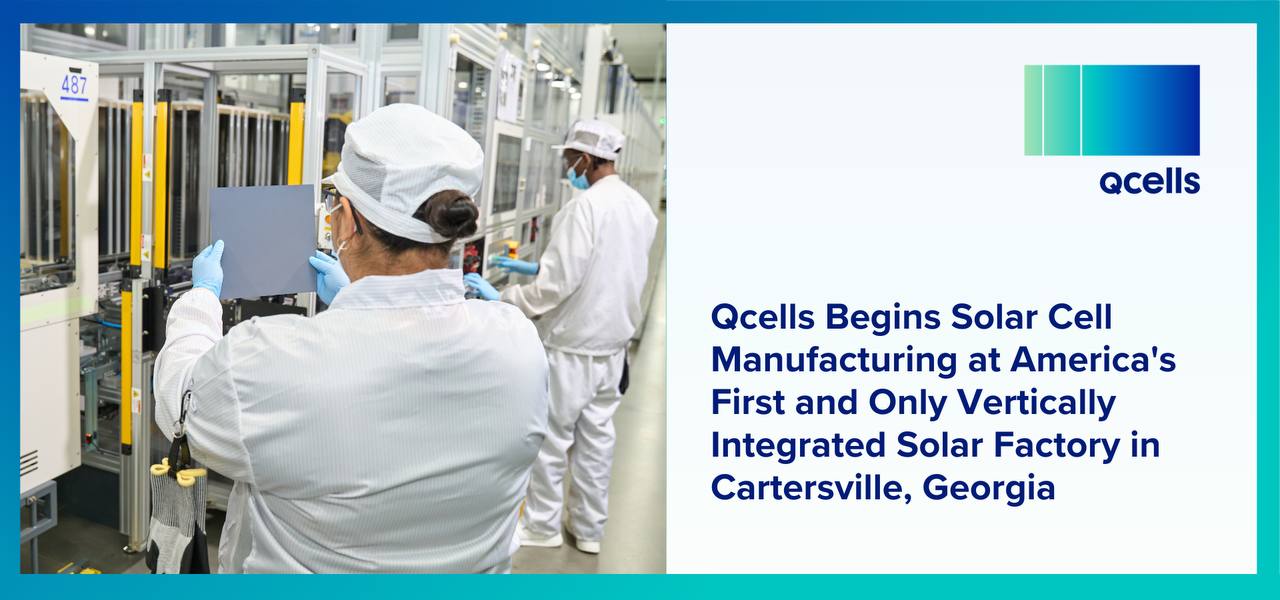
In Cartersville, Georgia, Qcells has just flipped the switch on the United States' first-ever facility that produces every major component of a solar module under a single roof—from raw ingot to finished panel ready for installation. The factory is already churning out 16,700 solar photovoltaic modules a day, and now, with solar cell production underway, it has become the largest solar cell manufacturing facility in American history.
This is more than just another factory. It represents a fundamental shift in how clean energy gets made at home. For decades, the U.S. solar industry has relied heavily on imported components, leaving supply chains vulnerable and keeping prices high. Qcells' vertical integration—producing ingots, wafers, cells, and modules all in one place—changes that equation. The company can now offer customers something rare: complete domestic sourcing, which unlocks a crucial 10% federal tax credit bonus under the Investment Tax Credit for projects using American-made equipment.
When the Cartersville facility reaches full capacity in the third quarter of 2026, it will produce 3.3 GW of ingots, wafers, and cells annually, alongside 3.5 GW of finished modules. That's roughly 47,000 panels a day—enough to power approximately 1.3 million American homes for a year. Combined with Qcells' expanded Dalton facility nearby, which tripled its module capacity to 5.1 GW in late 2023, the company's total Georgia operations will deliver 8.6 GW annually.
For Northwest Georgia, the economic impact is immediate and substantial. Qcells' operations across Bartow and Whitfield Counties are expected to employ nearly 4,000 people, with an estimated 3,800 direct jobs. These are skilled manufacturing positions in a region where industrial opportunity matters deeply.
The momentum here is worth pausing on. The Biden administration's clean energy subsidies—including support for domestic solar manufacturing—have survived political headwinds and remain intact. Qcells is betting big on sustained demand for fully American-made solar equipment, and the company's confidence appears warranted. Customers increasingly want supply certainty and transparent sourcing, especially as domestic content requirements tighten across various renewable energy incentive programs. The Cartersville factory delivers both, eliminating the uncertainty that comes from piecing together components from multiple countries.
This is what a functioning industrial strategy looks like: federal policy creating the conditions for private investment, manufacturing jobs returning to American soil, and consumers getting access to cheaper, more reliable clean energy. Qcells' Cartersville facility won't solve the energy transition alone, but it shows that large-scale solar manufacturing isn't just possible in the U.S.—it's becoming the competitive play.