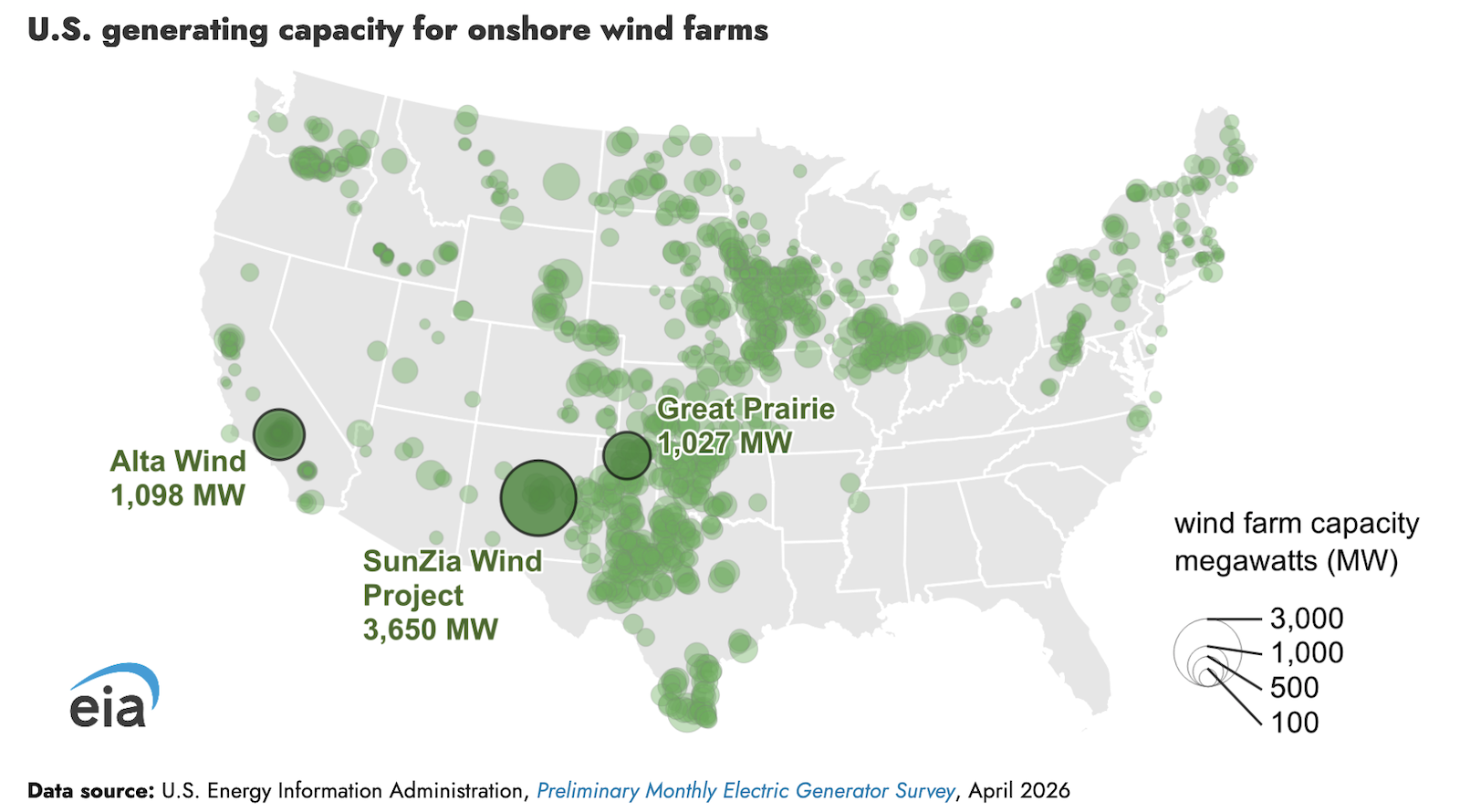
With 916 turbines spinning across central New Mexico, the SunZia Wind Project has begun commercial operations as the largest wind farm in the United States — a milestone that reshapes the energy landscape of the American West. The facility's 3,650 megawatts of capacity represents a quantum leap in wind power: more than three times larger than the Alta Wind project in Southern California (1,098 MW) and the Great Prairie wind farm in northern Texas (1,027 MW) combined.
The scale of this achievement becomes clear when you understand what it took to get here. Pattern Energy spent nearly two decades on permitting and planning before breaking ground in 2023, a reminder that transforming energy systems, even when the direction is clear, requires patience and persistence. The wind farm itself is woven across three counties—with 242 turbines rising in the northern sections spanning San Miguel and Lincoln counties, while 674 turbines stand in the southern reaches across Lincoln and Torrance counties. By April 2026, the facility had already entered a testing phase, with turbines feeding power into the grid.
What makes SunZia's arrival so significant is how dramatically it tips New Mexico's energy mix toward renewables. Before the project came online, the state had 3,997 MW of wind capacity. SunZia nearly doubles that figure, bringing total wind capacity to 7,647 MW. That single addition means wind now accounts for 45% of New Mexico's generating capacity—far outpacing solar (19%) and natural gas (19%). In a state with long-standing ties to fossil fuels, this represents a genuine pivot.
Yet SunZia's power is designed to flow far beyond New Mexico's borders. Pattern Energy built a companion transmission project: a 550-mile high voltage direct current line stretching from central New Mexico to south-central Arizona, with the capacity to carry 3,021 MW. Of that, 2,131 megawatts will ultimately be delivered to Southern California through the Palo Verde Substation. The integration of wind generation and transmission infrastructure shows how modern clean energy projects must operate at landscape scale—generation and delivery working as a single system.
The grid is already seeing the impact. On May 15, 2026, the California Independent System Operator reported hourly wind generation reached 7,122 MW—a figure 20% higher than the previous annual record of 5,922 MW set in 2024. That single day's performance suggests SunZia is not just adding capacity; it's rewriting what's possible for wind energy in the region.
For the millions of people living in the Southwest, Sunzia represents something tangible: electricity generated by wind rather than combustion, resources kept in the ground, and a step toward meeting climate commitments. The project's completion also signals confidence in renewables—that major energy companies are willing to invest billions in infrastructure that will deliver clean power for decades. New Mexico's transformation from a state defined by coal and oil to one where wind dominates the energy mix offers a template for what deliberate, long-term energy transition can accomplish.