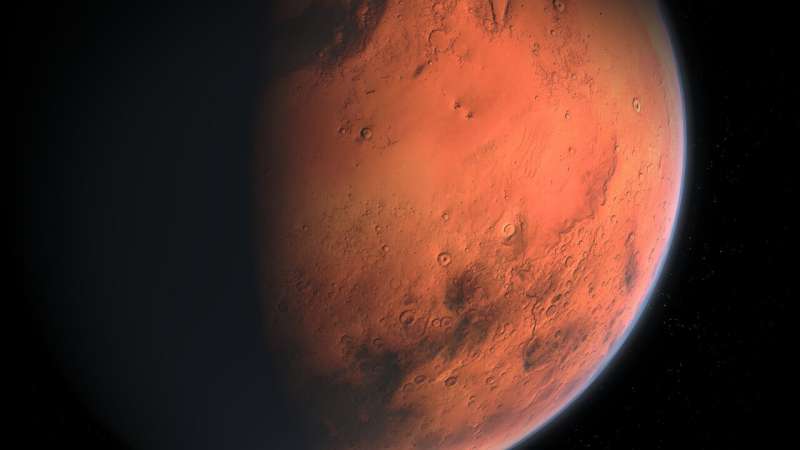
Imagine astronauts on Mars, boots crunching on rusty red soil, and just beneath their feet — frozen water they could turn into rocket fuel. That's the future scientists at the Planetary Science Institute are mapping out, literally.
A team led by Hanna Sizemore and Samuel Courville has just published two new papers creating the most detailed global maps yet of where water ice hides under Mars' surface. Their work, published in The Planetary Science Journal, is meant to help NASA figure out where to land the first humans on the red planet — and where they'll be able to find water they can actually use.
"Water ice excavated from the subsurface can be converted into hydrazine," Sizemore explains. "This can be used as rocket fuel for a return trip to Earth. Making fuel from Martian ice is one form of in situ resource utilization, and it can significantly reduce the mass and cost of a human mission."
Right now, ice can't sit exposed on most of Mars' surface. The planet's thin air causes ice to skip the liquid phase entirely and turn straight into vapor — a process called sublimation. The NASA's Phoenix lander already proved ice exists just centimeters below the surface, but it landed near the poles where conditions are different. Astronauts heading to warmer mid-latitude regions will need to dig deeper.
So how do scientists find buried ice from millions of kilometers away? They use heat. The team analyzed data from two NASA orbiters — the Mars Global Surveyor and the Mars Reconnaissance Orbiter — which measured how quickly different patches of ground warm up during the day and cool down at night. Ice, dust, dry sand, and solid rock all hold heat differently. By mapping these temperature patterns across the entire planet, researchers can guess what's lurking just under the surface, down to about 1 meter (3 feet) deep.
But here's the tricky part: no single instrument or model gives perfect answers. Different tools, different assumptions, and even dusty weather can throw off the results. So the team didn't just make one map — they made several maps using different methods and compared them. The spots where all the maps agree are the surest bets for ice. The spots where they disagree need more data.
Courville's paper takes things a step further by turning that uncertainty into actual numbers. "We can now say, 'We have a 64% chance of finding ice if we go to this location,'" Sizemore says. That kind of statistical certainty matters when you're sending humans into deep space.
The maps already show good agreement in most places. Where they don't, those are exactly the spots where future robot missions should go first to gather better information. It's slow, careful work — but it might just point the way to where humans will one day touch down and tap into Mars' frozen water to fuel their journey home.