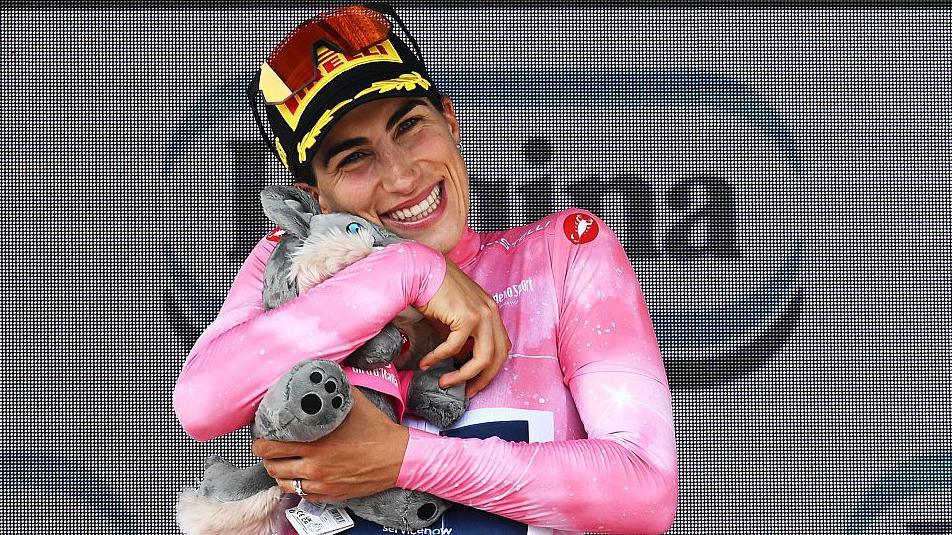
Just 200 metres from the finish line in Caorle, Elisa Balsamo unleashed a perfectly timed sprint that carried her across the line first, cementing her grip on the women's Giro d'Italia.
The 28-year-old Italian cyclist from Lidl-Trek claimed victory in Sunday's 156-kilometre stage near Venice, a win made all the sweeter because it wasn't handed to her by circumstance. Balsamo's Saturday opening stage victory came under unusual circumstances—fellow sprinter Lorena Wiebes was disqualified after crossing the line first due to a bike weight violation, a decision made just hours after the race concluded. But on stage two, Balsamo earned her position at the top the only way that counts: with her legs and her timing.
She finished ahead of Irish rider Lara Gillespie of UAE Team ADQ and Italian teammate Chiara Consonni, making for an identical podium to Saturday's stage. The three women have emerged as the race's sharpest sprinters, and Balsamo's ability to read the final sprint and execute at exactly the right moment underscores why she's leading this nine-stage race, which concludes on 7 June.
"I have been waiting for this win so much," Balsamo said after crossing the line. "I'm just so happy. I want to say a big thank you to my teammates because they did an amazing job the whole day. And then I just did a really good sprint." Her comments reflected the collective effort that goes into stage racing—the lead-outs, the blocking, the positioning work done by her support riders throughout the day that set up her moment at the finish.
Balsamo now leads Gillespie by eight seconds in the general classification, with Consonni a further four seconds back at 12 seconds down. The main peloton trails by 20 seconds, meaning the race remains tightly compressed. No comfortable margins here—every stage will matter, and every tactical decision carries weight.
The concentration required to hold a lead this slim, across multiple remaining stages, is immense. Balsamo acknowledged that pressure in her post-race remarks, noting the quality of her competitors. "I was just completely focused on the finish line and I pushed until the end because I knew that everyone could come from the back, they are so strong," she said. It's a realistic assessment. The gap between first and fourth is just 20 seconds; the race is balanced on a knife's edge.
What's notable about Balsamo's position is that she's leading not through a single dominant day but through consistency and smart racing across multiple stages. She's also leading as a home rider in Italy, racing the Giro d'Italia in her own country—a distinction that carries its own weight in European cycling culture. The pink jersey, cycling's symbol of leadership in stage racing, sits on the shoulders of an Italian rider on Italian roads, something that matters deeply both to her and to the crowds lining the routes.
With five more stages to go after stage two, the Giro d'Italia Women remains wide open. Balsamo's eight-second advantage is real but hardly commanding. Every rider in the top five understands that a single strong performance, one perfectly executed sprint or one well-timed attack, could reshape the entire race. What Balsamo has shown is that she has the tactical awareness, the team support, and the finishing power to handle that pressure. The question now is whether she can maintain that edge through the remaining stages.