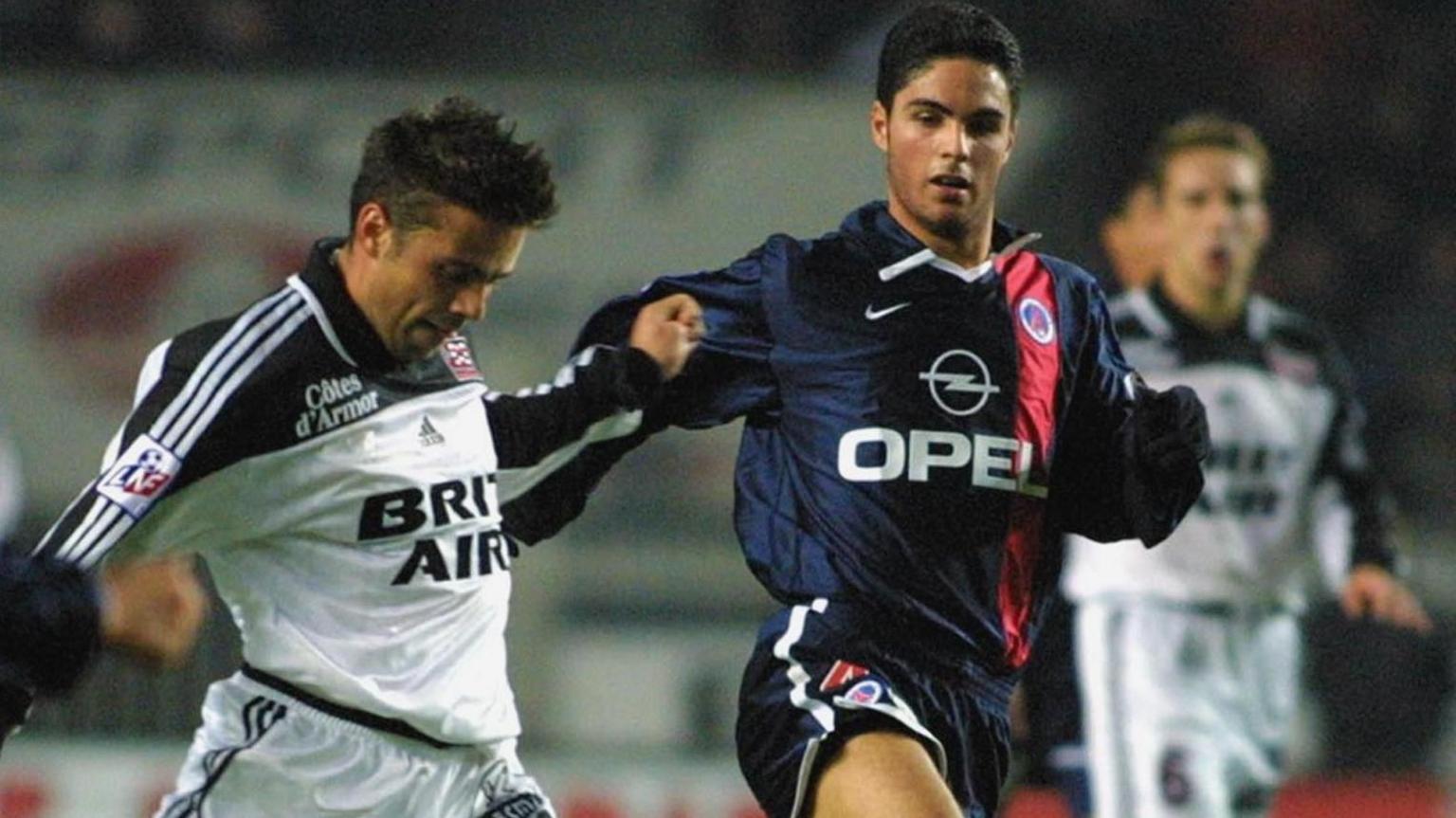
In January 2001, an 18-year-old Mikel Arteta arrived at Paris St-Germain on an 18-month loan from Barcelona, facing the daunting prospect of breaking into a midfield already crowded with World Cup winners and European stars. What unfolded over those months in the French capital would become the crucible in which his future as a tactical genius was forged — a transformation shaped most profoundly by one Argentine midfielder who recognized something exceptional in the quiet Spanish teenager immediately.
Arteta had left Barcelona because there was simply no path forward. Pep Guardiola, Emmanuel Petit, Phillip Cocu, and Xavi Hernandez occupied every inch of Barcelona's midfield, leaving no room for a promising but unproven youngster. PSG, then still building toward dominance in French football but already assembling an impressive roster that included Jay-Jay Okocha, Nicolas Anelka, and Mauricio Pochettino, offered a chance to grow. A young Ronaldinho would join that same year, turning the Parc des Princes into an incubator of talent.
The teenager barely spoke French, yet he settled quickly, aided by a small contingent of Spanish speakers and, crucially, by Pochettino's mentorship. The Argentine had also arrived that January, coming from Espanyol in La Liga, and the two struck an immediate bond — they even shared a hotel for their first three months in Paris. Pochettino, ten years older, became what Arteta would later describe as his "big brother" and "football father." It was Pochettino who first saw what others would spend years discovering: that beneath the composed exterior lived a coach already taking shape.
"He was already a coach," Pochettino recalled years later in 2023. "He was giving advice to me and the others. The character, the personality, the charisma. He already had the football brain." Manager Luis Fernandez deployed Arteta in a deep-lying midfield role, asking him to play simply and create a platform for creative talents like Okocha. The assignment suited him perfectly. Despite his age, Arteta displayed a tactical awareness and steely determination that impressed French football expert Matt Spiro, who noted that while Arteta possessed the technical excellence expected from any Barcelona product, his most striking quality was his mature understanding of the game's architecture.
That first season ended modestly — PSG finished bottom of their Champions League second-round group and only narrowly secured a top-half finish in the league. But Arteta had made 11 appearances and scored his first PSG goal in a 2-2 draw against Lille. The following season proved more fruitful. Arteta played the full 90 minutes in nearly every league match before Christmas, and PSG won eight and drew ten of their first 18 matches. Even when the team fell short in cup competitions, something tangible was being built.
The turning point came when Rangers faced PSG in the Uefa Cup last 32 in late November. Impressed by Arteta's performance across both legs, the Glasgow club offered Barcelona £6 million for the teenager. Despite holding a purchase option, PSG couldn't keep him. Arteta's time in Paris was ending, but the lessons learned there — about leadership, about seeing the game's geometry, about lifting those around you — would define everything he built after. His loan deal had been a masterclass in growth, delivered by a fellow exile and nurtured in the pressure of competing at Europe's highest level.