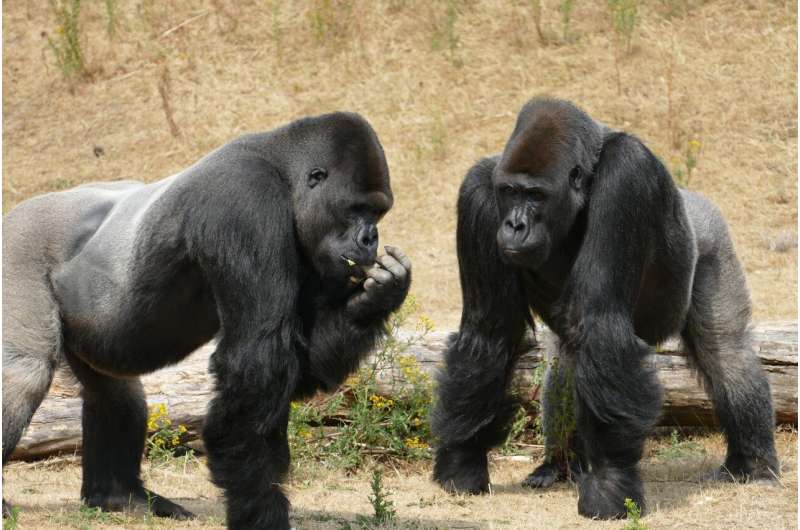
Manuel Bohn watched as a young orangutan hesitated at the edge of the testing enclosure, eyes flicking between the hidden food and the human researcher’s gaze—then made a choice that no one could have predicted. That moment, repeated across 48 great apes over 18 months, revealed something profound: just like humans, individual apes think differently, and those differences are stable, measurable, and deeply personal. At Leuphana University of Lüneburg, Bohn and his team have overturned a long-standing assumption in comparative psychology—that great ape cognition is largely uniform across species. Instead, their study, published in Psychological Science, shows that apes carry cognitive fingerprints as unique as their fingerprints.
For decades, scientists have used great apes to trace the evolution of human intelligence, assuming that if a trait like gesture-based communication appears in species close to us, it must be evolutionarily recent. But this view treats cognition as static and species-wide, ignoring individual development, personality, and life history. Bohn saw a gap: “We really have these kinds of developmental and different individual perspectives in humans. We thought this was clearly missing in the great apes.” To test this, his team studied 48 apes—bonobos, chimpanzees, gorillas, and orangutans—across varying ages and sexes, subjecting them to six cognitive tasks over a year and a half. These included attention-following, understanding communicative cues, and memory for food locations—standard tools in ape cognition research.
The results were striking. Individual differences accounted for a significant portion of cognitive performance, and these differences remained stable over time. Factors like social group, prior research exposure, sex, and rearing history strongly predicted how an ape performed. But even more surprising was the structure of cognition itself. Tasks involving social cues—like following a human’s gaze—did not correlate with one another, meaning an ape good at one social task wasn’t necessarily good at another. In contrast, non-social reasoning tasks showed strong correlations, suggesting a more unified nonsocial cognitive domain. This pattern defies the human model, where social cognition often clusters together. “We do not find these clusters that we expect to be there from a human perspective, which I think is really interesting and thought-provoking,” Bohn said. “If it's not this, then what is the structure of all of this?”
The study, while based on a modest sample, opens a new frontier. Current tools for measuring ape cognition weren’t designed to capture its full architecture. Longitudinal studies—rare but crucial—could track cognitive development across lifetimes, revealing how experience shapes the ape mind. By comparing these trajectories with human development, scientists may uncover not just how we diverged, but how intelligence itself can be structured in different ways. “Think about these alternative structures of cognition,” Bohn urged. “What are the lines along which we can think about cognition being structured, other than the ones that we put in place for humans?” The answer may not only reshape our understanding of apes—but of intelligence itself.