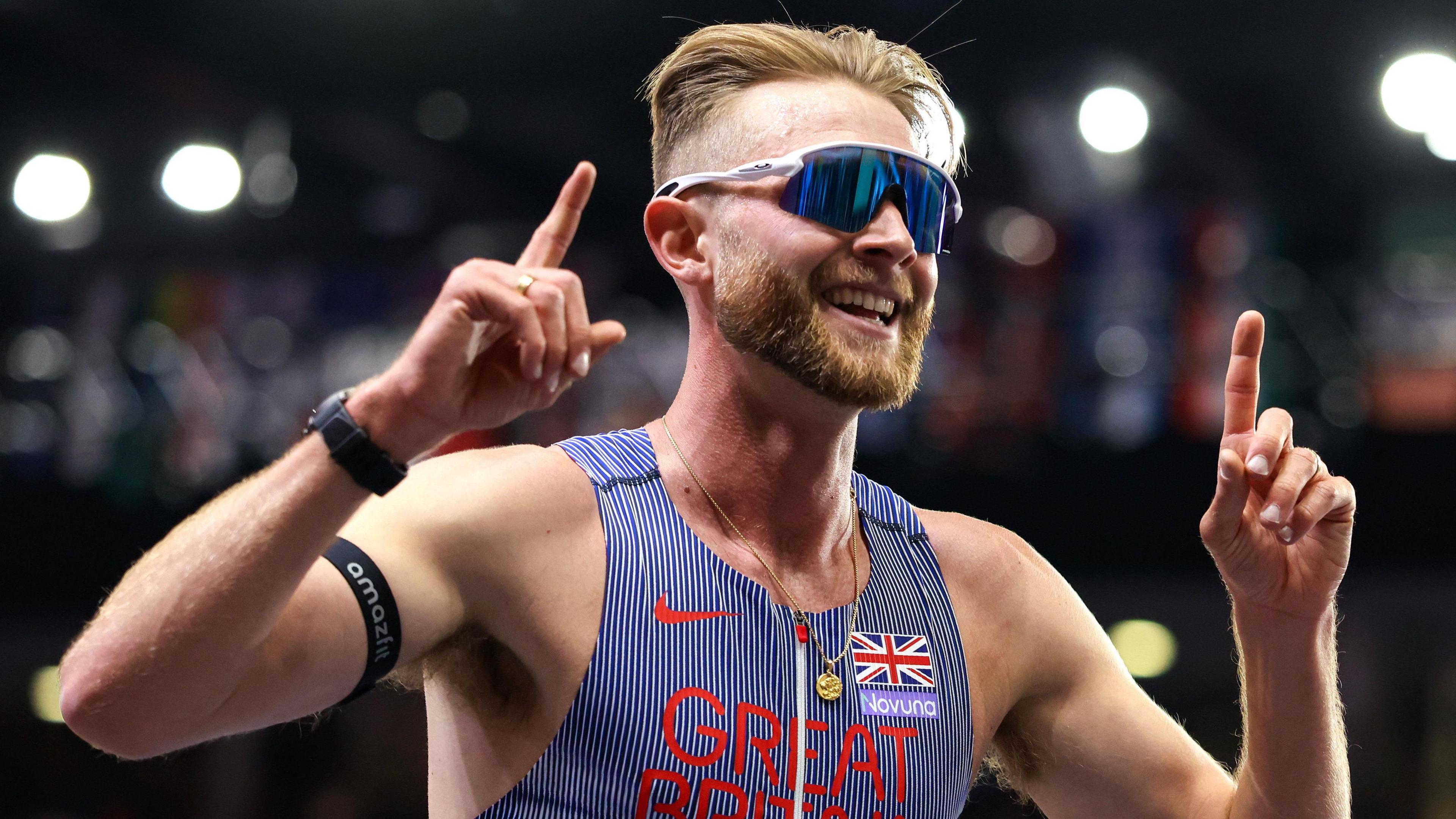
Josh Kerr always believed he could break the fastest mile the world had ever seen. On Saturday night in London, he proved it.
The 28-year-old Scottish runner crossed the finish line at the London Diamond League in 3 minutes 42.66 seconds, shattering a record that had stood for nearly three decades. Hicham El Guerrouj of Morocco set the previous mark of 3:43.13 back in 1999 — the year Kerr was just one year old. Kerr beat it by nearly half a second.
Sixty thousand fans packed into London Stadium, roaring as Kerr pulled away from the pack. Two pacemakers had helped push him through the early laps, but by the 1,000-meter mark they were gone. From there, Kerr ran alone, his eyes fixed on the wavelights along the track's edge that measured his pace. He went through 1,500 meters faster than his own British record at that distance, then held on for the final stretch as the crowd rose to their feet.
"It felt like I had a kitchen full of amazing incredible chefs and I was like, 'what the hell are we going to make?' — and I was like, 'this is the dish I want to make, let's get to work!'" Kerr told BBC Sport. "It's very overwhelming with the amount of hype I created. I am surrounded by amazing people and was able to stay consistent and put the work in."
Kerr first announced he would target the world record in March — four months before he actually ran it. He called his training campaign "Project 222," a reference to the 222 seconds that separated him from history. His coach, Danny Mackey, confirmed Kerr had set his sights on the record since returning from a calf injury that ended his bid for gold at the World Championships in Tokyo last September.
Kerr becomes only the seventh British athlete to hold the mile world record, and the first since Steve Cram in 1985. He had already established himself as one of the sport's biggest stars, having won two Olympic medals and three world titles, including a stunning 1,500-meter victory in Budapest in 2023 that sparked his now-famous rivalry with Norway's Jakob Ingebrigtsen.
"Those performances take every single part of you, every single part of your team," Kerr said. "The amount of work behind the scenes is incredible. Today it was a performance I was able to bring out — I just hoped it would be a little bit faster!"
Kerr now turns his attention to the Commonwealth Games in Glasgow next month, where he will compete on home soil once again — though nothing may ever quite match what he accomplished in London.