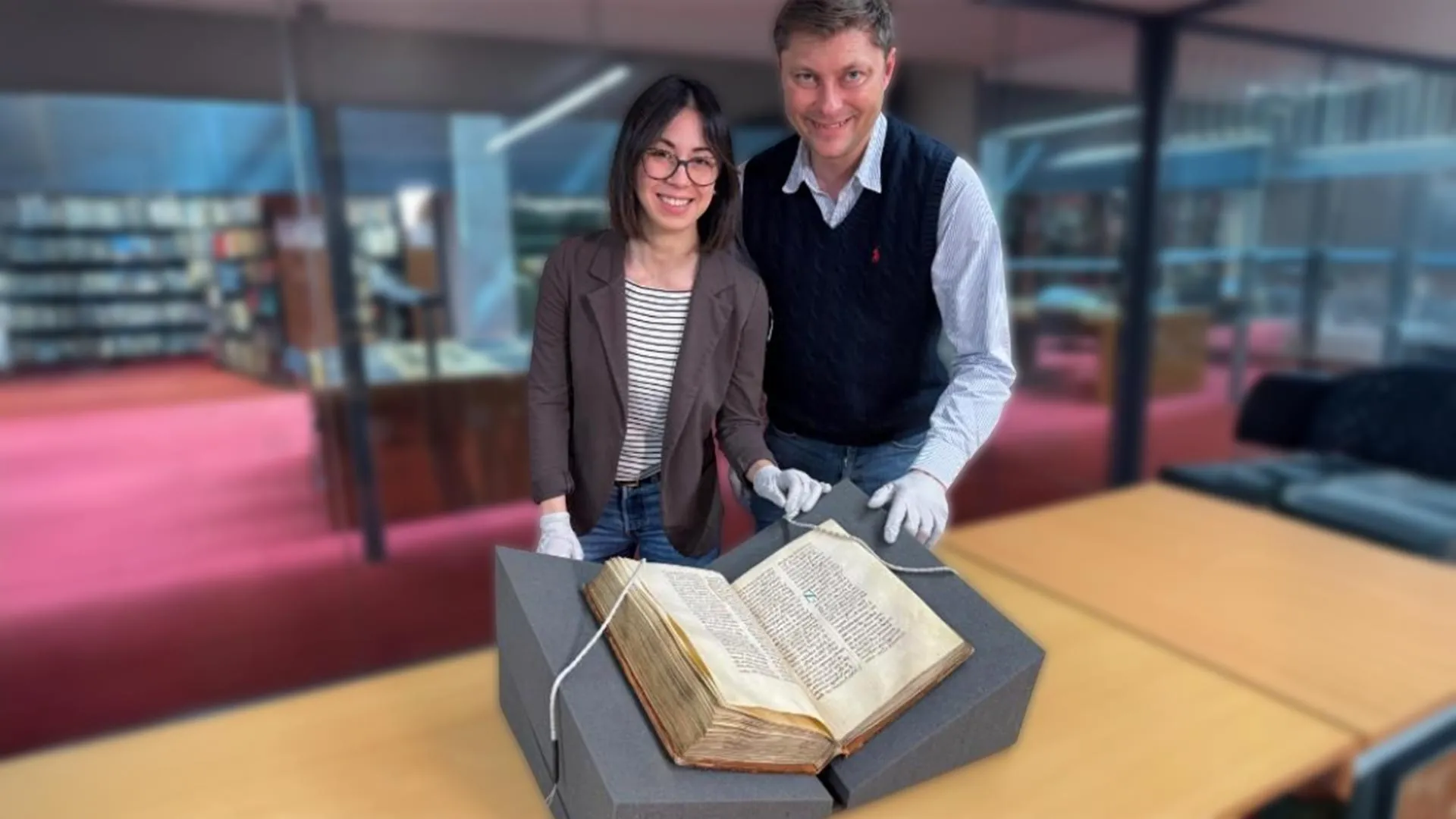
Nestled in the National Central Library of Rome, a 1,200-year-old manuscript holds the earliest known poem written in English — a nine-line hymn composed by a cowherd from Whitby who was visited by divine inspiration. Medieval manuscript experts Dr. Elisabetta Magnanti and Dr. Mark Faulkner from Trinity College Dublin stumbled upon Caedmon's Hymn while investigating conflicting references to Bede's History in Rome. What they found was nothing short of extraordinary: not just another copy of one of the world's oldest surviving poems, but evidence that early medieval readers treasured Old English poetry far more than scholars previously believed.
Caedmon's Hymn has survived for nearly 1,400 years because the English monk Bede included it in his Ecclesiastical History of the English People, an 8th-century Latin chronicle. But Bede did something curious: he translated the Old English verses into Latin rather than preserving the original poem in his manuscript. For centuries, only two older surviving copies of Caedmon's Hymn were known — one in Cambridge and one in St Petersburg — and both followed Bede's pattern. The Old English lines appeared only in margins or at the end, squeezed in as afterthoughts. The Rome manuscript, dated between 800 and 830, is the third oldest surviving copy. But it tells a radically different story.
In the Rome manuscript, someone deliberately wove the original Old English version directly into the Latin text itself. This integration happened within a century of Bede completing his History, suggesting that early medieval monks actively sought out and valued the authentic Old English poem — even as they copied the approved Latin translation. "It is a sign of how much early readers valued English poetry," explained Dr. Mark Faulkner, noting that only about three million words of Old English survive in total, with the vast majority from later centuries. Caedmon's Hymn stands almost alone as a seventh-century survival, connecting us to the very beginning of written English.
The manuscript's journey to Rome was anything but straightforward. It was produced at the Abbey of Nonantola in northern central Italy sometime during the early ninth century. During the Napoleonic Wars in the 1810s, it was moved to a Rome church for safekeeping, then stolen and passed through the hands of several private owners. By 1975, many Bede scholars had presumed it lost entirely. Its existence might have remained forgotten were it not for the National Central Library's decision to digitize its medieval collections and make them freely available online.
Dr. Elisabetta Magnanti described the moment of discovery with evident wonder: "The magic of digitization has allowed two researchers in Ireland to recognize the significance of a manuscript now in Rome, containing a poem miraculously composed in Northern England by a shy cowherd a millennium and a half ago." The finding, published in the Cambridge University Press journal Early Medieval England and its Neighbours, offers rare insight into how early readers engaged with their literary heritage. It suggests that the shift toward valuing vernacular languages began not in the Renaissance, but in the shadowy early medieval period — in scriptoriums where monks carefully chose to resurrect and preserve words in a language ordinary people could understand.